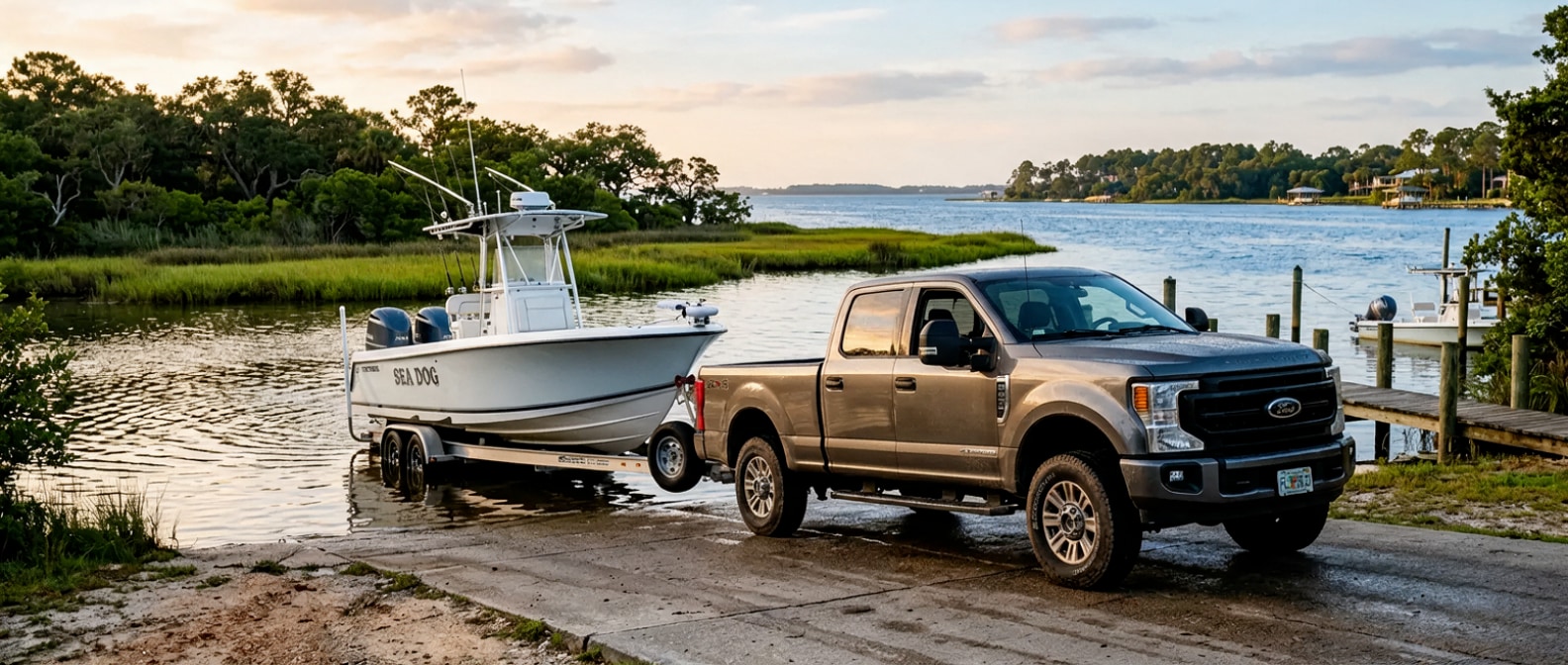
One number reshapes how you look at this truck. With a properly equipped 2026 Ford F-350 Super Duty in single-rear-wheel form, Ford lists conventional towing capacity at up to 25,000 pounds. The payload rating on many SRW diesel configurations runs north of 3,700 pounds. That gap over a comparably configured F-250 isn't a marketing badge. The structure is real, and it matters the moment you hook up a big boat on a steep concrete ramp at the end of Thomas Drive.
A first real season of Grand Lagoon boat launching has a way of turning an F-250 into a trade-up. The F-250 is a great truck. It just doesn't carry the suspension margin for a heavy boat on a steep ramp, and by the time buyers work that out, they've already spent the money.
What Do the Specs Actually Mean for a Panhandle Buyer?
The specs matter to a Panhandle buyer because they translate straight into ramp behavior and load margin, though the raw figures mean little until you connect them to a loaded trailer sitting on a steep concrete slope. Let's get concrete, because the spec sheet won't do that translation for you.
| Spec | 2026 F-350 SRW (Diesel) | What It Means Here |
|---|---|---|
| Conventional tow rating | Up to 25,000 lbs | Handles large center-consoles, bay boats, and heavy pontoons |
| 5th-wheel / gooseneck rating | Up to 27,600 lbs (SRW diesel) | Big RV and work trailer territory |
| Payload capacity (SRW diesel configs) | 3,686 to 4,859 lbs (varies by cab/bed) | Real margin for pin/tongue weight plus gear |
| Engine: 6.7L Power Stroke diesel | 475 hp / 1,050 lb-ft torque at 1,600 rpm | Full torque before the engine is working hard |
| Engine: 6.7L HO Power Stroke diesel | 500 hp / 1,200 lb-ft torque | For DRW buyers approaching the top of the chart |
| Transmission | 10-speed TorqShift automatic | Holds gears confidently on sustained pulls |
| Frame | Military-grade high-strength steel, fully boxed | Built for repeat heavy-load cycles, not just occasional use |
| Ground clearance | 8.7 inches | Clears most Gulf Coast road debris and marina lot obstacles |
| DRW towing (5th-wheel, max-equipped) | Up to 38,000 lbs | Opens fifth-wheel and gooseneck towing the F-250 can't touch |
| Cab/bed options | Regular, SuperCab, Crew Cab; 6.75 or 8-ft bed | Flex for work or family use |
Watch the payload number, because it's the one that trips buyers up. Payload isn't just what you pile in the bed. On a conventional ball hitch, 10 to 15 percent of your trailer's total weight lands on that ball as tongue weight, and that comes straight out of your payload budget. A 10,000-pound bay boat can put 1,000 to 1,500 pounds of tongue weight on the hitch alone, before you've added a tool box, a cooler, or a passenger. An F-250 diesel SRW with a loaded Lariat trim can have a door-sticker payload around 2,100 to 2,300 pounds. The F-350 SRW in a comparable config often stickers at 3,500 pounds or more. That gap is where your safety margin lives.
Grand Lagoon Boat Launches Specifically Eat Payload Margin
Grand Lagoon launches punish payload margin harder than flat-water ramps, because a steeper approach shifts weight onto the hitch and squats the rear, though the same physics is exactly why a heavier-duty truck feels planted where a lighter one wallows. Browse our pre-owned truck inventory and you'll notice how many used Super Duties carry a Gulf Coast history. There's a reason.
St. Andrews State Park sits at the end of Thomas Drive off State Road 392, with a public boat ramp dropping directly into Grand Lagoon. That ramp gives you access to the Gulf of Mexico, and it gets used hard. A steeper ramp angle means your tow vehicle is doing more than holding the trailer. The suspension compresses, the hitch geometry changes, and the rear of the truck squats under tongue weight. Forum owners who've run both trucks consistently report a loaded F-250 rear squatting 6 to 8 inches under a heavy boat, while the F-350 holds it to 2 or 3 inches under the same load. Less squat means better trailer tracking on the way in and better steering authority on the way back up the ramp.
Grand Lagoon means salt air all day, every day. On a used truck, that pushes past cosmetics into maintenance reality.
The F-350's fully boxed high-strength steel frame, set against the open C-channel frames you find on lighter trucks, resists the flex cycles that coastal corrosion exploits over time. Every time that frame twists under a heavy load, any existing corrosion path deepens. A stiffer, fully boxed platform slows the process.
See What Your Current Truck Is Worth
The Engine Choice Actually Changes What This Truck Can Do
The engine choice changes what an F-350 can do, and in used-truck shopping it matters even more, because you're inheriting the engine a previous owner picked for their own life and you need to know whether that overlaps with yours. Four different use cases, four different engines.
6.8L V8 gas (405 hp / 445 lb-ft): The entry-level gas option, and fine for moderate towing and lower-cost ownership. Payload ratings in some configurations run higher than the diesel alternatives, because the engine is lighter. If you're hauling more than you're towing, give it a look.
7.3L "Godzilla" V8 gas (430 hp / 485 lb-ft): Cast-iron block, forged-steel crankshaft, and a reputation as the "run it forever" gas engine, standard on King Ranch and Platinum trims. Lower upfront cost than diesel, commercial-grade durability, and it skips diesel-specific maintenance (DEF fluid, DPF filters). The tradeoff is that it doesn't match diesel torque at low rpm, which is exactly where boat-launch pulling happens.
6.7L Power Stroke diesel (475 hp / 1,050 lb-ft at 1,600 rpm): The workhorse choice. Full torque before the engine is strained, and Ford pairs it with the 10-speed TorqShift that holds gears when you want reserve power instead of hunting for ratios. For most boat-towing and contractor-hauling work on the Panhandle, the Power Stroke is the configuration that fits the job.
6.7L High Output Power Stroke diesel (500 hp / 1,200 lb-ft): Adds a water-jacketed turbocharger for thermal efficiency under extreme loads. The DRW configuration with this engine is where the 38,000-pound fifth-wheel rating comes from. Overkill for a 24-foot center-console? Probably. Exactly right for a dually pulling a large commercial trailer from a job site in Bay County? Without question.
Compare with the Ford F-250 if you're still on the fence between the two heavy-duty platforms.
Who the F-350 Actually Fits Around Thomas Drive and Bay County
The F-350 fits a specific kind of Bay County driver, and it's genuinely the wrong truck for another kind, so be honest with yourself before the spec sheet wins you over, because the biggest, most capable truck on the lot isn't automatically the right one for your week.
It fits you well if: You own a boat over 22 feet and trailer it often, which in this part of the Panhandle means real gross trailer weights starting around 6,000 to 8,000 pounds and climbing fast for larger rigs. It fits if you're a contractor hauling materials, equipment, or a loaded flatbed trailer on a regular basis in Bay County. It fits if you already outgrew an F-150 or watched an F-250 sag under your load. And it fits if you're pulling a large fifth-wheel RV to campgrounds on the Panhandle, since the SRW diesel gets you to 27,600 pounds on a fifth-wheel, a different universe than the F-150 can reach.
It's probably more truck than you need if: You're towing a small aluminum boat to St. Andrews once or twice a month, your bed mostly hauls beach gear and groceries, and you're commuting daily on narrower stretches of Thomas Drive or squeezing into tight beach lots. The F-350 is a large truck. It's longer, it's heavier, and in a used dually configuration the rear width adds real parking complexity in busy Panhandle lots. An F-150 or even a lighter Super Duty might serve those habits better.
The used-truck tradeoff we'll name plainly: A pre-owned F-350 with serious towing history has worked hard. None of that is a reason to avoid it, since the Super Duty platform is built for exactly that. It is a reason to verify the service records, the frame condition, and whether the tow package components (brake controller, hitch receiver rating, trailer wiring) are intact. We check these things before a truck goes on our lot, and you should still ask and verify directly.
Frequently Asked Questions
Is the Ford F-350 too big to use as a daily driver in Panama City Beach?
That depends entirely on your version of daily driving. In single-rear-wheel Crew Cab form, the F-350 sits physically close to an F-250 and handles Thomas Drive, US-98, and I-10 without unusual difficulty. The dually (dual-rear-wheel) configuration adds noticeable rear width, which can complicate parking in busy beach-area lots. If your daily routine runs through tight commercial parking or narrow neighborhood streets around the Thomas Drive corridor, an SRW setup is the more manageable choice. A dually starts making sense once your towing loads push toward fifth-wheel territory and you want the added stability those four rear tires deliver under a heavy trailer.
What should I look for when buying a used Ford F-350 that was used for towing?
Three things matter most on a pre-owned F-350 with tow history. First, check the door-sticker payload (the yellow sticker on the driver's door jamb) to confirm the specific configuration's actual rating, since it varies considerably by cab style, engine, and drivetrain. Second, inspect the frame and hitch receiver for corrosion or weld cracks, especially on a Gulf Coast truck where salt air accelerates metal fatigue. Third, if it's a diesel, verify the diesel exhaust fluid system and diesel particulate filter are working and that the cooling system has been kept up. A used F-350 that was serviced correctly is a genuinely durable truck. One that wasn't is a more complicated project.