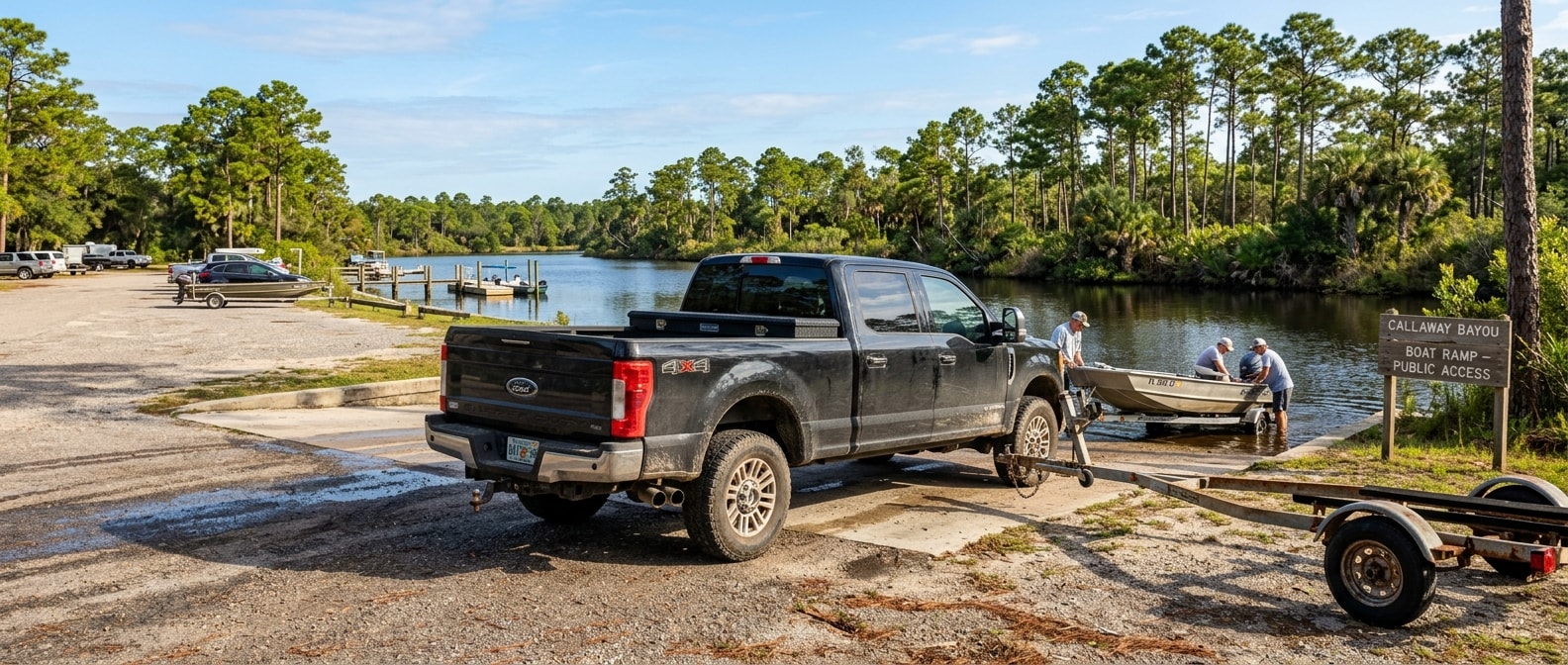
If you live in Callaway, you already know the routine. On weekdays you're running US-98 to Panama City for work, and come Saturday you've got a boat trailer hitched and you're pointed toward East Bay. Those two jobs ask different things from a truck. Buying a used one that handles both without quietly rusting underneath you is the problem most shoppers don't frame right until they're already standing on a lot.
A trap we watch for at Bay Cars is a buyer locked on a single spec (towing capacity, usually) who walks right past a truck that would've served them beautifully, or ends up with a capable unit nobody checked for coastal corrosion. Good news is this problem's solvable. Get the model-year sweet spots right, run the right inspection, and a used truck in Callaway becomes one of the best-value vehicles you can own.
Browse our used truck inventory at Bay Cars
What's Actually Going On? Daily Callaway Driving vs Real Truck Capability
Your used truck in Callaway is really pulling two shifts, a short suburban weekday commute and a heavier weekend haul, and those two shifts pull in opposite directions, so buying for one job and ignoring the other is exactly where a good deal goes wrong. US-98 is a divided four-lane corridor for most of it, stop-light heavy, and fuel economy matters more than people admit when they're romanticizing a V8. Then the weekend hits and the use case flips entirely. A boat headed for East Bay, or a load of hurricane-cleanup debris in the bed. That dual-duty reality is what you're actually buying for.
Where does a used-truck purchase usually go sideways? Speccing the truck for the weekend and ignoring the weekday tax, or buying purely on reliability reputation without checking whether that specific used unit spent years near salt air with no undercarriage attention.
| Truck | Best Used Model Years | Max Towing (when properly equipped) | EPA Highway MPG (base engine) | Coastal Use Fit |
|---|---|---|---|---|
| Ford F-150 | 2021-2023 | Up to 13,200 lbs (3.5L EcoBoost) | Up to 25 mpg (2.7L EcoBoost) | Heavy tow + daily commute balance |
| Toyota Tacoma | 2020-2023 | Up to 6,800 lbs (3.5L V6, Access Cab RWD) | Up to 24 mpg (highway, 2WD config) | Light-to-medium tow, long-run reliability |
| Ram 1500 | 2021-2023 | Up to 7,660 lbs (when properly equipped) | Up to 25 mpg (highway, V6 eTorque) | Crew cab comfort + weekend boat duty |
*Towing figures are maximums for properly equipped configurations. The EPA rates individual configurations (verify the specific truck's build before you commit to a tow job).*
The Coastal Condition Problem Nobody Talks About
Salt air is the diagnosis hiding in plain sight, and here it matters more than in almost any inland market, since Callaway's coastal chemistry keeps working on a truck's underside around the clock, whether that truck is parked in a driveway or running US-98 every morning. Callaway sits on East Bay and Callaway Bayou. Gulf Coast humidity means salt particles travel several miles inland on coastal winds. They cling to metal and keep reacting around the clock.
The practical consequence for a used-truck buyer is real. A 2021 Ford F-150 that spent its first four years in the Panhandle without undercarriage attention may show more frame wear than a comparable truck from central Georgia with twice the miles. None of that's alarmist. Salt-air chemistry is just doing what it does, and it changes how you evaluate a used truck here versus anywhere inland.
National "best used trucks" lists skip this diagnosis entirely, because they're written for everywhere. We're writing this one for Callaway.
The sweet spot years exist for a reason. When Ford redesigned the F-150 in 2021, it brought an aluminum-intensive body that resists coastal surface corrosion better than earlier steel-body generations. Toyota's 2020-2023 Tacoma ran the proven 3.5L V6 (a well-documented engine across hundreds of thousands of miles of Gulf Coast use) before the switch to the turbocharged i-FORCE for 2024. Over on the Ram side, the 2021-2023 1500 benefits from improved corrosion protection over earlier generations, plus the eTorque mild-hybrid system on the V6 that adds real-world efficiency on the stop-start driving of Callaway's commercial corridors.
Your Pre-Purchase Inspection Checklist for a Coastal Used Truck
Once you've settled on the right model and the right year range, the last job is verifying this specific unit, because a coastal truck's history lives on its underside and a checklist is how you read it before you sign. Work down the list slowly, and don't rush the parts you can't see from standing height.
- [ ] Frame rails and cross-members: Look for scale rust (flaking, layered corrosion) distinct from surface oxidation. A light reddish tint is normal on a used truck. Flaking or pitting is a different story.
- [ ] Brake lines: Trace them along the frame. Coastal salt accelerates brake-line corrosion; any soft spots, kinks, or green oxidation near fittings warrant a professional look.
- [ ] Differential and transfer case covers: Weeping gear oil combined with rust pitting can mean the seals have been compromised by corrosion rather than normal wear.
- [ ] Wheel wells and bed floor: Lift the bed mat if there is one. Standing water trapped under a mat accelerates floor corrosion from the inside.
- [ ] Tow hitch receiver and wiring harness: If this truck towed regularly near saltwater, the 7-pin connector and receiver tube are the first places to find corrosion that tells the story of its past life.
- [ ] Cabin A/C function: Callaway summers are hot and humid. An A/C that blows cool but weak, or that smells musty, often means a clogged or corroded evaporator drain in a truck that sat with wet mats or a leaking seal.
- [ ] Underhood coolant condition: Gulf Coast heat runs cooling systems harder than northern climates. Check the overflow reservoir for color and clarity. Brown or oily coolant is a conversation to have before you sign.
- [ ] VIN history for previous registration state: A truck that lived in the Panhandle its whole life is a known quantity. One that came from a flood-affected northern state adds a variable that the inspection alone may not reveal.
Explore Financing Options at Bay Cars
When to Handle It Yourself vs See the Bay Cars Team
Plenty of this you can handle yourself, and a few items are worth a professional set of eyes before you buy, so the split really comes down to what needs a lift and a trained eye and what only needs a flashlight and a few minutes. The inspection items above that require only your eyes, a flashlight, and a VIN report are genuinely DIY-friendly. You don't need to be a mechanic to check a frame rail or look at a tow hitch connector.
The items that cross into "have a professional look before you buy" territory are brake lines, the cooling system, and anything that requires lifting the truck safely. Those aren't difficult inspections, but they require a lift and the right eye.
What we do at Bay Cars is walk through every used truck with the buyer before a sale. We're not going to hide a rusty frame behind a spray can of undercoating. A truck that doesn't pass the honest look doesn't make it onto our lot in the first place. If something comes up in your own walk-around that you want a second opinion on, that's exactly what our team's here for. Ask us. That conversation is what makes a used truck a good truck for Callaway.
The real upshot is simple. For the daily US-98 commute plus occasional East Bay boat-launching, a clean 2021-2023 Ford F-150 with the 2.7L EcoBoost gives you the broadest capability envelope in this used market. Go with the 2020-2023 Tacoma if your loads stay light and you want a truck with a reputation for running well past 200,000 miles with routine maintenance. The 2021-2023 Ram 1500 lands in the middle (more interior comfort than the Tacoma, better ride quality than the F-150 on the city segments of US-98, and plenty of towing for a Bay County boat).
None of them's a wrong answer. The wrong answer is skipping the undercarriage.
Frequently Asked Questions
What used truck holds up best in coastal Florida conditions?
The Toyota Tacoma has a well-earned reputation for long-run reliability in high-humidity coastal environments, and the 2020-2023 model years with the 3.5L V6 make up a generation whose durability is well-documented. That said, any truck can hold up well in coastal Bay County conditions when the previous owner kept up the undercarriage and the cooling system. Model year and brand matter less than the specific truck's inspection history in salt-air environments like Callaway.
How much can a used Toyota Tacoma actually tow for East Bay boat trips?
A 2020-2023 Toyota Tacoma with the 3.5L V6 engine, configured as an Access Cab with rear-wheel drive, is rated to tow up to 6,800 lbs when properly equipped. That covers most recreational fishing boats and smaller bay boats that are common on East Bay. If your trailer and boat together run heavier than that, the Ford F-150 with the 3.5L EcoBoost is the right step up. It's rated to tow up to 13,200 lbs when properly equipped with the Max Trailer Tow Package.