
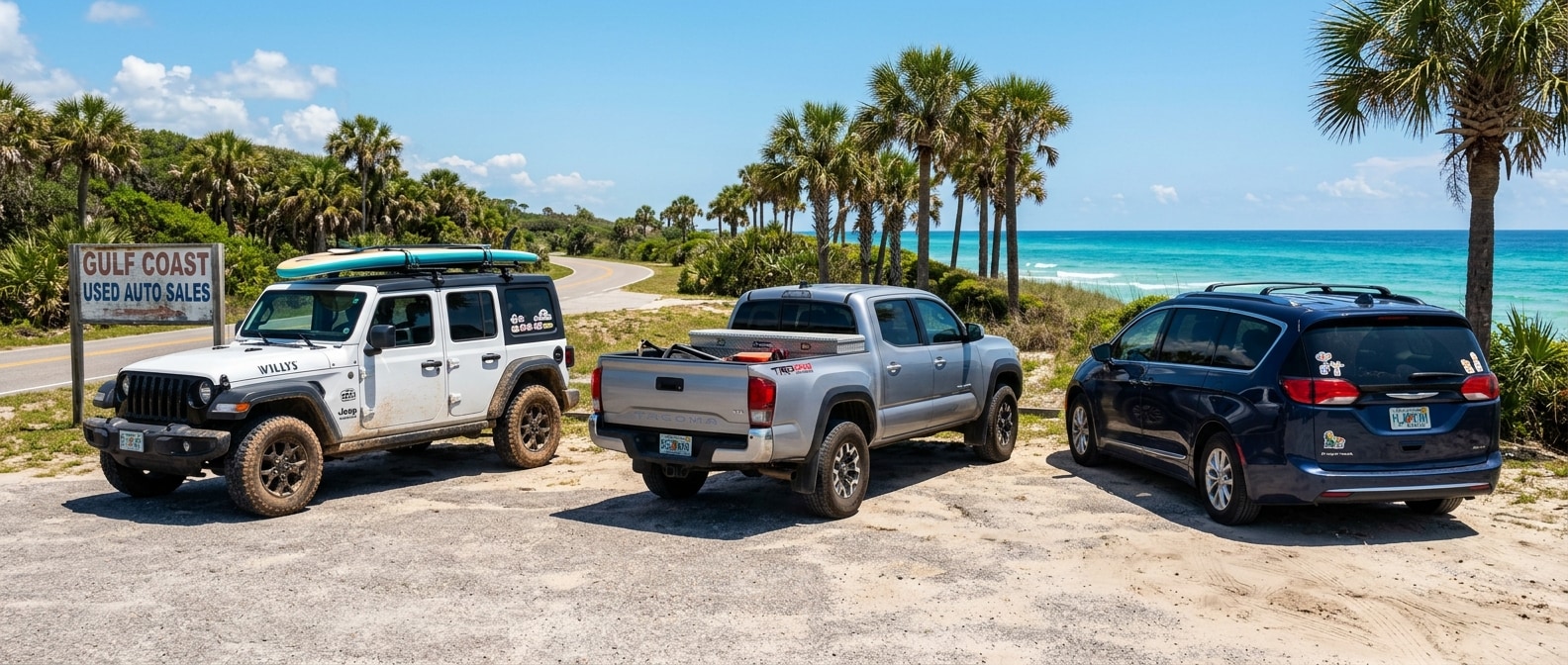
The bottom line: value in a used vehicle isn't about finding the lowest sticker on the lot. What matters is the overlap between what you'll actually do with the vehicle and what that vehicle was built to handle. Get that match right and a used car on Bay County roads can serve you for years. Get it wrong and you're paying for strengths you never touch.
Think about it this way. Panama City life runs three lanes at once. There's the beach-and-boat lane, where you're hauling gear to a capable, sand-friendly used Jeep Wrangler or backing a skiff down the ramp at St. Andrews State Park. There's the work lane, where a truck bed earns its keep on a weekday job site. And there's the family lane, where you need rows of seats, A/C that doesn't quit in August, and enough cargo room to survive a Panhandle road trip. None of those lanes wants the same vehicle. That's actually useful, because it narrows the list fast.
What Do You Actually Get at Each Budget Tier?
Used-car value on the Gulf Coast sorts into roughly three tiers, defined less by price (we don't post prices here, and the lot changes daily) and more by what you're buying functionally. The smart tier for you depends on how the vehicle earns its place in your week. Take a look at how they stack up.
| Tier | What You Actually Get | Best Fit For |
|---|---|---|
| Beach/Lifestyle | Open-air capability, short-wheelbase maneuverability, iconic resale pull, tolerates sand and salt with routine upkeep | Solo commuters, couples, beach enthusiasts, weekend adventurers |
| Work/Utility | Payload and tow ratings that hold up under real loads, crew-cab versatility, modern safety tech on later model years | Contractors, boat owners, tradespeople, anyone who earns with the truck |
| Family Hauler | Three rows or massive cargo flexibility, high-mileage reliability track record, modern driver-assistance features | Families of four or more, road-trip households, school-run duty |
None of these tiers is about cutting corners. A well-chosen used vehicle in any of them can run for another hundred thousand miles without drama. The question is whether you're buying a truck to park in the driveway twice a week, or a van you'll put 20,000 miles on this year. Your answer changes everything.
Reliability and Smart-Buy Considerations by Segment
Segment reliability comes down to the specific model year far more than the badge on the tailgate, because the same nameplate can be a strong buy one year and a genuine headache the next. Narrow by year and trim before you fall for a body style you like. We'll name names.
Beach Tier: Jeep Wrangler (approximately 2018-2022)
The Wrangler is the straightforward answer for anyone who wants Gulf Coast capability with a personality. Removable doors, open sky, clearance for soft sand. The real tradeoff shows up at the pump. The EPA rates the 3.6-liter V6 Wrangler at 17 city and 23 highway, so you're not buying this one to save fuel.
Durability and demand retention are where it earns its money. The Wrangler's cult-level resale history is well documented. For Panama City buyers, the specific advantage is the JL body style (2018 forward), which brought genuine improvements in ride comfort and infotainment over the older JK. Daily drive it and you'll feel every mile of highway. Keep it as an occasional beach and trail machine with a weekday commute, and it makes a lot more sense.
One salt-air note is worth flagging. Surface corrosion on brake lines and underbody components is a real coastal Florida consideration on any used vehicle. On a Wrangler, the body-on-frame construction makes inspection and spot-treatment more straightforward than on a unibody crossover.
Work/Utility Tier: Toyota Tacoma (2018-2023 third generation)
The used Toyota Tacoma has earned its reputation the hard way, and the third-generation trucks (2016-2023) are the version worth targeting. The detail that's easy to skip is the transmission story. The 2016 and 2017 trucks carry documented automatic transmission shudder complaints in NHTSA records. Calibration updates helped, but the complaints were real and widespread. The 2018 model year is where Toyota resolved most of those issues with revised components, and Toyota Safety Sense P became standard across most 2018 trim levels.
One more used-Tacoma fact is worth knowing. The notorious frame rust that hit second-generation trucks (2005-2015) was primarily a cold-weather, road-salt problem. Florida's coastal environment brings surface corrosion risks, but the structural frame-perforation issue that drove class-action attention was concentrated in northern states. A solid inspection still matters, but a Florida-titled 2019 or 2020 Tacoma carries a very different rust-risk profile than the same truck out of a Michigan winter. Apple CarPlay and Android Auto became standard on the 2020 model year, which is worth noting if connectivity matters to you.
For Bay County contractors, the midsize bed handles most job-site loads without the parking headaches of a full-size. US-98 runs east to west through Panama City. The truck takes those lanes easily. Need to tow a boat to the Gulf? The 2020-2023 Tacoma is rated to tow up to 6,800 pounds when properly configured per Toyota's specifications, which covers a lot of Bay County skiffs with room to spare.
Family Hauler Tier: Honda Odyssey (2021 and newer)
The used Honda Odyssey is the most sensible three-row family answer in this segment, but the model year matters here more than almost anywhere else. The 2018 and 2019 Odysseys carry a "Mixed" reliability signal in data sourced from NHTSA complaint filings. The 2018 had 13 recalls, and the 2019 accumulated 17 recalls and 768 owner complaints on record, with the electrical system and powertrain leading the categories. NHTSA campaign 23V751 covered connecting rod bearing wear on 2018-2019 engines. The 2020 improved but still carried 11 recalls. The 2021 is where the picture gets meaningfully cleaner.
So the tradeoff with the Odyssey is a fair one. You get real family utility (the magic-slide second row alone justifies the segment for families managing car seats across rows), but shop 2021 and up, and run any 2018-2019 VIN through NHTSA's recall checker before buying.
For Panhandle families, the Odyssey's climate control capacity earns its keep in summer. Gulf Coast August heat is sustained rather than a few hot afternoons. A minivan's rear-zone A/C keeps the back row livable on a run down the Emerald Coast without everyone arguing about the vents up front.
The Smart Choice Framework for Bay County Buyers
The budget frame is useful but incomplete on the Gulf Coast market, because a well-chosen used vehicle that matches your real life holds its value in two directions at once, and that matters more here than the sticker you started with. It costs less to maintain, since you're not overbuying capability you never use. And it keeps enough demand that when you're ready to move on, someone in this market wants what you have.
The used Kia Soul deserves a mention here as the overlooked option in the commuter tier. The EPA rates the 2020 Soul with the 2.0-liter engine at 28 city and 33 highway. For someone doing a US-98 commute and weekend beach runs without a boat in tow, the Soul delivers square cargo geometry, seating for five, and fuel economy that makes the daily grind noticeably cheaper. It won't stand in for a work truck or a family van, but as a small-footprint commuter it's genuinely practical, and the Panhandle's parking reality rewards it.
The smarter framing here is simple. Ask what you need the vehicle to do in September in Panama City, and forget what you needed somewhere else. Hauling gear to St. Andrews State Park on a Saturday afternoon and making a weekday highway run up to Tallahassee are two different asks. The vehicle that handles both for your specific use is the one that's actually a value.
Frequently Asked Questions
What's the biggest used-car mistake buyers make when shopping for Gulf Coast life?
Buying capability they'll never use. A four-door full-size truck is genuinely excellent if you tow a boat or haul materials on a regular basis. If you don't, you're paying at the pump on every highway mile. Going the other way, buying too small for a family of five and discovering on the first long road trip that the back row is miserable is just as avoidable. Be honest about your actual weekly use, not your hypothetical weekend use.
Should I worry about rust on a used vehicle in Panama City?
Surface corrosion on brake hardware, exhaust components, and underbody fasteners is a real consideration with any used vehicle that has lived near the Gulf. It stands apart from the structural frame rust that affected Toyota Tacomas in cold northern states, which was driven by road salt and largely concentrated in the 2005-2015 second-generation trucks. For a Florida-titled used vehicle, the pre-purchase inspection should look at brake lines, wheel wells, and underbody hardware. Treat it as a routine check. There's no reason to avoid used vehicles over it.