
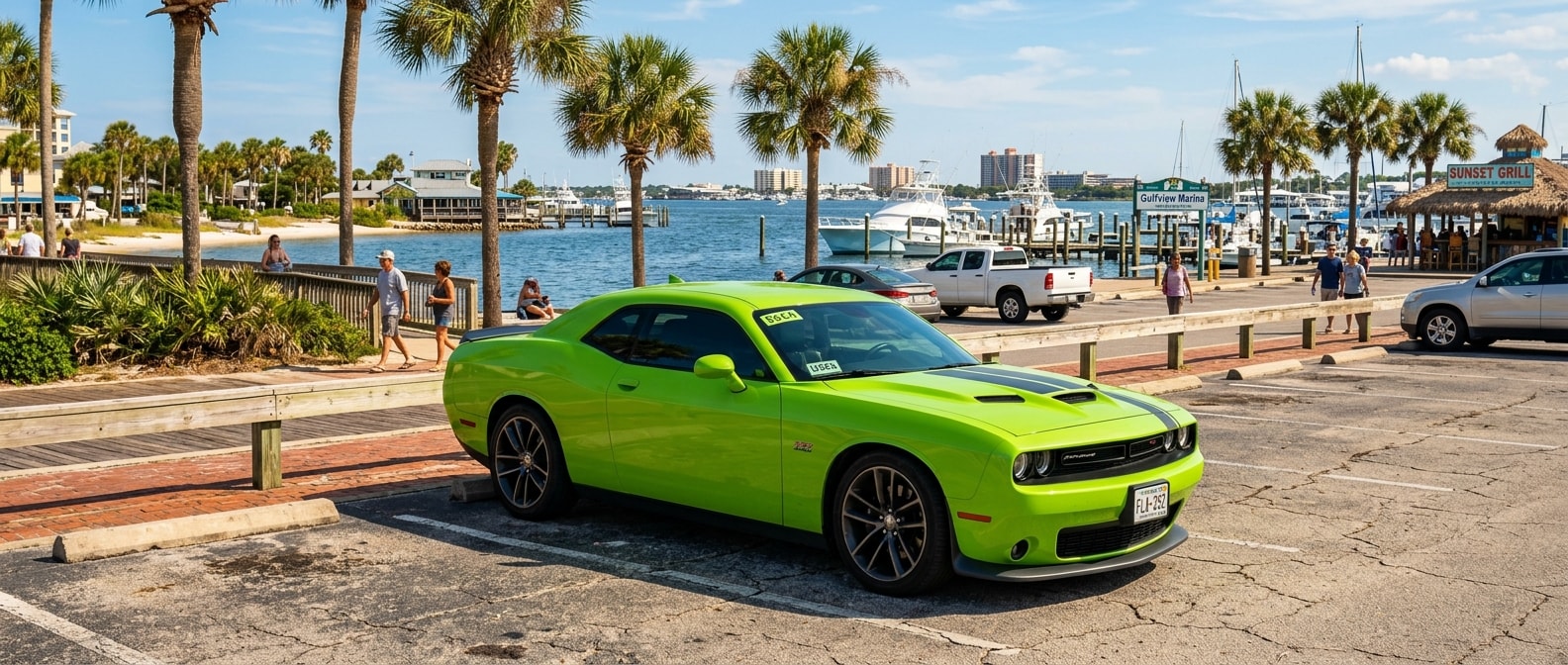
Picture a Dodge Challenger and your brain jumps straight to a thundering HEMI, zero highway manners, no back seat, and a gas-station relationship that borders on abusive. We hear a version of that on the lot. A lot of it isn't true, and the parts that ARE true come with more nuance than the internet gives them credit for.
- The Challenger was discontinued after the 2023 model year, so used is your only option now and supply is finite.
- The V6 SXT trim is EPA-rated at 30 mpg on the highway, which holds up fine on long Panhandle runs on US-98.
- It seats five and carries 16.2 cubic feet of trunk space, more than any other sports car in its class.
- Early model years (2009 to 2013) carry a heavier recall and complaint history; 2020 to 2023 examples are significantly cleaner.
- The real downside is two-door access and genuine city fuel economy. If that trade-off fits your life, this is a great used buy.
Browse used Challengers on our lot
Is the Challenger Actually That Bad on Gas?
Mostly fiction if you're looking at the V6, and fair enough if you're looking at the V8, because the SXT trim earned an EPA rating of 19 mpg city and 30 mpg highway while the HEMI cars sit well below that in town. On the open highway driving that defines the Panhandle, with long flat stretches on US-98 between Panama City and the beach communities to the east and west, that 30-mpg highway figure is genuinely achievable and competitive with plenty of non-performance cars. The 5.7-liter HEMI R/T drops to 15 city and 23 highway, which is fair to call thirsty in town. The jump between the V6 and the V8 is the biggest fuel economy story here, and it's not some monolithic "Challengers burn gas" verdict.
| Trim | Engine | City MPG (EPA) | Highway MPG (EPA) |
|---|---|---|---|
| SXT | 3.6L V6 | 19 | 30 |
| GT (AWD) | 3.6L V6 | 18 | 27 |
| R/T | 5.7L HEMI V8 | 15 | 23 |
| R/T Scat Pack | 6.4L HEMI V8 | 14 | 23 |
| SRT Hellcat | 6.2L Supercharged V8 | 13 | 22 |
So is the reputation earned? Partly. The V6 highway number is the myth-killer, and if you're commuting daily to a job across Bay County or making regular runs toward Panama City Beach, the SXT won't punish you at the pump the way its reputation suggests.
The Challenger's Practicality Is Genuinely Underrated
Search all used inventory at Bay Cars
More practical than the shape lets on, with a genuine caveat about door access we'll get to, because the Challenger carries 16.2 cubic feet of trunk space that isn't just "pretty good for a sports car," it matches a midsize sedan and blows past the Chevrolet Camaro's 9.1 cubic feet by almost a factor of two. The rear seatbacks fold 60/40, so beach chairs, surfboards in bags, or a Costco run from Panama City's stores all fit with room to spare.
The back seat accommodates five passengers total, with 33.1 inches of rear legroom. Real adults fit, and that's unusual in this segment. The front rows offer 42 inches of legroom and 39.3 inches of headroom, specs that the EPA and industry measurements consistently confirm across model years 2018 through 2023.
The spec sheet leaves out one thing. Getting INTO that back seat through two big doors is genuinely awkward when you're doing it multiple times a day with kids, groceries, or passengers who have any mobility considerations. We're not going to pretend otherwise.
- For occasional rear-seat use, it's a non-issue
- For daily school runs with car seats on every trip, it's a real inconvenience
- For situations without frequent back-seat passengers, this trade-off disappears
Cargo and Comfort Specs
The comfort and cargo numbers land better than a two-door coupe body would lead you to expect, and they're the concrete reason we call this car livable rather than just quick, so here's what the interior actually gives you before you write it off.
- 16.2 cu ft trunk (class-leading, midsize-sedan territory)
- Five-passenger seating with 33.1 inches of rear legroom
- 60/40 split-folding rear seats for longer cargo
- Three full LATCH connector sets in the rear for child safety seats
- Dual-zone automatic climate control standard on SXT and above (important on the Gulf Coast in September)
Which Model Years Actually Hold Up?
Check current Bay Cars specials
The newer ones hold up best, and the early cars aren't automatically a bad buy as long as you run the history first, because the Challenger ran from 2008 through 2023 and not all of those years are created equal. Plenty of early examples still fill the used market, and a few of those years carry baggage worth knowing about before you buy.
The 2009 through 2013 range logged the most complaints and recalls in the model's history. Here's what stands out in that early window:
- Takata's airbag recall touched the 2009 model year and some early examples beyond it.
- Look at 2010 on its own and you'll find 298 NHTSA complaints.
- Then 2015 carried eight recalls in that calendar year, including an instrument cluster software issue and a radio cybersecurity vulnerability affecting Uconnect.
None of that is a reason to panic about every early Challenger, but it's a reason to pull the NHTSA VIN check before you commit.
The 2020 through 2023 model years tell a cleaner story. You're looking at just two recalls each for 2021, 2022, and 2023 in NHTSA's records.
The 2022 recall involved a TPMS sensor battery that could fail prematurely, logged as NHTSA campaign 22V808000. That one's manageable. For 2023, the record shows 2 recalls and 38 total complaints on file, a light record for a vehicle in its final production year. Our team looks specifically at the post-facelift 2015 and newer generation when we're evaluating used Challengers, and we lean toward 2020-and-up for buyers who want the cleanest reliability picture.
Prefer a four-door? See our used Charger inventory
Drawn from NHTSA data, the recall calendar below is what we'd point a buyer to.
| Model Year Range | NHTSA Recall Count | Notes |
|---|---|---|
| 2009-2013 | 7 to 10 per year | Takata airbag recall, electrical and engine complaints |
| 2014-2016 | 3 to 8 per year | Uconnect software recall, fuel line issues on some SRT models |
| 2017-2019 | 3 to 4 per year | Improving picture, check VIN for any carryover issues |
| 2020-2023 | 1 to 2 per year | Cleanest record in the generation; sweet spot for used buyers |
So Should You Actually Buy One?
Whether you should buy one comes down to your commute and your passengers, a clean yes if it's highway miles and five seats you're after, a clear no if daily two-door access with car seats is your reality.
The case for buying. If your daily drive includes Gulf Coast highway miles, you want five seats, and you'd like something with actual character at a used-car value point instead of yet another crossover, the Challenger makes real sense. The SXT is the most practical version and the least misrepresented one. The HEMI trims are honest about what they are, performance-first and fuel-economy-second, and worth it if that's what you're after.
What doesn't work. If two-door access is a regular friction point for your specific passengers, or if most of your driving is stop-and-go Bay County traffic rather than highway, the city fuel economy figure of 15 to 19 mpg (depending on trim) is real and you'll feel it. The Challenger doesn't pretend to be a crossover. It just happens to be more livable than its reputation admits.
Production ended after the 2023 model year, and there are no new Challengers coming. The used supply is what it is, and it won't grow. For a buyer who's been on the fence, that's the reason to stop waiting.
Frequently Asked Questions
Is the Dodge Challenger still being made?
No. Dodge ended Challenger production after the 2023 model year. There are no 2024, 2025, or 2026 model year Challengers, and the used supply won't grow.
Is the Dodge Challenger a good used car for everyday driving in Panama City?
It depends on which trim and which years. The V6 SXT earns an EPA highway rating of 30 mpg, which handles Panhandle highway commutes well. The back seat fits real adults and the trunk holds 16.2 cubic feet, more than any other sports car. The main practical limitation is two-door access for frequent rear-seat passengers. For model years, we recommend 2020 through 2023 examples, which carry the lightest recall records in the model's history.