
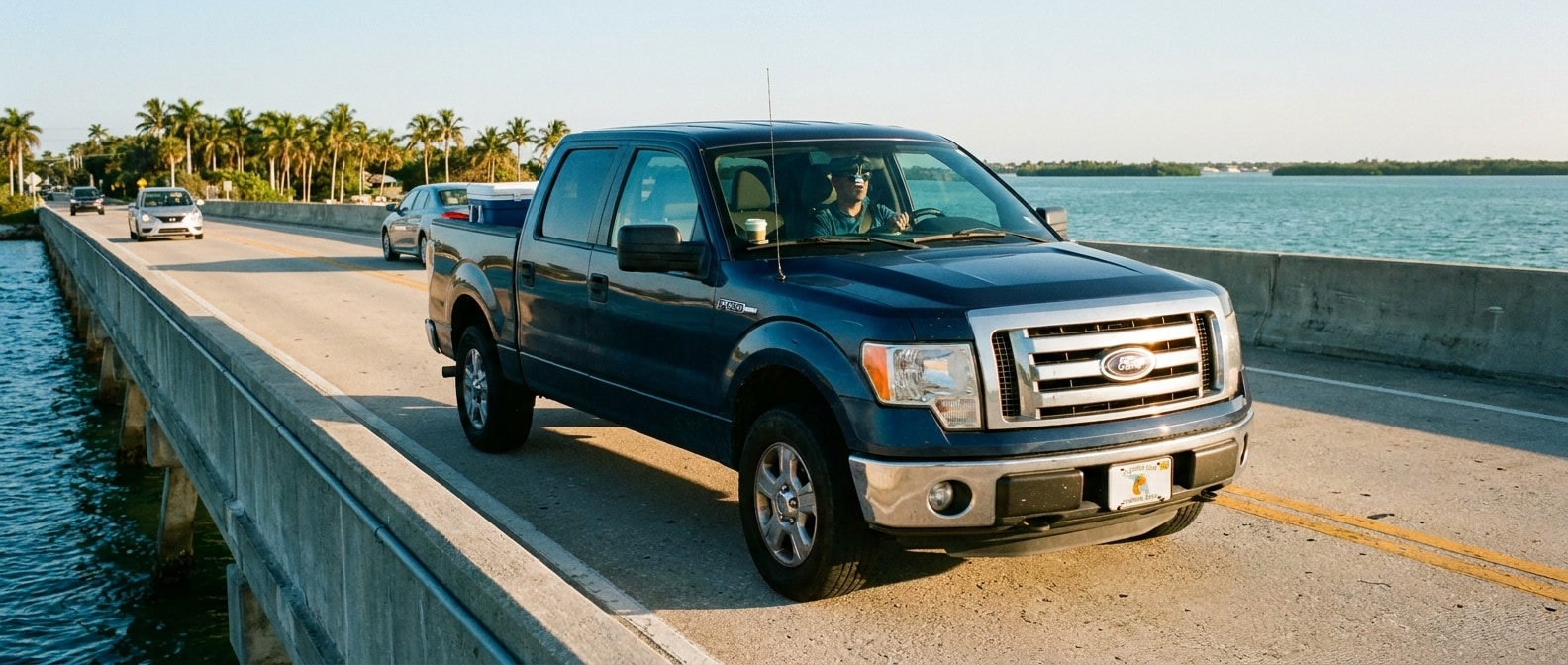
If you're making the daily run from Panama City Beach across the Hathaway Bridge on US-98 into Panama City, the first question isn't really "which truck?" The better question is "which *year* of that truck?" Get the year wrong and a perfectly good nameplate bleeds cash in repairs before summer's over. Get it right and you've got a reliable daily driver that can still haul a kayak to St. Andrews Bay on the weekend without drama.
We've watched which trucks hold up on the Panhandle and which ones come back with headaches. When you're buying used, model-year selection matters more than brand loyalty. This guide covers three trucks we carry at Bay Cars (the Ford F-150, Ram 1500, and Toyota Tacoma) with the specific year ranges that make sense for a Bay County commuter.
- Ford F-150 sweet spot: 2018-2020 (sorted aluminum body, 2.7L EcoBoost EPA-rated ~20 city / 26 highway mpg, mature 10-speed transmission)
- Ram 1500 sweet spot: 2017 and 2020 (avoid 2014 and 2012 above all others; HEMI lifter and rocker arm failures are documented in NHTSA complaint data)
- Toyota Tacoma sweet spot: 2019-2020 (third-gen bugs worked out, low NHTSA complaint volumes, RepairPal average maintenance at modest annual costs)
- Years to watch on all three: any first-year-of-generation model (2015 F-150, 2019 Ram redesign, 2016 Tacoma) carries above-average early-production risk
- The commuter detail nobody mentions: the Hathaway Bridge run is steady-speed highway driving (exactly where EcoBoost engines earn their fuel economy numbers)
By the Bay Cars Team | September 2026
Which Years Are the Sweet Spot?
Each of these trucks has a "settled" era, the years when the factory worked out its launch bugs, the powertrain proved itself in the real world, and NHTSA complaint volumes dropped. Buy inside those windows and you're buying the truck the engineers intended. Buy outside them and you're paying for someone else's learning curve.
Ford F-150
| Year Range | Generation | Sweet Spot? | Notes |
|---|---|---|---|
| 2009-2014 | 12th gen | Yes (2013-2014 best) | Cleanest production launch; lowest complaint rate per unit |
| 2015-2017 | 13th gen early | Caution | Aluminum body teething; NHTSA recall 20V525000 on output shaft |
| 2018-2020 | 13th gen late | Top pick | Sorted construction; mature 10-speed; 2.7L EcoBoost ideal for commuters |
| 2021 and up | 14th gen | Solid, higher cost | Still commanding near-new asking values on the used market |
Most reviewers put the 12th-generation F-150 (2009-2014) at the top of this nameplate's reliability history, with the cleanest production launch and the lowest NHTSA complaint rates per unit sold. The 2013 and 2014 are the pick of that litter.
Then there's a gap you need to know about. Ford switched to an aluminum body in 2015, and the first three model years (2015, 2016, 2017) carried real teething pains. NHTSA recall 20V525000 covers the rear output shaft bearing on 2015-2019 F-150 models. Some are fixed, some aren't. Check completion status by VIN before you commit to anything in that range.
By 2018 the picture changes. The 2018-2020 trucks are a genuinely different truck from the 2015-2017s, even though they share a generation badge. Ford sorted the aluminum construction and the 10-speed automatic by then. The 2.7L EcoBoost V6 in those years is the commuter's engine. The EPA rates the 2018 F-150 2.7L EcoBoost in rear-wheel drive at approximately 20 mpg city and 26 mpg highway. On the Hathaway Bridge crossing (steady speed, flat highway), you'll live closer to that highway figure than to the city one. That matters when you're doing it twice a day.
See the F-150s on our lot at Bay Cars
Ram 1500
| Year Range | Generation | Sweet Spot? | Notes |
|---|---|---|---|
| 2009-2016 | 4th gen | Mixed | Avoid 2012 and 2014; HEMI failures documented in NHTSA complaints |
| 2017-2018 | 4th gen late | Yes | Fewest complaints of the generation; 2017 broadly regarded as most reliable year |
| 2019 | 5th gen launch | Caution | First-year redesign; steering complaints and 10 NHTSA recalls on record |
| 2020-2023 | 5th gen settled | Yes | 2020 standout year; fresh exterior, low documented complaint volume |
The Ram 1500 hides one documented trap for used buyers, the 2014 model. NHTSA complaint data consistently flags it as the worst year in the lineup's recent history, with documented engine failures including broken rocker arms and camshaft-related issues in the HEMI V8. The 2012 follows the same pattern. Skip both.
The 2017 Ram is the steady, safe choice. Parts are easy to source, the proven fourth-generation design keeps shop costs manageable, and owner accounts describe solid reliability at high mileage. The 2020 is the other standout. Its fifth-generation redesign had settled after the rough 2019 launch, and documented complaint volumes reflect that. For a straight commuter on flat Panhandle roads, the 3.6-liter Pentastar V6 (introduced in 2013) handles the Bay commute without the fuel cost of the HEMI. Early Pentastar years had some documented oil consumption tendencies (a simple level check during your pre-purchase inspection catches that).
Explore Financing Options at Bay Cars
Toyota Tacoma
| Year Range | Generation | Sweet Spot? | Notes |
|---|---|---|---|
| Pre-2012 | 1st/2nd gen | Caution | Frame corrosion documented; coastal exposure increases risk |
| 2013-2015 | 2nd gen late | Yes | Solid years; proven platform |
| 2016-2018 | 3rd gen early | Caution | Transmission lag and infotainment issues documented in NHTSA complaints |
| 2019-2020 | 3rd gen settled | Top pick | 2020 near-zero NHTSA complaints; early-gen issues resolved |
| 2021-2023 | 3rd gen late | Yes | Consistent; RepairPal average maintenance at modest annual costs |
Toyota launched the third-generation Tacoma in the 2016 model year and carried it through 2023 with running updates.
The Tacoma is a mid-size truck, and that's actually a feature for a Panama City commuter. It handles downtown traffic better, slots into a parking space near W. 15th Street more easily, and the fuel economy on four-cylinder trims beats the truck's reputation. The tradeoff is real. Most used Tacomas wear the 3.5-liter V6, and in real-world mixed driving that engine delivers roughly 19-20 mpg combined. That's perfectly reasonable for a truck, though it's still not a sedan.
Browse available Tacomas at Bay Cars
Get an undercarriage inspection on any pre-2012 Tacoma before you fall for it. For Gulf Coast buyers, the pre-2012 frame question is serious. Documented frame corrosion affected earlier generations, and salt air is hard on unprotected steel. The 2019 and 2020 third-gen trucks cleared the early-generation issues (transmission lag and infotainment bugs that showed up in 2016-2017 NHTSA complaints) and carry much lower complaint volumes in the federal data. The 2020 is especially clean.
Which Years Should You Watch Out For?
A handful of specific years earn a hard look before you buy, and none of it is opinion, since each pattern below shows up in NHTSA complaint and recall data rather than in anecdotes. Some of these trucks turn out fine once a recall is closed. Others carry a documented mechanical risk you don't want to inherit.
Ford F-150 (2015-2017): NHTSA recall 20V525000 covers the rear output shaft bearing on 2015-2019 models. Not every truck is affected, and recall completion status varies by VIN. Beyond the recall, the early aluminum-body years accumulated meaningfully more complaints per unit than the later 2018-2020 trucks from the same generation. Same exterior styling. Genuinely different reliability profile.
Ram 1500 (2012, 2014, 2019): The 2014 generated the highest documented engine complaint volume in recent Ram history per NHTSA data, with rocker arm failures and camshaft-related breakdowns in the 5.7-liter HEMI V8. The 2012 follows a similar pattern. Ram's 2019 first-year redesign lands in a different category (not as severe), but it accumulated 10 documented NHTSA recalls and elevated steering complaint rates. It needs more due diligence than a 2017 or 2020.
See used Ram 1500s available at Bay Cars
Toyota Tacoma (2016-2017 and pre-2012): The third-generation Tacoma launched in 2016 with documented transmission complaints and infotainment reliability issues that Toyota addressed by 2019. More critically for a Florida buyer, pre-2012 Tacomas with Gulf Coast exposure have well-documented frame corrosion histories. An undercarriage inspection is not optional on older examples. Consider it required.
Which Year for Which Buyer?
The right year depends on what you're actually doing with the truck beyond the daily bridge run, so match the model year to the job you hand it on weekends. A boat trailer points one direction. A three-year resale plan points another.
You want the best fuel economy on the bridge run and still need towing capability: The 2018-2020 F-150 with the 2.7L EcoBoost is the call. The EPA-rated approximately 20 city and 26 highway mpg means the steady Hathaway crossing works in your favor, and you still have real towing capacity when the boat trailer needs to move. The honest tradeoff runs like this. A turbocharged engine needs consistent oil changes and a proper warm-up before hard use. Neglect the maintenance schedule and the EcoBoost will eventually tell you about it.
You want the smoothest ride and quietest cabin for the daily grind: The Ram 1500 earns better ride-comfort marks than comparably priced F-150s in this era. A 2017 or 2020 Ram with the Pentastar V6 covers the Bay commute without drama, and the interior in those years feels more refined than comparable F-150 trims. The tradeoff is minor. Ram parts can be a bit less universally stocked at smaller independent shops in some Panhandle markets, though Bay County handles both brands without issue.
You want the truck that holds its value best and handles coastal life with lower maintenance overhead: The 2019-2020 Tacoma. RepairPal puts Tacoma average annual maintenance at modest costs, which is below average for mid-size trucks. For a commuter planning to sell in three to five years, lower depreciation combined with lower average maintenance costs makes a genuine case. The tradeoff is simple. It's a mid-size truck rather than a full-size, so payload and towing capacity are limited compared to the F-150 or Ram.
You want a tow-ready, weekend-capable Panhandle truck that also handles the commute without breaking the bank: A 2020-2021 GMC Sierra 1500 with the 5.3-liter engine is worth adding to the search. Avoid the 2019 launch year (10 NHTSA recalls, elevated engine and powertrain complaints in federal data) and avoid the 6.2-liter engine on 2021-2024 models (NHTSA recall 25V-251 covers an engine block manufacturing defect on that engine). The 5.3-liter 2020-2021 Sierra is a settled, capable truck that tends to get overlooked next to the F-150 (which sometimes means better value on a used lot).
Stop by Bay Cars on W. 15th Street. The lot is in Panama City. We're happy to pull up whatever's in stock and walk through it with you. No pressure. Just trucks.
Frequently Asked Questions
Does a used full-size truck make sense as a daily commuter, or is the fuel cost too high?
It depends on which engine you choose and which roads you drive. A 2018-2020 Ford F-150 with the 2.7L EcoBoost V6 is EPA-rated at approximately 20 city and 26 highway mpg (competitive with many used midsize SUVs). On the Panama City Beach to Panama City run (roughly 10 miles each way across the Hathaway Bridge), you spend more time at steady highway speeds than in stop-and-go, which is exactly where EcoBoost engines earn their efficiency ratings. A V8-only or older naturally aspirated truck is a different calculation, especially in Gulf Coast summer heat with the A/C running hard. A turbocharged V6 in the right year range is a legitimate daily-driver engine.
What is the single most important thing to check before buying a used truck for a daily commute?
Pull the VIN through the NHTSA free recall database before anything else. Several widely recommended used-truck years (including 2015-2019 Ford F-150s and the 2019 Ram 1500 redesign) carry open or recently closed recalls that matter. Confirm those recalls are completed on the specific vehicle you're considering, not just that the recall exists. A truck with an incomplete recall is a known problem you're paying to inherit. That check takes five minutes online and it's the most useful five minutes in any used-truck purchase.
Is the Toyota Tacoma's higher resale value worth the tradeoff for a Bay County commuter?
For the right buyer, yes. RepairPal puts Tacoma average annual maintenance at modest costs, which is below the mid-size truck average. For a commuter planning to sell in three to five years, lower depreciation combined with lower average maintenance costs can offset a higher purchase price and deliver real value.