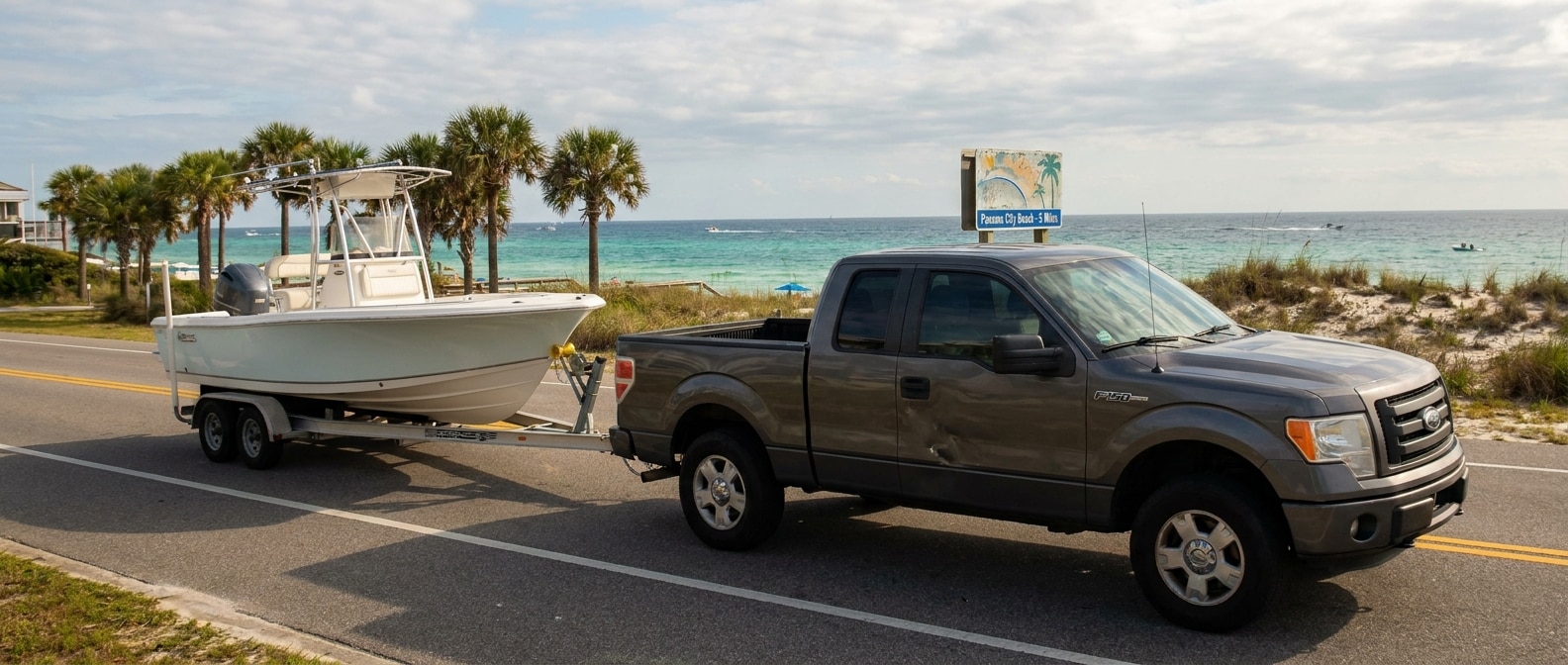
You've got a boat to tow to St. Andrews, a contractor job that loads the bed every morning, and two kids who need rear-seat space on the weekends. One truck, three completely different jobs. The good news is the 2026 used truck market runs deep enough that you can land one truck for all three without giving up much on any of them, as long as you know which specs matter for life on the Gulf Coast.
One honest answer before the steps: the right used truck for Panama City depends on how much you tow, not on brand loyalty. If your boat and trailer run under 5,000 pounds, a well-spec'd used midsize gets the job done. Above 8,000 pounds, you're in full-size territory, full stop.
a used Ford F-150 covers the widest range of those needs, but it isn't the only answer, and we'll show you exactly where the other options on our lot fit in.
What You Need Before You Start
Before you match a truck to your life, you need four numbers, and pulling them up on your phone right now beats guessing out on the lot. These four tell you more about a real fit than brand loyalty or a shiny trim badge, and skipping them is the one move that leads straight to a bad match.
| What to Gather | Where to Find It | Why It Matters |
|---|---|---|
| Your trailer's loaded weight | Trailer paperwork or a weigh station | Sets the minimum tow rating you need |
| Your boat's dry weight + fuel + gear estimate | Manufacturer spec sheet | A 20-ft center console and trailer can easily hit 6,500-8,000 lbs |
| Payload you'll regularly carry in the bed | Your own estimate (tools, materials, coolers) | Determines max payload rating needed |
| Cab and bed configuration you need | Count your regular passengers | Crew cab adds 18+ inches of rear legroom vs. access cab |
The loaded weight figure is the one that surprises folks. A modest aluminum skiff with trailer might come in under 3,500 pounds. A fiberglass bay boat with a 150-horsepower outboard and a roller trailer? You're looking at 5,500 to 7,500 pounds before you add fuel and gear. Know your number.
Step-by-Step: Matching the Right Used Truck to Your Gulf Coast Life
Browse the Bay Cars pre-owned inventory to get familiar with what's on the lot, then work through these steps.
Step 1. Lock In Your Tow Rating Requirement
Start here, because your tow rating is the filter everything else runs through. Nail it and the rest falls into place.
Ford lists the 2023 F-150's maximum towing capacity at up to 14,000 pounds with the 3.5L EcoBoost V6 and the Max Trailer Tow Package, but that's the ceiling. A 2022 or 2023 F-150 with the more common 2.7L EcoBoost V6 (which is what we see on a lot of used XLT and Lariat trims) is rated at 10,100 pounds, which handles most Gulf Coast boat rigs with room to spare.
The 2022-2023 Toyota Tacoma with the 3.5L V6 is rated at up to 6,800 pounds. A flat-bottom skiff, a small center console, or a pair of Jet Skis on a tandem trailer all fit under that. It does NOT cover a trailered 21-footer heading out to the Gulf. Know the difference.
Ram rates the 2023 Ram 1500 with competitive full-size tow ratings in the 12,700-pound range (3.5L eTorque V8). Smooth ride, capable numbers, and the Ram earned an 88 out of 100 J.D. Power reliability score for 2023 per U.S. News rankings.
Step 2. Check the Payload Sticker, Not the Brochure
A used Toyota Tacoma is a capable truck, and we'll never tell you otherwise. But the payload ceiling matters on a working truck. The 2022-2023 Tacoma V6 has a maximum payload of around 1,440 to 1,685 pounds depending on configuration. Fine for beach gear and coolers, tight if you're hauling a full pallet of materials or a loaded toolbox plus two passengers.
The 2022-2023 F-150 5.0L V8 pushes maximum payload up to 3,315 pounds. That's a different category of work truck. If your bed hauls demo debris, lumber runs, or heavy landscaping loads most workdays, that gap is real.
Skip the brochure math and read the door jamb instead. The actual payload for any specific used truck is stamped on the driver's door jamb. Two identical-looking F-150s with the same engine can carry different payload ratings based on options and cab/bed combo. Check the sticker on the specific truck you're buying.
Step 3. Think About the Front Beach Road Reality
Front Beach Road drives nothing like a highway, so plan for stop-and-go traffic, tight parking lots, beach access turn-ins, and a corridor where you'll parallel-park next to rental cars driven by people on vacation. A 2022 GMC Sierra 1500 or F-150 SuperCrew with a 6.5-foot bed is a large vehicle in that environment.
If your work is inland and your beach trips are light-load, a used Toyota Tacoma Double Cab is easier to maneuver and easier to park (a real gift on a crowded Saturday). If you're launching at St. Andrews State Park's boat ramp and your rig is over 6,500 pounds, you want the full-size.
Pick the size that fits your real parking and driving life, then let the towing max confirm it.
Step 4. Salt-Air Is a Real Factor on the Gulf Coast
We won't dramatize it, but salt air is a practical consideration when you shop used trucks here. The salt air along the Gulf Coast accelerates surface corrosion on brake lines, exhaust components, and undercarriage metal. When you look at any used truck, run your eye along the frame rails and under the bed. Watch for the gap between surface rust and structural rust. Surface rust stays cosmetic and manageable, and structural rust opens a very different conversation.
Models known for better corrosion resistance on treated steel frames include the 2019-2023 Toyota Tacoma and Tundra generations. Ford's aluminum-body F-150 (2015 and newer) eliminated most of the door, hood, and bed-panel rust concerns that plagued older steel-body trucks in coastal markets.
Step 5. Decide on Cab Config for Family Life
Crew cab means a full rear door and real rear-seat legroom. An extended or access cab works for occasional passengers but gets uncomfortable on a long run down US-98 to Destin. If family road trips are part of the picture, budget specifically for a crew-cab trim. The rear seat makes a measurable difference when two adults are back there for two-plus hours.
Step 6. Run the Final Three-Way Check
| Need | Midsize (Tacoma, Ranger) | Full-Size (F-150, Ram 1500, Sierra 1500) |
|---|---|---|
| Towing under 6,500 lbs (small boat, PWC) | Yes | Yes |
| Towing 7,000-14,000 lbs (large bay boat, 5th wheel) | No | Yes |
| Max payload over 2,000 lbs | No | Yes (properly equipped) |
| Easy parking on Front Beach Road | Yes | Tight, manageable |
| Family crew cab comfort | Possible (Double Cab) | Yes (SuperCrew, Crew Cab) |
| Lower used cost of entry | Yes | Depends on trim/year |
- [ ] You know your trailer's loaded weight (write it down before you shop)
- [ ] You've checked the door-jamb sticker on the specific used truck you're considering
- [ ] You've sat in the rear seat with someone your size to confirm family comfort
- [ ] You've confirmed the cab/bed combo fits your parking situation
- [ ] You've checked the frame and undercarriage for structural rust, not just surface rust
Get a Fast Trade-In Value on Your Current Truck
Your Pre-Purchase Recap: Print This and Bring It to the Lot
Run through the fast version below before you hand over any paperwork, and treat it as a final gut-check that the truck matches your tow weight, your payload, and your family before anything gets signed. The three numbers do the deciding, so let them.
For towing: the door-jamb GVWR and GCWR are law. Tow rating in the brochure is the absolute max under perfect conditions with the optional tow package. Your real-world rating on a hot Panhandle afternoon, trailer swaying at 65 mph on US-98, is lower. Stay at least 10-15 percent under the rated max.
For payload: add up the driver, passengers, bed gear, and trailer tongue weight. That total must stay under the payload number on the sticker. Every pound counts here.
For family: if rear passengers matter, get in the back seat. A long crew-cab ride down the Panhandle isn't the place to discover the rear seat is too short for adult legs.
Check out used Ram 1500 options alongside the F-150 and Tacoma if you want a full-size truck with a notably smoother ride (the coil-spring rear suspension on the Ram 1500 is a genuine differentiator for family road trips).
For salt-air condition: budget time for a visual undercarriage inspection on any used Gulf Coast truck, especially anything that spent time near the beach. Aluminum-body trucks (F-150 2015+) and galvanized-frame Toyotas hold up better in this climate.
The right truck for life near Front Beach Road isn't necessarily the biggest one or the cheapest one. It's the one that handles your specific boat weight, fits your family, and survives the Gulf Coast climate for the long haul.
Frequently Asked Questions
What towing capacity do I actually need for a Gulf Coast boat?
A small flat-bottom skiff or pair of Jet Skis on a tandem trailer typically comes in under 4,000 pounds loaded, which a used midsize like a Toyota Tacoma with the V6 handles. A fiberglass bay boat with a 150-horsepower outboard, roller trailer, fuel, and gear can reach 6,500 to 8,000 pounds. That's full-size truck territory. Weigh your rig at a local scale before you shop.
Is a used Toyota Tacoma big enough for family life and beach trips?
For a family of four with manageable gear loads and a light trailer (or no trailer), a used Tacoma Double Cab works well. The 2022-2023 Tacoma V6 tows up to 6,800 pounds and carries up to 1,685 pounds of payload, which covers most casual beach and camping setups. If you regularly load the bed with work materials AND carry a full family AND tow a larger boat, a full-size truck gives you more margin.
Should I prioritize tow rating or payload when choosing a used truck?
Both matter equally for your specific life. A truck rated to tow 10,000 pounds but with only 1,500 pounds of payload gets overloaded in the bed before you even hook up a trailer. Start with the towing weight of your rig (boat plus trailer plus fuel and gear), then confirm the payload sticker covers the total you'll regularly carry in the bed plus passengers.