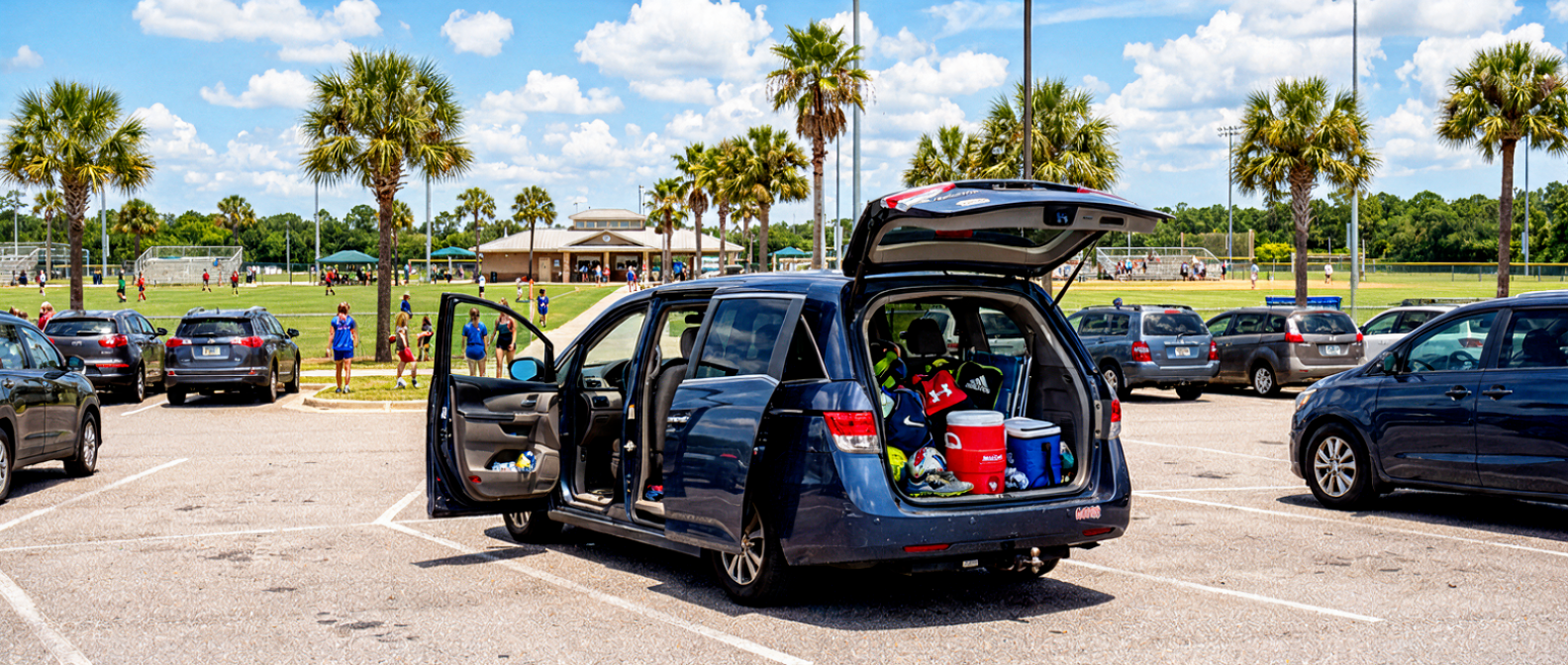
If your family spends weekends at the Panama City Beach Publix Sports Park, you already know what the parking lot looks like on tournament morning. Hundreds of vehicles, coolers strapped to roof racks, ball bags crammed into every corner, kids in cleats trying not to trip over each other. The question isn't just which used SUV looks nice. We want the one that handles a full sports weekend and still gets home on one tank.
We've put together this breakdown for the Bay County families shopping our lot. Three vehicles from our pre-owned inventory keep showing up as the go-to picks for this exact lifestyle, and they're the Honda Odyssey, the Kia Telluride, and the Ford Explorer. Each one fits a different kind of Panhandle family, and here's what you need before you decide. None of them is perfect.
How Far Will Each One Really Go on a Tournament Weekend?
All three clear a full tournament weekend on a single tank if you fill up before you arrive, though the Odyssey stretches furthest on its EPA-estimated range and the Telluride gives up the most miles between stops under the same conditions. You won't be hunting a gas station mid-bracket on any of them.
Run the AC hard through a Gulf Coast October afternoon out here and you'll shave real mpg off whatever the EPA sticker claims. The 160-acre complex sits just north of Panama City Beach off Chip Seal Parkway, so you get plenty of idling, short hops to concessions parking, and stop-and-go in a packed lot. Stop-and-go hurts mpg more than highway.
The specs that matter to a Panhandle sports family are below, and they're easy to compare.
| Vehicle | EPA Combined MPG | Tank Size | Est. Range Per Tank | Cargo Behind Row 3 | Max Cargo (all rows down) | Tow Rating |
|---|---|---|---|---|---|---|
| Honda Odyssey (2019-2022) | 22 mpg | 19.5 gal | ~429 miles | ~33 cu ft | ~144 cu ft | 3,500 lbs |
| Kia Telluride (2020-2022) | 21 mpg | 18.0 gal | ~378 miles | 21 cu ft | 87 cu ft | 5,000 lbs |
| Ford Explorer (2020-2022) | 23 mpg | 18.6 gal | ~428 miles | 18.2 cu ft | ~81.7 cu ft | Up to 5,300 lbs |
The EPA rates the 2019-2022 Honda Odyssey at 19 city / 28 highway / 22 combined mpg with a 19.5-gallon tank, giving you an EPA-estimated range of about 429 miles on a fill-up. On the three-row side, the EPA rates the 2020-2022 Kia Telluride at 21 mpg combined. For the Explorer, the EPA rates the 2020-2022 Ford Explorer at 23 mpg combined with the 2.3-liter EcoBoost four-cylinder. You're comparing against those sticker figures before the Gulf Coast heat eats into them.
In practice, real-world Gulf Coast stop-and-go with the AC running drops all three closer to their city numbers when you're circling a 1,000-car tournament lot. Plan for city, not highway.
The honest tradeoff. The Odyssey wins on cargo volume by a lot, and it's not close. You can stuff 144 cubic feet of gear in there with the seats managed, versus 87 in the Telluride and about 81 in the Explorer. But it only tows 3,500 pounds, which rules out a ski boat or a loaded utility trailer. If you need to pull something to the tournament site or make a weekend beach run with a trailer, the Telluride and Explorer leave the Odyssey behind.
Where Does Each One Fit Into Your Panhandle Life?
Each of these three fits a different slice of Panhandle life, so the right pick depends on what happens before and after game day, with the Odyssey built for gear, the Telluride built for towing, and the Explorer splitting the difference for families who commute more than they haul. You can't rank them until you know your own trips.
The Publix Sports Park puts you on the northwest edge of Panama City Beach, a few miles from the beach and a straight shot back down US-98 toward Panama City. What your vehicle needs to do depends on the trips you're running on either side of the games.
Think of the Odyssey as the gear hauler. Its sliding doors let kids pile out in a tight parking row without dinging the vehicle next to you (a real issue at a tournament lot that regularly fills 1,000 spaces). The second-row seats fold flat with a strap pull, and the third row drops into the floor. You can break down the cargo area fast for a post-tournament grocery run. What it won't do is tow your Jon boat or carry eight adults comfortably on the way back from St. Andrews State Park once all the gear is loaded.
The Telluride seats up to eight across three genuine rows. NHTSA rates the 2020 Telluride with a 5,000-lb tow capacity, so it handles a bass boat trailer or a loaded utility trailer. Its 21 cubic feet behind row three is tight next to the Odyssey, but the Telluride's third row is actually usable for average-sized adults (the Explorer's is more of a kid-only zone on longer runs). Just note one thing on the 2020 model year. It carries seven NHTSA recalls, including one involving seat belt child-restraint anchor compatibility. All are documented and fixable, so confirm the recall work is completed on any unit you're considering.
The Explorer threads between the two. Its 23 mpg EPA combined rating is the best here, and NHTSA gave the 2020 Explorer a five-star overall safety rating. Its 81.7 cubic feet of maximum cargo space falls behind the other two, and the 2020's 10-speed automatic transmission drew documented complaints about low-speed clunkiness. It's a genuinely capable three-row family SUV, and the one we'd lean toward for families who mix daily commuting on the US-98 corridor with occasional tournament weekends.
The Print-and-Go Checklist Before Your First Tournament Weekend
Before you commit any of these three to sports-park duty, run a short checklist built around the salt-air, heat, and sand problems a Gulf Coast used vehicle tends to hide, since a clean listing photo won't tell you whether the AC compressor is tired, the cargo floor has started to rust, or the seat folds are packed with grit. Work through it for any of the three before you buy, and you'll thank yourself later.
- [ ] Confirm all open NHTSA recalls are closed (check vin.nhtsa.dot.gov with the specific VIN)
- [ ] Verify third-row legroom matches your kids' size before you buy, not after (test with the full family)
- [ ] Check that both sliding-door tracks (Odyssey) or tailgate power assist (Telluride/Explorer) work without binding
- [ ] Confirm the AC blows cold at full blast. Gulf Coast humidity is unforgiving on a weak compressor
- [ ] Test cargo area floor for rust bubbling or water intrusion (salt air accelerates floor pan issues on Gulf Coast vehicles)
- [ ] Check tow hitch receiver and wiring if the listing mentions towing capability
- [ ] Look under all seat-fold mechanisms for sand and grit (tournament families are hard on floor surfaces)
Plan It This Way: How to Match the Vehicle to Your Family
Matching the vehicle to your family comes down to three plain questions about towing, cargo, and how much of your week is commuting versus hauling, and the path below points you to one of these three based on your answers rather than on which looks best in the lot. We walk families through it on the lot, and it's quick.
If your tournament weekends are gear-heavy and you're not towing, go Odyssey. It's the most cargo-efficient vehicle in this group, the sliding doors make tournament-lot loading noticeably easier, and its 5-star NHTSA overall safety rating (2019 model) gives you a solid baseline. It also ages best into whole-travel-team duty.
If you tow a boat, trailer, or gear hauler AND need three real rows, go Telluride. The 5,000-lb tow rating and genuinely adult-usable third row make it the only one here that handles both jobs without compromise. Do your recall homework on the 2020.
If your priority is daily commuting on US-98 with tournament weekends as a secondary use, the Explorer's better EPA combined rating and rear-drive-based handling give it an edge in day-to-day feel. Its cargo room is the tightest of the three, so it's best when your sports gear is moderate.
One thing we tell buyers straight. None of these used vehicles will be pristine. Browse what's on our lot right now and bring your checklist. A well-maintained 2020 or 2021 version of any of these three will serve a Panhandle sports family better than a newer vehicle with a cloudy history.
Frequently Asked Questions
What's the cargo difference between the Honda Odyssey and the Kia Telluride?
The gap is big, and you'll feel it on loading day. The Honda Odyssey gives you about 33 cubic feet of cargo space behind its third row and opens up to roughly 144 cubic feet with the seats folded, per EPA capacity figures. The Kia Telluride starts at 21 cubic feet behind row three and grows to 87 cubic feet with both rows down. For pure gear-hauling at a place like Publix Sports Park, where you're loading multiple ball bags, folding chairs, and a cooler, the Odyssey's advantage is real and easy to see.
Does the Ford Explorer's recall history affect which year to buy?
It does, and it's worth knowing before you shop. The 2020 Ford Explorer picked up a substantial number of NHTSA recalls from early production issues after its complete redesign that year. The 2021 and 2022 model years show far fewer documented recalls once those issues were addressed. So if you're shopping an Explorer for family duty, the 2021-2022 range gives you a cleaner reliability profile. Run the specific VIN through NHTSA's free lookup tool to confirm all recall work has been completed before you buy.
How does Gulf Coast heat affect real-world fuel economy for these vehicles?
All three run closer to their EPA city figures than their highway figures during a tournament day at Publix Sports Park. In plain terms, the Odyssey lands closer to 19 mpg, the Telluride closer to 20 mpg, and the Explorer closer to 21 mpg under real-world conditions with sustained AC use and stop-and-go parking lot traffic. EPA ratings are verified under controlled conditions and work as a comparison baseline. Plan your fuel stop around that rather than counting on highway numbers when you're in the lot for a full day.