
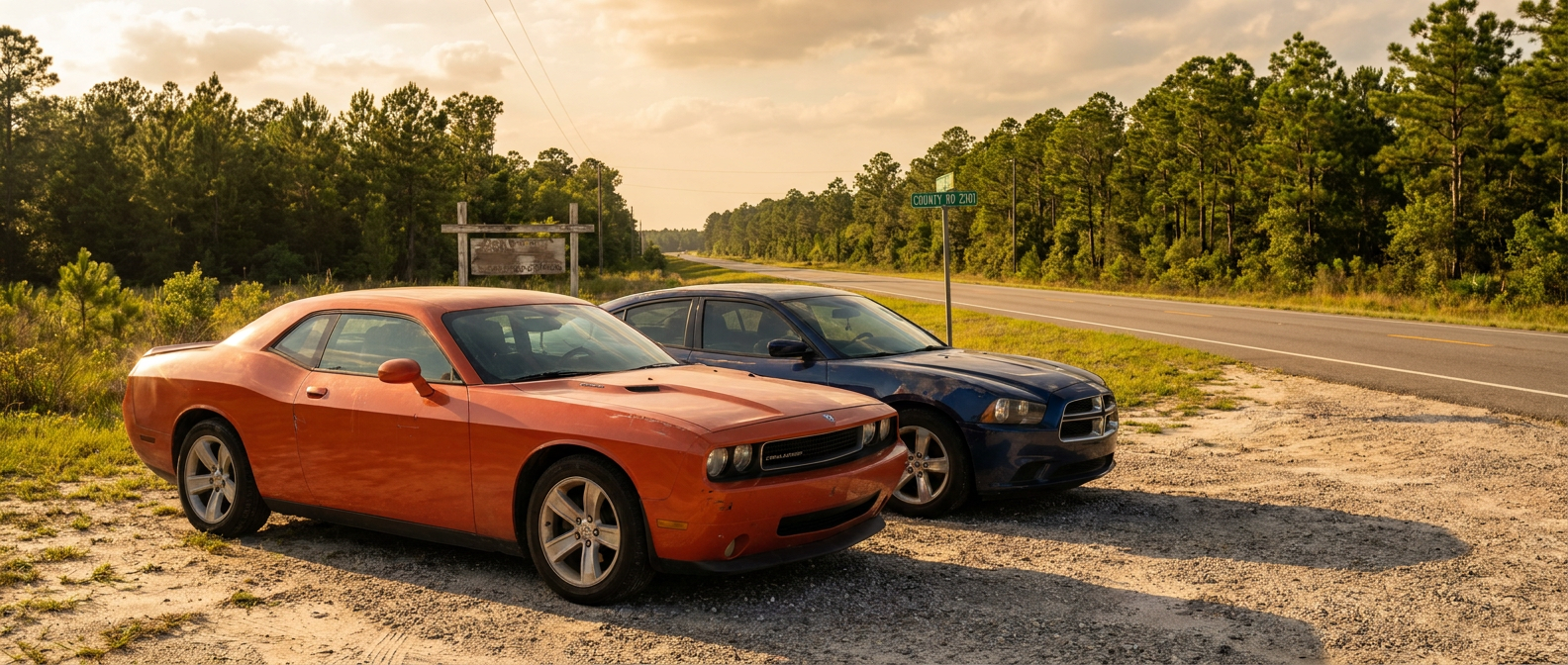
Both cars are gone from new-car lots now. Production on the gas-powered Dodge Challenger and Dodge Charger ended in December 2023, so every one you'll find today is a used car, and that shifts how you ought to approach this choice. The short version is simple. If you're making a daily run down US-231 from Youngstown or Fountain into Panama City with anyone in the back seat, buy the Charger. If you drive alone or with one other person and want the pure coupe experience, buy the Challenger. Everything else is detail.
Browse used Challengers on our lot
The Do-or-Don't Table: Which Car Matches Your Life
| Your situation | Go Challenger | Go Charger |
|---|---|---|
| Daily passengers in the back seat | No | Yes |
| Need AWD for wet Panhandle weather | Harder to find | Easier. AWD was a V6 option |
| Want a 6-speed manual option | Yes (select trims) | No. Automatic only |
| Rear-seat legroom matters | No. Tight | Yes. 7 extra inches vs Challenger |
| Car-seat or LATCH anchor count matters | No. 2 anchors | Yes. 3 lower LATCH anchors |
| You want the widest stance and coupe look | Yes | No |
| Primary driver + one front passenger | Either works | Either works |
The Charger's four-door sedan body sits on a stretched version of the same platform as the Challenger, so it picked up roughly seven inches of rear legroom along the way. Dodge also gave it three sets of lower LATCH anchors where most sedans stop at two. Call that a real family difference, not a marketing one.
Body Style Is the One Technique That Matters Most
Body style is the single decision that should drive this purchase, because both cars share almost everything else under the skin, and once you've matched the shape to how you actually live, the rest sorts itself out. Pick for the life you live, not the life you imagine.
Here's how the engines break down:
- Both cars shared the same lineup, from the 3.6-liter Pentastar V6 (303 hp in the Challenger, 292-300 hp in the Charger) up through the supercharged 6.2-liter HEMI V8 in Hellcat trim (717 hp in both).
- In a straight line on US-231, you won't feel much between comparable trims.
- Performance isn't the tiebreaker here. Body style is.
A used Charger R/T with the 5.7-liter HEMI V8 makes 370 hp. A Challenger R/T makes 375 hp from the same engine.
See used Chargers available at Bay Cars
The Challenger's rear seat is tight. Two adults back there on a long stretch of highway is uncomfortable, and the steeply raked rear glass limits rearward visibility in ways you notice right away. The Charger's rear cabin is actually roomy. Adults fit, car seats fit, and getting in and out through four doors is just easier, especially with a car seat. For buyers commuting from Youngstown or Fountain into town daily, that practical difference adds up fast.
All-wheel drive tilts toward the Charger too. Dodge offered AWD on V6-powered Chargers, which genuinely helps on slick Panhandle pavement after a summer rainstorm. The Challenger's AWD availability was narrower and harder to find in used inventory.
Search all pre-owned inventory at Bay Cars
Get Pre-Approved for Financing
The One Honest Tradeoff, Then You're Done
The Challenger earns the nod if you're a one-or-two-person household chasing the coupe silhouette, the available manual transmission, and that wider, lower stance, and the real cost you accept in return is two doors, a tighter back seat, and rearward visibility that takes some getting used to. It's a distinctly different ownership feel.
Go Charger and you get the same power with four doors and no compromises for passengers. The tradeoff is that it doesn't feel like a coupe. If the coupe shape matters to you, the Charger won't scratch that itch.
So which buyer are you? Answer that and you're done, because neither pick is wrong. They're built for different people, and knowing which one you are saves you from regretting the purchase six months later on the drive up Highway 231.