
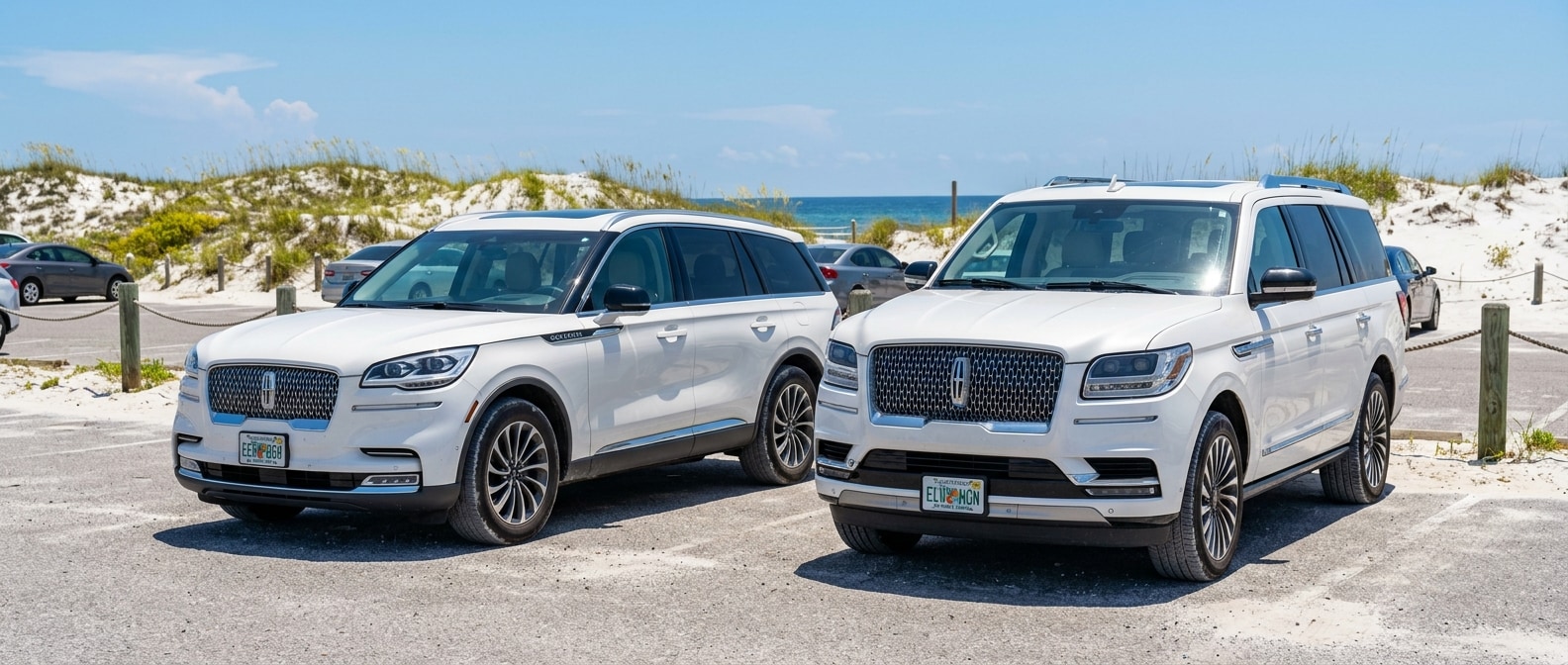
Both are truly luxurious Lincoln SUVs, and if you're shopping used, both represent serious value. But they're not interchangeable. The Navigator is a full-size people-mover built for big families and big boats, while the Aviator is a midsize that's easier to live with daily. Find a used Grand Touring trim and it brings a plug-in hybrid powertrain that nothing in the Navigator's lineup can match.
- The Navigator wins on raw space: third-row legroom of 40.9 inches means adults actually fit; the Aviator's 29.2 inches is a kids-only zone.
- The Aviator wins on maneuverability: at roughly 16.6 feet long vs. the Navigator's 17.5 feet, it's meaningfully easier in tight 30A beach-access lots.
- Towing: Navigator by a mile. Up to 8,700 lbs vs. the Aviator's 5,000 lbs standard. If you're pulling a center console to St. Andrews State Park, that gap matters.
- Used PHEV Aviators are a sleeper deal: Grand Touring trims from 2020-2024 carry a 494-hp plug-in hybrid rated at around 56 MPGe. No Navigator equivalent exists.
- Bottom line: families who regularly seat six or seven adults buy the Navigator. Couples, smaller families, and daily commuters who visit 30A on weekends buy the Aviator.
If you're weighing a used Lincoln Navigator against something smaller and easier to park, read on. We've sold both out of Panama City, and the decision tends to come down to one thing. How you actually use that third row.
What's the Real Difference Between These Two Lincolns?
Both Lincolns share a family resemblance and plenty of DNA, so on a spec sheet they look like cousins, but the size gap in person runs larger than the photos suggest, and that gap shapes everything from third-row comfort to how the SUV behaves in a packed beach lot.
| Spec | Lincoln Aviator (2020-2025) | Lincoln Navigator (2020-2025) |
|---|---|---|
| Engine | 3.0L Twin-Turbo V6 | 3.5L Twin-Turbo V6 |
| Horsepower | 400 hp | 440 hp |
| Torque | 415 lb-ft | 510 lb-ft |
| EPA MPG (AWD/4WD) | 17-18 city / 24-26 hwy | 15-16 city / 22 hwy |
| Towing Capacity | Up to 5,000 lb (gas) | Up to 8,700 lb |
| Seating | Up to 7 | Up to 8 |
| Third-Row Legroom | 29.2 in | 40.9 in |
| Max Cargo (seats folded) | 77.7 cu ft | 107.0 cu ft |
| Overall Length | ~199.7 in (16.6 ft) | ~210 in (17.5 ft) |
| PHEV Option | Yes (Grand Touring, 2020-2024) | No |
Under the hood, the Navigator runs Lincoln's 3.5-liter twin-turbo V6 making 440 horsepower and 510 lb-ft of torque, while the Aviator's 3.0-liter version produces 400 horsepower and 415 lb-ft. Both bolt to a 10-speed automatic. Around Panama City you won't feel that 40-hp gap in daily driving. You'll feel it at highway speed on I-10 with a loaded trailer, and you'll feel it in your fuel receipts. The EPA rates the Navigator at 15 city and 22 highway, and the Aviator's AWD models come in around 17-18 city and 24-26 highway depending on the year.
Does the Third-Row Legroom Actually Matter for Bay County Families?
Yes, it matters, and for a lot of households it decides the whole thing more than any price difference does, because a third row that fits adults versus one that only fits small kids changes who can ride along on a weekend run to the coast.
One thing worth keeping in mind at Bay Cars. Younger kids grow faster than a cramped row three forgives, and it's easy to underestimate that when the kids are still small. A 29.2-inch third row in the Aviator is fine for an eight-year-old. It falls short for a teenager, and it falls short for a second adult couple on the drive out to a used Lincoln Aviator-sized adventure toward 30A.
By comparison, the Navigator's 40.9 inches of third-row legroom is, for a full-size SUV, genuinely adult-friendly. Lincoln also builds a Navigator L with an extended wheelbase that stretches overall length to nearly 222 inches. If you're hauling a big crew and have the driveway for it, the L is worth a look on the used market. Even the standard-wheelbase Navigator gives row-three adults room to uncross their legs.
The caveat is real. That extra size costs you at the pump and in the parking lot. The EPA's numbers are what they are. Factor in real Gulf Coast summer heat with the A/C running hard, and the Navigator's combined figure of 17 MPG is the realistic baseline. Neither SUV is economical, but the Aviator is the better choice if fuel economy is really part of the math.
Parking on 30A: The Navigator's Biggest Real-World Challenge
On paper the Navigator's footprint looks manageable, but parking it on 30A is where the full-size dimensions turn from a number into a daily hassle, especially in summer when the beach-access lots fill early and the spaces were never drawn for a 17.5-foot SUV.
Scenic Highway 30A runs as a two-lane road hugging the Gulf, and many of its beach access points have small lots. Places like the Ed Walline Regional Beach Access near Santa Rosa Beach carry roughly 39 spaces, and the Blue Mountain access runs about 20. Drop a 17.5-foot Navigator into a packed lot alongside other SUVs, especially in summer when Panhandle beach traffic peaks, and you've got a real test of patience. You'll find spots, but you'll earn them.
The Aviator, at about 16.6 feet, isn't compact. But those 10 inches of difference show up constantly in real driving.
Those inches turn into tighter turns, easier backing into a diagonal spot, and less stress when a lifted truck parks two inches off your driver-side mirror. If your weekends regularly involve driving over from Panama City toward the 30A corridor for beach days, that matters.
The Aviator Grand Touring PHEV: A Used-Market Wild Card
A used-market angle worth putting on the table here is the plug-in hybrid, which rarely shows up in a Navigator-versus-Aviator comparison yet shifts the efficiency picture enough that it earns its own section for anyone shopping the 2020 to 2024 model years right now.
Lincoln offered the Aviator Grand Touring as a plug-in hybrid from 2020 through the 2024 model year. That powertrain pairs the 3.0-liter V6 with an electric motor for a combined output of 494 horsepower and 630 lb-ft of torque. More power than the Navigator. EPA ratings on those models run around 56 MPGe in electric mode, with roughly 21 miles of all-electric range before the gas engine takes over. A used 2022 or 2023 Grand Touring bought here in Bay County lets you run most of your Panama City-area errands on electricity and still have a full V6 for highway drives.
The Navigator has never offered a hybrid option. If fuel cost is a real factor in your decision, a used Aviator Grand Touring flips the efficiency math and lands squarely in the Aviator's favor.
Check the battery health before you commit to a used Grand Touring. The PHEV battery and related systems add complexity, so ask how it's been maintained and whether it's still holding meaningful charge. That's a real consideration for any used PHEV, not an Aviator-specific knock.
So Which Lincoln Should You Pick?
Pick the Navigator when your week regularly includes six or seven people who expect real comfort (adults in row three included), when you tow a boat to St. Andrews State Park or haul anything over 5,000 pounds, or when the bigger-is-better statement genuinely fits your life.
Pick the Aviator when your family fills two rows and row three is occasional overflow, when you value easier daily parking and slightly better fuel economy, or when you can find a used Grand Touring PHEV that fits your budget and adds real-world EV range for everyday driving.
We carry both at Bay Cars, and we've seen this decision go both directions. When a Navigator buyer second-guesses the choice, it tends to trace back to how often it lands in a tight parking spot. When an Aviator buyer does, it tends to trace back to kids who outgrew row three. Neither is a wrong choice. They're just different tools.
Check our current vehicle specials to see what's available in both nameplates right now.
Frequently Asked Questions
Is the Lincoln Navigator too big for everyday driving near Panama City?
It comes down to where you park. The Navigator's overall length of approximately 210 inches (17.5 feet) is manageable on Panama City streets and US-98, though tight parking at some 30A beach access lots (many with fewer than 40 spaces) can be a genuine inconvenience. If your daily routine runs through crowded lots or narrow streets, the Aviator's roughly 16.6-foot length is the easier call. If you're mostly moving between a home garage, work, and open-lot destinations, the Navigator's size matters a lot less.
Can a used Lincoln Aviator tow a boat for Gulf Coast use?
Yes, within a limit. The standard gas Aviator is rated to tow up to 5,000 pounds with the proper tow package, which covers a lot of the smaller fishing boats and center consoles common around Bay County. The Aviator Grand Touring PHEV is actually rated slightly lower at 5,000 pounds on some year configurations, so verify the tow rating on any specific vehicle. The Navigator, by contrast, is rated for up to 8,700 pounds with a tow package, a meaningfully different capability if you're moving a larger vessel.