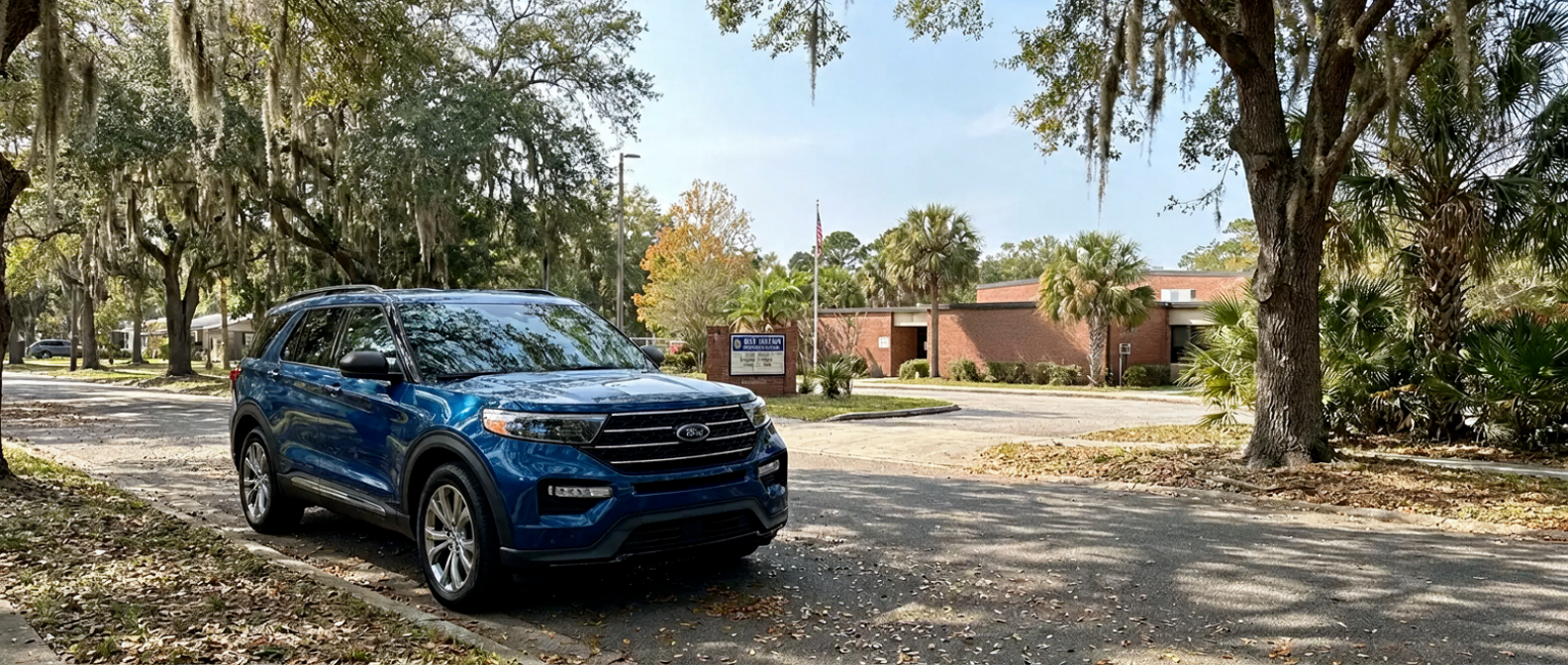
For most Panama City families grinding through the daily school pickup, the Ford Explorer is the right call. The Expedition fits a specific buyer. We'll be straight about who.
- The Explorer is about 11 inches shorter and nearly 9 inches lower than the Expedition, which matters a lot in tight school-zone traffic and older neighborhood streets.
- Both seat up to seven (Explorer) or eight (Expedition), but the Explorer's third row is honestly best for kids, not adults.
- The Explorer's EPA-estimated fuel economy is 20 city / 29 highway (RWD) versus the Expedition's 17 city / 23 highway, a real daily-cost difference on Bay County commutes.
- The Expedition wins on towing and cargo if you're regularly pulling a heavy boat trailer or hauling a crew of eight with gear.
- For the majority of Panama City families doing school runs, US-98 commutes, and weekend beach trips, the Explorer hits the sweet spot between practicality and size.
What's the Real Difference Between These Two Fords?
Both are three-row Fords that split right at the foundation, with the 2026 Explorer arriving as a midsize, unibody crossover on a car-derived platform and the 2026 Expedition built as a full-size, body-on-frame SUV the same way Ford builds its trucks. The structure shapes everything downstream, from how they ride and park to how much fuel they burn and whether they clear a parking-garage ceiling without a second glance.
Compare the specs that move the needle for a Bay County family in the table below.
| Spec | 2026 Ford Explorer | 2026 Ford Expedition |
|---|---|---|
| Length | 198.8 in | 209.9 in |
| Height | 69.6 in | 78.1 in |
| Max seating | 7 passengers | 8 passengers |
| Engine | 2.3L EcoBoost 4-cyl, 300 hp | 3.5L EcoBoost V6, 400 hp |
| EPA MPG (city/hwy) | 20 / 29 (RWD) | 17 / 23 (RWD) |
| Cargo behind row 3 | 16.3 cu ft | 21.6 cu ft |
| Max cargo (all rows flat) | 85.8 cu ft | 108.5 cu ft |
| Max towing (properly equipped) | 5,000 lbs | Up to 9,600 lbs (4x4, HD pkg) |
| Parking-garage clearance | Clears easily at 69.6 in | Tight at 78.1 in |
Ford lists these specs on their official site for each 2026 model, and the EPA fuel-economy figures are published on fueleconomy.gov.
Does Size Actually Matter for the School-Pickup Run?
Yes, size matters here, and not the way the spec sheet makes it look, because the dense older grid around the school rewards the shorter vehicle every afternoon, and the Expedition's length only earns its keep out on the open road. Jinks Middle School sits at 600 W. 11th St. in Panama City.
At 198.8 inches long, the Explorer fits into standard parking spaces and handles a U-turn on a side street the way you'd expect a car-derived crossover to handle it. The Expedition, at 209.9 inches, is nearly a foot longer with a considerably taller profile. The 11-inch gap is real money when you're threading through a line of waiting parents, pulling into a spot on a narrow street, or backing out of a shared driveway.
Walk around both on our lot and that gap lands differently than it does on paper. The Explorer doesn't feel small. It seats six or seven, carries 16.3 cubic feet of cargo with all three rows up, and expands to 85.8 cubic feet when you fold the back rows. It's just not a bus.
The Ford Expedition we carry is a genuine full-size, truck-based SUV, and it earns its keep. It just earns it on the water or on I-10 with a loaded trailer, not necessarily on West 11th Street at 3:15 in the afternoon.
See What Your Current Vehicle Is Worth
Which Ford Has More Room for a Growing Family?
Our pre-owned inventory carries both, so we're not playing favorites here, and the straight answer on space is that the Expedition has more of everything in raw numbers while the Explorer still holds plenty for the way a normal school, grocery, and beach week fills a cargo area.
The Expedition's third row has 2.1 inches more rear legroom than the Explorer's (41.1 inches vs. about 39 inches), and that difference shows up for adult passengers on a longer Gulf Coast road trip.
The Explorer's third row works for school-age kids. It gets tight for adults.
On cargo, the Expedition carries 21.6 cubic feet behind its third row versus the Explorer's 16.3. Fold everything flat and the Expedition opens to 108.5 cubic feet; the Explorer reaches 85.8 cubic feet. Neither is a van, but the Expedition offers more room when you need it.
The tradeoff for that extra space shows up at the pump, where the Expedition's EPA-estimated city economy drops to 17 mpg against the Explorer's 20 mpg. On a daily Bay County commute, the Explorer's 2.3L EcoBoost four-cylinder simply uses less fuel than the Expedition's 3.5L V6.
Gulf Coast Hauling: Towing and Weekend Capability
Towing is where the Expedition makes its clearest case, and if you're regularly hauling a boat to St. Andrews State Park or running a 22-foot center console down US-98 to a Gulf-side launch, capacity moves from a spec-sheet footnote to a genuine decision factor, though for lighter loads the Explorer closes most of that gap.
Properly equipped, the 2026 Explorer tows up to 5,000 pounds, enough for a small fishing boat, a personal watercraft trailer, or a lightweight camper without issue.
The 2026 Expedition sits in a different towing category, and when it's equipped with the Heavy-Duty Trailer Tow Package and 4x4 drivetrain, it reaches up to 9,600 pounds. A twin-axle pontoon boat or a mid-size travel trailer lives right in that range. If that's your life on weekends, the Expedition is the correct tool.
Do you own, or plan to own, a boat or trailer that pushes past 5,000 pounds? Be straight with yourself, because if the answer is yes the Expedition deserves serious consideration, and if you're realistically towing a jet ski or a small bass boat, the Explorer handles it and stays easier to live with the other six days of the week.
So Which Ford Should You Pick?
Buyer profile decides this one, and we'd rather be useful than tell you both vehicles are great, so the short version is that the Explorer fits the everyday Panama City family while the Expedition fits the household that tows big or regularly seats a true crowd.
Pick the Explorer if: You have two to three kids (especially middle-school age or younger), your garage was built before 1990, you care about fuel costs on daily Bay County driving, and you don't routinely pull trailers over 5,000 pounds. The Explorer seats the family, carries beach gear and soccer bags, and doesn't require a three-point turn on every residential street. For the typical Panama City household doing the actual school-pickup-to-beach-run daily loop, it's the practical, right-sized choice.
Pick the Expedition if: You routinely haul a large boat or travel trailer, you need adult-comfortable third-row seating for actual adults on regular trips, or you frequently carry seven or eight passengers with gear on longer runs. The Expedition is a better vehicle in those specific scenarios. But it's a harder vehicle to justify for standard Panama City daily family life when the Explorer covers the bases so well.
Our financing team can walk you through used options on both. No pressure, no pitch. We'll put you in the one that actually makes sense for your driveway.
Frequently Asked Questions
Is the Ford Explorer big enough for a family of five or six?
Yes. The 2026 Explorer seats six with the available second-row captain's chairs or seven with a second-row bench seat. Ford lists 150.3 cubic feet of passenger volume and 16.3 cubic feet of cargo space with all three rows in use, which is workable for a family carrying everyday gear. The third row is better suited to children than adults for longer trips.
Does the Ford Expedition fit in a standard garage?
The standard 2026 Expedition is 209.9 inches long, which fits in a standard 20-foot garage bay. However, its height of 78.1 inches puts it close to the typical 6-foot-10-inch parking-garage clearance limit. The Explorer, at 198.8 inches long and 69.6 inches tall, clears both comfortably. If your home garage or a nearby parking structure has a low ceiling, this is worth measuring before you buy.