
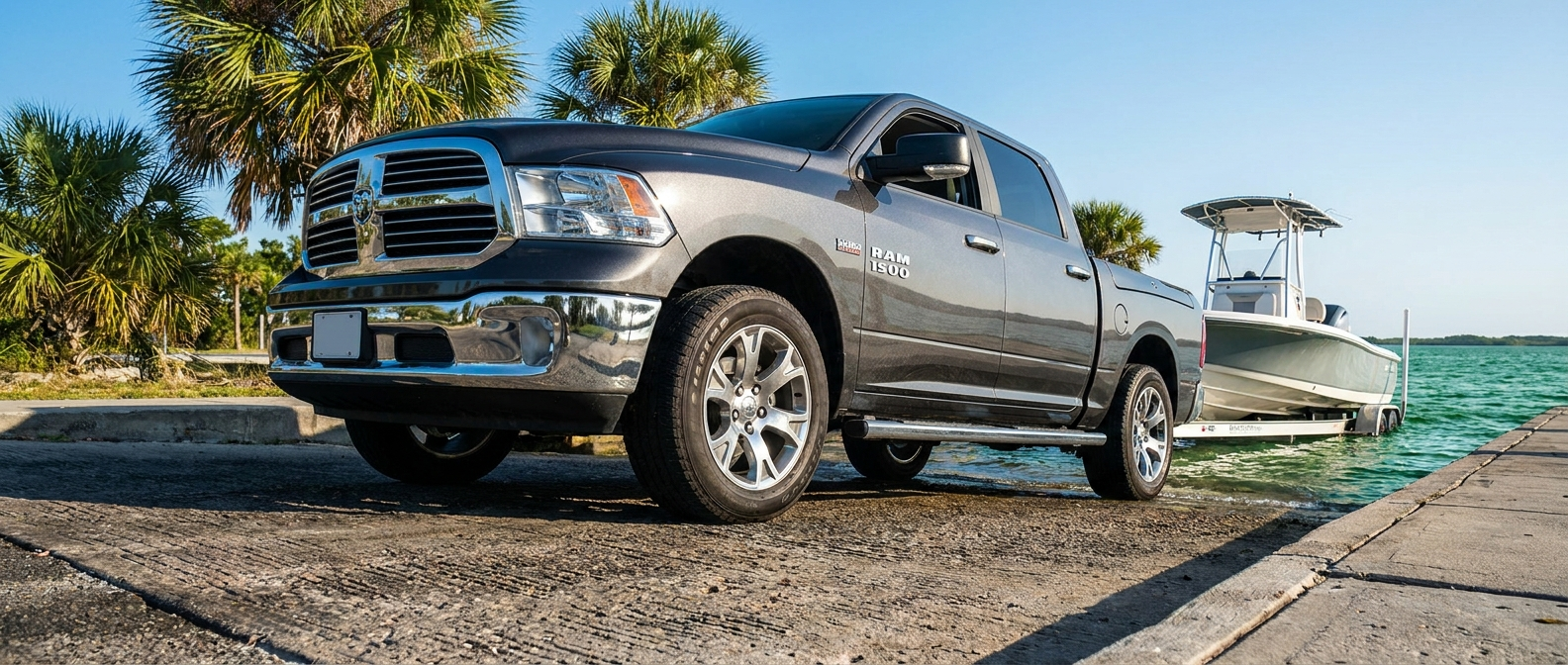
When the fifth-generation Ram 1500 (2019-2023) arrived, it brought something no other half-ton pickup offered at the time. You got a four-corner air suspension option built on top of a standard five-link coil-spring rear setup. Every other full-size truck in its class still ran leaf springs out back. That difference isn't just a ride-quality footnote. It shows up on ramp approaches, on US-98's patched pavement, and anywhere you're hauling weight across Bay County's Gulf Coast roads. As Stellantis noted in the 2019 engineering press release, that five-link coil design "provides better articulation over obstacles than a leaf spring system." Back a boat trailer down the concrete ramp at St. Andrews State Park before sunrise, and that matters.
Browse used Ram 1500 trucks on our lot to see what's currently available. Here's what our team looks at when we're walking one of these trucks with a buyer.
What Do the Specs Actually Mean for a Panhandle Buyer?
The numbers do look impressive on paper, and a properly equipped Ram 1500 can tow up to 12,750 lbs, but "properly equipped" is carrying a lot of weight in that sentence, so a used buyer needs to know exactly what configuration gets you there versus what's realistic on a typical pre-owned lot.
| Spec | Engine / Config | Verified Figure |
|---|---|---|
| Max towing | 5.7L HEMI V8 w/ eTorque, Quad Cab 4x2, Max Trailering Pkg | 12,750 lbs |
| HEMI V8 (no eTorque) towing | 5.7L HEMI V8, standard | 11,610 lbs |
| V6 eTorque towing | 3.6L Pentastar V6 w/ eTorque | 7,730 lbs |
| V6 mpg (EPA, 4x2) | 3.6L Pentastar V6 w/ eTorque | 20 city / 25 hwy |
| HEMI V8 mpg (EPA, 4x2) | 5.7L HEMI V8 (no eTorque) | 15 city / 22 hwy |
| HEMI V8 eTorque mpg (EPA, 4x2) | 5.7L HEMI V8 w/ eTorque | 17 city / 23 hwy |
| EcoDiesel mpg (EPA, 4x2, 2023) | 3.0L EcoDiesel V6 | 21 city / 29 hwy |
| Payload (V6 eTorque, max) | 3.6L Pentastar V6 w/ eTorque | up to 2,300 lbs |
| Ground clearance (standard, 4x4) | 2020-2022 DT 4x4 | up to 8.2 in |
| Suspension type (2019-2023) | All DT-gen Ram 1500 | Five-link coil-spring rear, standard |
What does this mean in practice? A bay boat and trailer running under 7,000 lbs combined gross weight sits well within reach of the V6 eTorque. You don't need the HEMI to tow a 22-foot bay boat to the St. Andrews State Park ramp on Grand Lagoon. But pull something heavier, a larger center console or a sport-fish rig over 9,000 lbs, and the HEMI with Max Trailering Package is where you want to be. The V6 is genuinely good in this market. The HEMI is for the heavy rigs.
The Coil-Spring Ride Advantage Isn't Just Comfort
The coil-spring rear is easy to dismiss as a brochure line, but it earns its keep the moment you load the bed or drop a trailer on the hitch, because the ride stays composed instead of harsh, and that's a difference you feel on Bay County roads, not just a line on a spec sheet.
Every Ram 1500 in the 2019-2023 DT generation runs a five-link coil-spring arrangement out back (coil-over up front) as standard equipment. Every Ford F-150 and Chevy Silverado 1500 in this same window runs leaf springs in the rear. The coil design does a specific thing. It lets the spring compress progressively, softer when unladen and firmer under load. Autoblog's 2020 suspension deep-dive noted the 2020 Ram 1500 "represents a dozen years since coil spring rear suspension debuted" in this segment, and no competitor had matched it. Leaf springs are stiff by design because they carry the load AND damp the ride through the same strip of steel. Coil springs have one job, which is to spring. The damping goes to a separate shock, tuned independently.
On Bay County roads, this translates into two real things. St. Andrews State Park sits in Bay County. First, the empty-truck ride on US-98 is noticeably more composed than a leaf-spring half-ton with nothing in the bed. Second, load the bed with gear for a weekend at St. Andrews, or add tongue weight from a trailer, and the progressive-rate spring tightens up rather than flopping around. This won't drive like a sports car. But it skips the punishing empty-bed bounce you get from a traditional leaf setup.
What's the tradeoff? Coil springs add parts complexity compared to leaf springs. If a coil or link wears out, it's costlier to replace than a leaf pack. That part is real. It's worth asking for a suspension inspection on any used DT Ram 1500 before you buy, and worth knowing why we check that specific system when one comes through.
Get an Estimate on Your Current Truck
Which Model Years Are the Sweet Spots (and Which Need a Second Look)?
Not every 2019-2023 Ram 1500 is an equal buy on the used lot, and the gap between the best years and the trickiest ones is wide enough to matter, so here's the breakdown our team leans on when we're sorting the clean trucks from the ones that need a closer look.
2019-2020: Capable, but inspect the exhaust manifold. The 5.7L HEMI V8 in these early DT years has a documented exhaust manifold bolt issue. A cast-iron manifold meets an aluminum head and a steel block, and the thermal cycling causes bolts to crack or shear. NHTSA records show the 2019 Ram 1500 accumulated 28 recalls across its production run. The 2020 model accumulated 13. Owner reports consistently surface exhaust manifold cracking as a recurring complaint across both years. A pre-purchase inspection that checks the manifold flanges and listens for a ticking exhaust warm-up sound is worth doing on these years. That said, a clean example with the repair already done is just a well-sorted truck.
2021: The sweet spot if you want HEMI and want to save. The 2021 carries the same engine lineup as 2020 but has had more time for early-build issues to surface and get addressed. It also sits squarely in the used-value window now. Still check the manifold on the 5.7L.
2022-2023: The cleanest used bets in this generation. Consumer Reports' subscriber reliability survey rated the 2023 Ram 1500 as "much more reliable than other cars from the same model year", a meaningful improvement from the 2019 and 2020 ratings. The 2023 carries 10 NHTSA recalls, down from 28 on the 2019. If budget allows, the 2022-2023 range gives you the full DT-generation feature set (including the optional 12-inch Uconnect screen) with a cleaner reliability picture. The EcoDiesel (3.0L V6, 2020-2023) is worth serious consideration for a Panhandle buyer who logs real highway miles. The EPA rates the 2023 EcoDiesel 4x2 at 21 city and 29 highway. That's diesel fuel economy in a half-ton body that still tows up to 9,600 lbs.
What about the Ram 1500 Classic? The Ram 1500 Classic ran alongside the DT generation as a separate, lower-cost trim based on the older DS platform. It doesn't have coil-spring rear suspension. It's a simpler, more affordable truck. If ride quality and the coil-spring towing refinement matter to you, the DT-gen Ram 1500 is the one.
Who Actually Fits This Truck in Bay County?
The Ram 1500 earns its place for a wide slice of the Panhandle market, though it isn't the right answer for everyone, and the line between a great fit and the wrong truck comes down to how much weight you pull and how often you pull it.
It fits you well if: You tow a bay boat, a flats skiff, or a mid-size trailer to the St. Andrews State Park ramp or the Grand Lagoon area on a regular basis. You want a daily driver that doesn't punish you on empty Panhandle roads. You haul gear, tools, or supplies but your loads stay under about 1,900 lbs in the bed. You want the option of a quieter, more car-like cabin when you're not working the truck hard.
It's the wrong call if: You're pulling something that pushes you over 10,000 lbs gross trailer weight on a routine basis. For that, we'd point you toward a used Ram 2500, a purpose-built heavy hauler with the frame and axles to match. The Ram 1500 is a capable half-ton, and it isn't a heavy-duty truck pretending otherwise.
The fuel cost tradeoff is real. The 5.7L HEMI V8 at 15 city / 22 highway makes for a noticeable fuel bill on a commute-heavy schedule. The V6 eTorque (20 city / 25 highway per EPA) is a legitimate choice if your towing needs stay under 7,730 lbs and you want to keep fuel costs reasonable. The EcoDiesel lands between the two on tow rating but leans toward the V6 on fuel economy while adding torque. That "choose the biggest engine" reflex doesn't really apply here anymore.
If you're still deciding between this segment and something with more passenger space, our full pre-owned inventory includes other trucks and SUVs worth comparing. And if you've got a trade, our team can take a look before you commit to anything.
Frequently Asked Questions
Is the Ram 1500 good for towing a boat in the Panama City Beach area?
Yes, with the right configuration. A Ram 1500 equipped with the 5.7L HEMI V8 and the Max Trailering Package tows up to 12,750 lbs, and even the base 3.6L V6 with eTorque handles 7,730 lbs. Most bay boats and mid-size trailers used at area ramps like the one at St. Andrews State Park fall well within the V6's range. The specific tow rating for your truck is on the door-jamb sticker, and that number, not the brochure ceiling. Is the one to match against your trailer's actual loaded weight.
Which used Ram 1500 year should I buy to avoid problems?
The 2022 and 2023 model years are the safest bets in the DT generation for a used buyer. Consumer Reports' subscriber reliability data rated the 2023 Ram 1500 "much more reliable than other cars from the same model year," and NHTSA recall counts drop from 28 on the 2019 to 10 on the 2023. The 2019 and 2020 5.7L HEMI V8 variants have a documented exhaust manifold bolt issue worth inspecting before you buy. A clean 2021 is also a solid value if the early-build issues have already been addressed.