
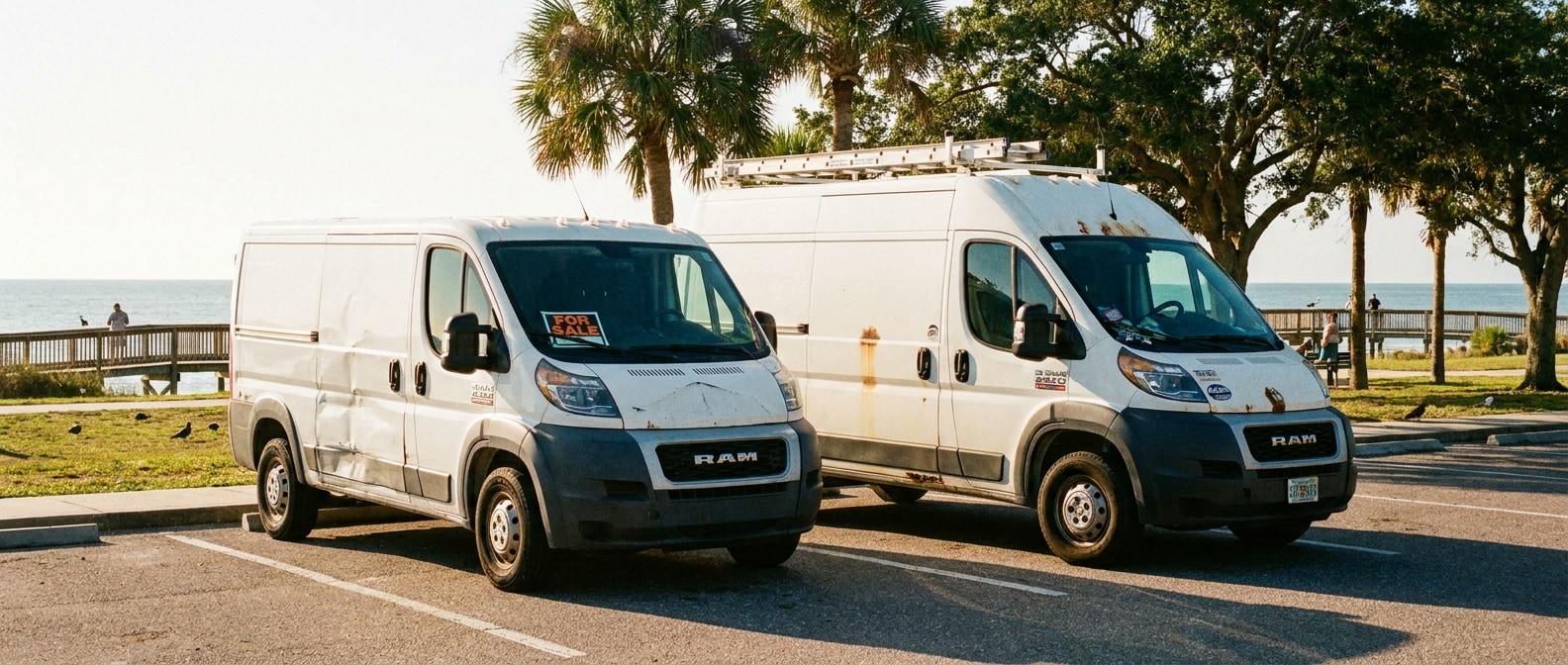
The short answer is honest enough. The ProMaster 1500 and 2500 are the same basic van with different payload envelopes, and for most Bay County small businesses the 1500 is enough. But if you need the high-roof, long-wheelbase box (think plumbers, HVAC techs, or caterers loading event gear for a Carl Gray Park tournament weekend), the 2500 is the only way to get there. Model year matters more than trim on a used buy, and right now there's an active federal recall covering every ProMaster built from 2022 through 2026 that you need to know about before you hand over a check.
Browse used ProMaster 1500 vans on our lot or explore the ProMaster 2500 inventory. Either way, read this guide first so you know exactly what you're looking at.
- Sweet-spot years: 2018-2020. Lowest recall counts in the used-market window, solid reliability data, and enough depreciation to represent real value.
- Years to watch carefully: 2014-2017. The first four model years carried 12-16 recalls each, concentrated in powertrain, electrical, and brake systems. A pre-purchase inspection is non-negotiable here.
- Active recall right now: 2022-2026 ProMasters (all variants). NHTSA issued recall 26V621 on September 29, 2026. Water intrusion into the electric power steering wiring harness can disable steering assist. Check the VIN on any van built in those years before you buy.
- 1500 vs 2500: Same engine, same drivetrain, same body. Different GVWR and payload ceiling. The 2500 is the only one that offers the 159-inch wheelbase with a high roof and up to 420 cubic feet of cargo space.
- 2021 had the most owner complaints of any post-2017 year (67 NHTSA complaints, 4 recalls). It's not the worst van on the market, but it's the prickliest year in that otherwise solid 2018-2022 band.
Which model years are the sweet spot for a used ProMaster?
For most Bay County buyers, we'd steer you toward the 2018, 2019, and 2020 model years, since Ram had ironed out the early-generation bugs by then and complaints were running in the low-to-mid twenties per NHTSA data, though you'll still want service records and a confirmed recall history before you commit. Those three years have been through enough real-world fleet use that the patterns on what holds up are well established.
| Model Year | NHTSA Complaints (approx.) | Recalls on Record | Sweet Spot? | Notes |
|---|---|---|---|---|
| 2014 | 57 | 4+ | Avoid | First model year; powertrain and electrical roll-out issues |
| 2015 | High | 13+ | Avoid | Highest recall count in the generation; brake module, electrical |
| 2016 | Elevated | ~10+ | Caution | EcoDiesel option years (2014-2016) add complexity; avoid diesel |
| 2017 | 48 | 4 | Caution | Better than 2015-2016 but still elevated complaint volume |
| 2018 | 26 | 2 | YES | Lowest complaint count in the used-value window; strong buy |
| 2019 | Low | 2 | YES | Solid reliability score, good value vs. mileage tradeoff |
| 2020 | 37 | 2 | YES | Complaints tick up but still within a clean range; excellent value |
| 2021 | 67 | 4 | Caution | Highest complaint count of any post-2017 year; inspect carefully |
| 2022-2026 | Varies | Active recall | Check VIN | Open NHTSA steering recall 26V621. Verify fix status before buying |
One thing the numbers don't tell you is how the payload gap between the 1500 and 2500 shows up in the used market as a size question as much as a weight question. If you want the 159-inch wheelbase with the high roof, you're in 2500 territory. Full stop. That configuration unlocks up to 420 cubic feet of cargo space, according to Ram's published specs. The 1500 maxes out at 304 cubic feet in the 136-inch wheelbase, low-roof version. It's fine for plenty of applications. A 1500 just can't become a 2500 high-roof.
Which years should you watch out for?
Look at ProMaster 2500 listings on our lot for our current inventory, but filter what you're looking at by year, because the vintage matters a lot on this platform.
2014 and 2015: the ones to skip. The ProMaster launched in 2014 as a rebadged Fiat Ducato, and first-year launches rarely go smoothly on a platform that's new to the North American market. NHTSA data shows the 2015 model carrying over 13 recalls covering transmission pump failures, electrical shorts, and brake-related issues. The 2014 has a similar profile. Both can still be running fine at high mileage (owners report that), but a pre-purchase inspection on one of these is a real line item you shouldn't skip.
2016-2017: better, still cautious. These years dropped the notoriously troublesome 3.0L EcoDiesel (which Ram offered 2014-2016). If you find a gas-engine 2016 or 2017, you're in materially better shape than the diesel years. Complaint volumes were still elevated, but the pattern shifted from catastrophic powertrain failures toward more manageable electrical gremlins. Headlight ballast failures showed up repeatedly in owner complaints across this period, not a deal-breaker, but negotiate accordingly.
2021: the outlier in an otherwise clean band. The 2021 can catch you off guard. NHTSA recorded 67 owner complaints on the 2021 ProMaster (the highest of any post-2017 year) and 4 recalls. More than the 2018, 2019, and 2020 combined. The 2021 isn't a lemon by any means, but it's the prickliest year in an otherwise clean stretch. Know what you're buying.
2022-2026: active recall, check the VIN first. For the newest used vans, there's a live recall to clear before anything else. NHTSA issued recall 26V621 on September 29, 2026, covering 265,512 ProMaster vans (1500, 2500, and 3500) built between 2022 and 2026. Water can enter the electric power steering wiring harness and disable power steering assist. Per NHTSA, that increases crash risk. The ProMaster 2500 accounts for 147,204 of those units, the largest share. The ProMaster 1500 accounts for another 44,391.
The fix is a dealer repair handled at no charge to the vehicle owner. But on a used purchase, you need to verify whether the specific VIN has already had the recall performed. Check the VIN at the NHTSA recall lookup tool before you commit to a van from any of those model years.
1500 or 2500: which one actually fits your work?
For a lot of Bay County runs, the 1500 is the right call even though buyers assume the 2500 is automatically "better," because local deliveries, a landscaping setup, or a mobile detailing rig reward the lighter van that's a touch more maneuverable in tight spots and still carries a healthy payload ceiling of up to 4,010 pounds per Ram's published specs. Plenty of capacity for a full tool load.
Browse our full used van inventory to see what's available across both variants right now.
| Your situation | Go with the 1500 | Go with the 2500 |
|---|---|---|
| Local runs, lighter cargo | Yes | Overkill |
| Frequent highway hauls, heavier loads | Possible | Better choice |
| Need High Roof (stand-up work inside) | Only on 136" WB | Available on 136" AND 159" WB |
| Max cargo volume (420 cu ft) | Not available | Yes |
| Tight parking, urban stops | Easier | More to maneuver |
| Planning a plumber or HVAC upfit | Might be tight | Recommended |
| Budget is a factor, value per dollar | Often less expensive used | Slightly higher used |
The tradeoff is worth stating plainly. The 2500 gives you more room and a higher GVWR, but it's a bigger van to park. If you're parking at Carl Gray Park for an event setup, or threading through a Panama City neighborhood between service calls on US-98, the 1500's shorter 118-inch or 136-inch wheelbase is easier to work with day to day. The 2500 earns its keep when you're genuinely filling the box or need to stand up inside to wrench on something.
Get Pre-Approved for Financing
Which year fits which buyer?
Here's how we'd break it down for the Bay County buyer shopping used right now, because the right year depends less on the badge than on your budget and how much model-year risk you're willing to carry against the open recall on the newest vans.
You want the most dependable used ProMaster available: Target a 2018, 2019, or 2020 with service records. Gas engine only. Confirm all recalls have been resolved (run the VIN). At that age and mileage range you're buying a van that's proven itself in real fleet service without the elevated complaint profile of the early years or the active open recall on the newer ones. The 2018 in particular scores well on combined reliability and value data.
You're buying on a tighter budget and will accept more model-year risk: A 2016 or 2017 gas-engine van can be a reasonable buy if the price reflects the risk and you get a proper inspection. Budget for electrical work (headlights, connectors) and confirm the transmission fluid has been serviced. Avoid the diesel variants from 2014-2016 altogether. They add a layer of complexity and parts availability that isn't worth it for most Bay County work schedules.
You want a newer ProMaster (2022-2024 range): Totally workable, but run the VIN through NHTSA's recall lookup and confirm that recall 26V621 (the power steering wiring harness issue) has been completed on that specific van. Don't take a seller's word for it. Get the repair order in writing.
You need the 2500 specifically: The same year guidance applies. The 2018-2020 band is your sweet spot here too. If you need the 159-inch wheelbase high-roof configuration for a full upfit, remember that an upfitted van has an installed weight from the shelving and equipment. NHTSA notes that a fully upfitted ProMaster 2500 can leave you with roughly 2,500 to 2,800 pounds of usable payload for tools and materials depending on the configuration, so plan around that working number instead of the raw maximum.
The ProMaster platform's core engine and drivetrain haven't changed dramatically across its run. Mostly, that's a good thing. It means parts are available, techs in Bay County know the van, and a well-maintained 2018 isn't wildly different under the hood from a 2022. The years to avoid come down to recall density and complaint volume, not fundamental platform flaws, which is why the 2018-2020 window looks so clean by comparison.
Frequently Asked Questions
What is the real difference between a used ProMaster 1500 and a ProMaster 2500?
Both vans share the same 3.6-liter V6 engine, 9-speed automatic transmission, and front-wheel-drive layout. The difference is GVWR (gross vehicle weight rating) and payload capacity. The 1500 carries up to 4,010 pounds of payload and comes in 118-inch or 136-inch wheelbase configurations. The 2500 raises the payload ceiling (up to 4,260-4,480 pounds depending on configuration) and adds a 159-inch wheelbase option with a high roof, opening up to 420 cubic feet of cargo space. If you need to stand up and work inside the van, or need the maximum box, the 2500 is the only path to those configurations.
Is there an active recall on used ProMaster vans I should know about?
Yes. NHTSA issued recall 26V621 on September 29, 2026, covering 265,512 Ram ProMaster 1500, 2500, and 3500 vans built between the 2022 and 2026 model years. Water can enter the electric power steering wiring harness and disable power steering assist. The recall repair is performed at no charge at a Ram dealer, but on a used purchase you need to verify that the specific VIN has already had the repair completed. Run any van from the 2022-2026 model years through the NHTSA recall lookup tool before you finalize a purchase.
Which used ProMaster model years should I avoid in Bay County?
The 2014 and 2015 model years carried the highest recall counts in the generation (13 or more per year) with issues concentrated in powertrain, electrical, and brake systems. The 2021 model year had the most owner complaints of any post-2017 year (67 per NHTSA data), more than the 2018, 2019, and 2020 combined. The 2014-2016 diesel variants are also worth avoiding, the 3.0L EcoDiesel added complexity that outlasted its usefulness for most commercial buyers. Our team's recommendation for a used ProMaster in Bay County: target a gas-engine 2018, 2019, or 2020 with documented service history and confirmed recall completion.