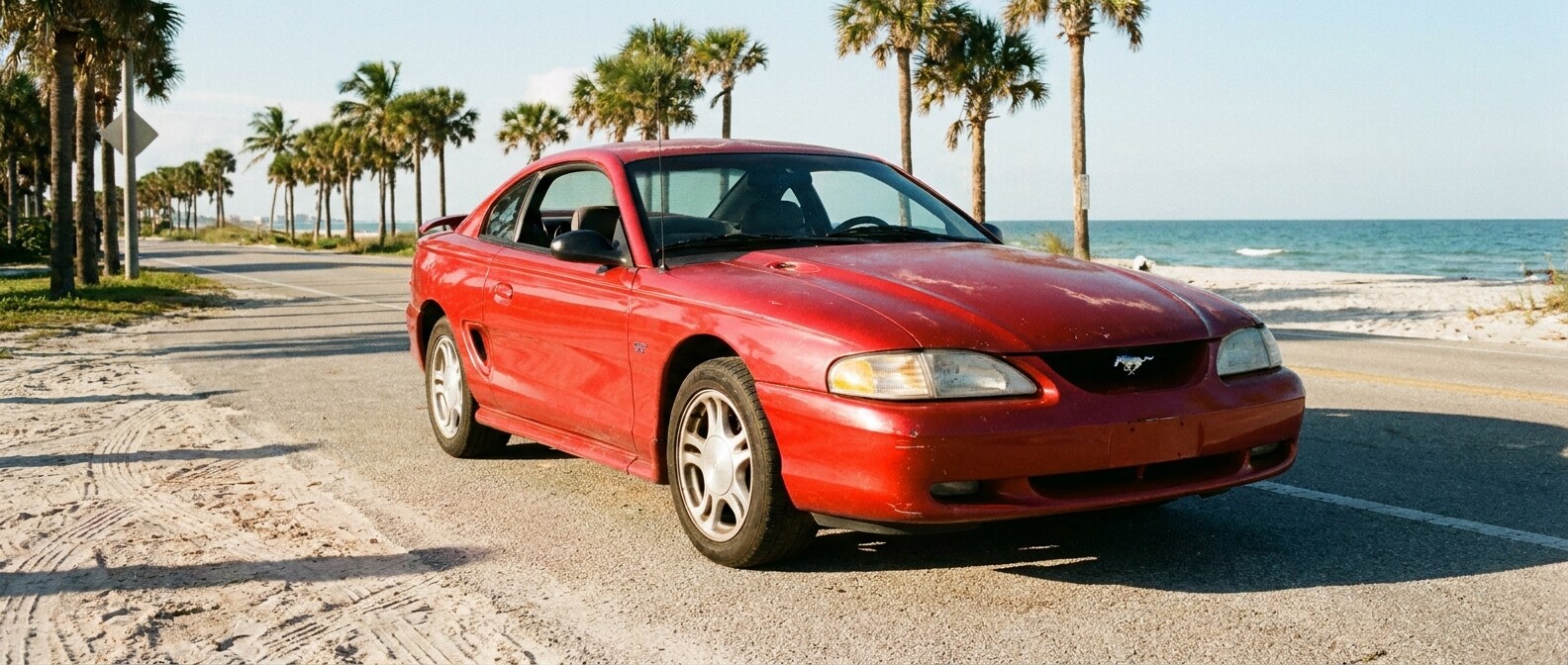
If you're shopping near Fort Walton Beach and Panama City, aim for a 2018 or 2019 Ford Mustang GT with the 5.0-liter V8 and the 10-speed automatic, bought from a seller who can show no open TSBs on the transmission. The EcoBoost four-cylinder is a real car, not a consolation prize, though the V8 is why used Mustangs hold their value the way they do. The 2018-2019 window hands you the refreshed platform without the heavier recall history that trails 2021 and later.
Browse our used Ford Mustang inventory to see what's on the lot right now.
Which Model Years Are Actually Worth Buying Used?
Most of the 2017 through 2019 range is worth buying used, while the bookend years ask for more caution, since the sixth-generation Mustang (S550) ran from 2015 through 2023 and isn't equally reliable from one end to the other. Our team breaks it down like this when a buyer walks in asking where to focus.
| Model Year Range | Reliability Signal | Key Watch Item | Our Take |
|---|---|---|---|
| 2015-2016 | Watch carefully | First-year body/paint complaints, NHTSA fuel tank recall 15V-339 (2015), transmission gripes | Skip unless inspected by a shop you trust |
| 2017 | Solid | Minor electrical TSBs | Good entry point; still uses 6-speed auto |
| 2018-2019 | Sweet spot | 10-speed harsh-shift TSBs. Verify repair history | NHTSA data shows 2018 had the fewest recalls of the generation (4 total) |
| 2020-2021 | Good with caveats | Airbag recall 22V-083 on 2021; brake pedal bracket recall 20V-573 on 2020 | Fine if open recalls are cleared at purchase |
| 2022-2023 | More recalls, more complex | Steering torque sensor recall (NHTSA 24V-493 / 25V-096); 2022 had 9 recalls total per NHTSA data | Not bad cars, just do a full VIN check before signing |
The 2018-2019 window keeps surfacing for a reason. Ford's mid-cycle refresh for 2018 cleaned up the rougher shift calibrations from 2015-2017, updated the interior, and added the 10-speed automatic across both EcoBoost and GT trims. NHTSA data shows the 2018 carries just 4 recall campaigns, the lightest record in the entire S550 generation.
That said, the 10-speed (called the 10R80) has a documented story worth knowing before you buy any post-2017 automatic Mustang. Ford issued multiple Technical Service Bulletins, including TSB 23-2152 and the later TSB 25-2126 (hosted by NHTSA), for harsh engagement, harsh shifts, and delayed shifts on 2018-2021 Mustangs equipped with the 10R80 transmission. The question to ask a seller is simple. Has this transmission ever had TSB service? A yes with paperwork is actually the better answer. A blank stare is the one to worry about.
Search our pre-owned inventory by year and trim
EcoBoost or GT, Which Engine Fits the Way You Drive?
Both engines earn their keep, and which one fits comes down to how you actually drive the US-98 run between Fort Walton Beach and the broader Panhandle, where the EcoBoost rewards a daily commute and the GT rewards the weekend. Each side carries one genuine tradeoff, so neither choice is wrong on its own.
The EPA rates the 2018 EcoBoost at 21 city / 31 highway / 25 combined mpg (with the 6-speed manual) versus the 2018 GT at 15 city / 25 highway / 18 combined. That gap is real on a daily commute. The EcoBoost's 2.3-liter turbocharged four-cylinder makes 310 horsepower and 350 lb-ft of torque in 2018 trim. Those aren't economy-car numbers. The car is genuinely quick.
The GT's 5.0-liter V8 produces 460 horsepower and 420 lb-ft, and the sound, the character, and the community around it all land differently. Used buyers who go EcoBoost first often circle back to the V8 on a second purchase, so it's worth being clear with yourself about which one you really want.
The real tradeoff runs like this. The EcoBoost costs less to feed on the Panhandle's stop-and-go US-98 segments, but it has historically shown more powertrain-adjacent complaints in NHTSA data, partly because the 10-speed was paired with that engine in a wider volume of vehicles.
The GT's 5.0-liter is a simpler, more proven engine by complaint history. The transmission service question matters a bit more on a used automatic EcoBoost from 2018-2020.
Explore financing options at Bay Cars
What Should You Physically Check Before Buying a Used Mustang?
A used Mustang deserves a closer look than a quick walk-around, because these cars draw enthusiastic drivers and that history shows up in the tires, the transmission, and the recall record long before it shows up on the window sticker. Knowing what the previous owner did with it is half the purchase.
Check the history before you check the paint.
- Run the VIN on NHTSA's free recall lookup. The 2019-2023 models in particular have multiple campaigns still open on some units (rearview camera software, body control module, steering sensor). An unrepaired recall is a legal obligation on the seller, and in Florida that's worth asking about directly.
- Check the 10-speed transmission (2018 and later automatics). Cold-start behavior is the tell. Warm it up for 5-10 minutes, then drive. Per Ford TSBs, early-production 10R80 units were the most prone to harsh-shift behavior, and many pre-owned units have never had the TSB service.
- Look at the rear tires. Mustang buyers who enjoyed the launch control and line-lock feature leave evidence. Uneven or accelerated rear wear on a relatively low-mileage car tells you something about how it was driven, usually hard.
- Check the convertible top (if applicable). Florida's UV exposure degrades convertible top material faster than most climates. Creases, bleaching, or delamination at the rear window are common on Gulf Coast cars that spent time outdoors.
- Ask about modifications. A tuned EcoBoost or a cold-air-intake GT isn't automatically a problem, though aftermarket modifications can complicate coverage on remaining recalls and affect long-term reliability. Know what you're buying.
Value your trade-in before you shop
Get Pre-Approved Before You Shop
What About the 2015 and 2016 Models?
The 2015 and 2016 models can still work, and they tend to tempt on price, but the first two years of the S550 generation carry enough documented build issues that they're a cautious buy rather than a confident one. We won't pretend they're terrible cars. Those early years carry documented first-year production issues, from transmission gripes and body panel alignment complaints to paint concerns and an NHTSA fuel tank recall (15V-339) covering certain 2015 EcoBoost models. The 2016 improved on some of those issues but still drew more complaints than the 2017 and later cars. If a 2015 or 2016 is priced right and you've had a trusted mechanic check it out, it can still be a solid buy. Go in knowing what to look for.
Frequently Asked Questions
Is the Ford Mustang EcoBoost a good used buy?
Yes, with the right year. The 2018 and 2019 EcoBoost models are solid picks when you can confirm the 10-speed automatic has had TSB service for harsh-shift issues. The 2.3-liter turbocharged four-cylinder produces 310 horsepower and 350 lb-ft of torque in those model years, and the EPA rates the 2018 manual at 25 mpg combined. The tradeoff is that the EcoBoost lacks the V8 sound and character many Mustang buyers ultimately want.
What used Mustang years should I avoid?
The 2015 model year is the clearest one to approach carefully. It carries an NHTSA fuel tank recall (15V-339), more first-year build complaints than later models, and transmission concerns that Ford addressed in subsequent production. The 2016 improved but still trails the 2017+ cars in complaint volume. Within the 2018-2023 range, the 2022 had the highest recall count in the generation (9 NHTSA campaigns per NHTSA data), so a full VIN check is especially important on that year.
How many miles is too many on a used Mustang?
There is no universal cutoff, but the inspection shifts based on mileage range. Under 60,000 miles, focus on the transmission service history and open recalls. From 60,000 to 100,000 miles, add a check of the clutch or transmission fluid condition, cooling system, and rear differential. Beyond 100,000 miles, the car can still be a great buy, but a pre-purchase inspection by a trusted independent shop is worth every dollar. Mustangs that were maintained and not abused routinely run well past 150,000 miles.