
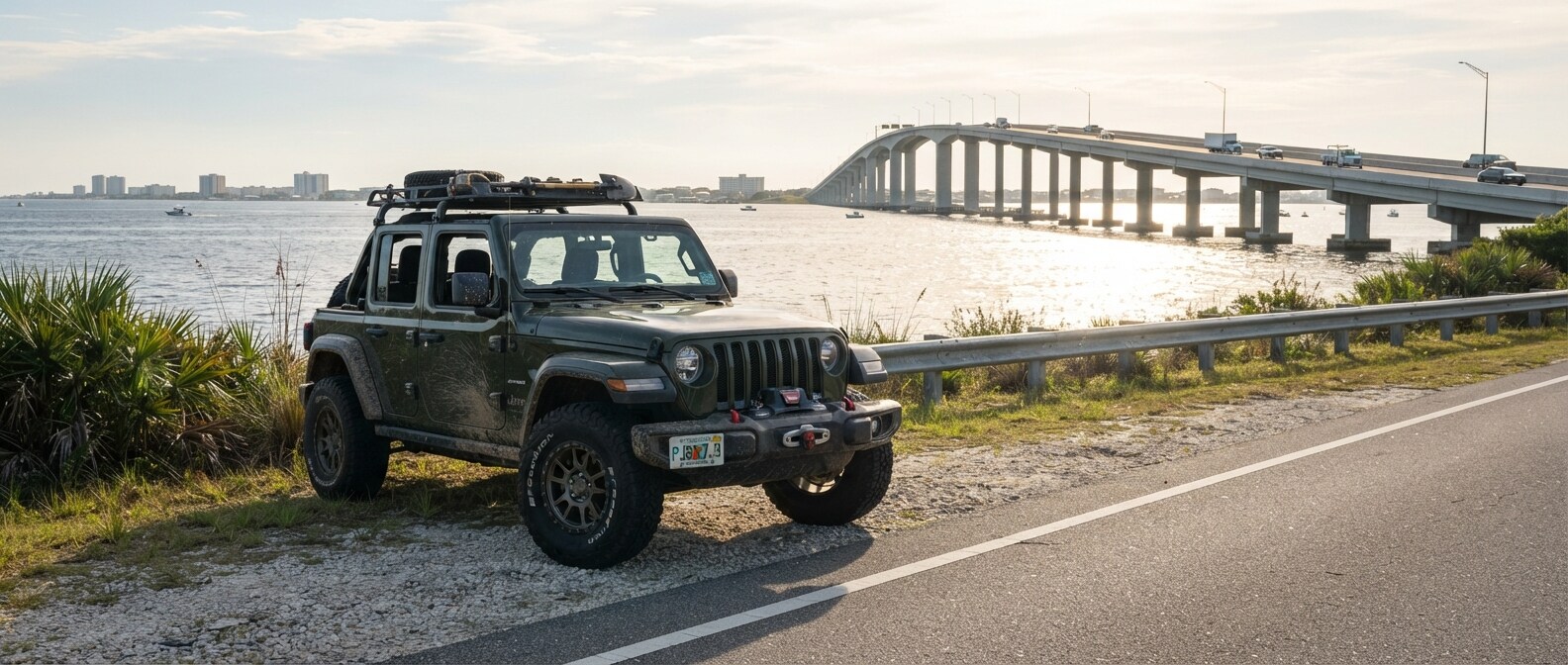
You want one vehicle that handles the daily run from Panama City Beach to Panama City and still has genuine trail and beach-access capability on the weekend. Fair ask. The catch is that the hardware making a rig truly capable off-road (solid axles, aggressive tires, lifted suspension) is the same hardware that turns a 10-mile highway commute louder, rougher, and thirstier than a crossover. We've seen buyers on both sides of that tension come through here, and some used off-roaders thread that needle far better than others.
Here's the short version. Match the generation and trim to your priority (commute comfort versus genuine trail hardware), verify the condition of a few specific wear items before you sign, and you'll have a rig you'll actually enjoy driving every single morning.
What You Need Before You Start
Before you weigh any specific truck or SUV, get clear on what your commute actually demands, because the run from Panama City Beach to Bay Cars on W. 15th Street is roughly 10 miles along US-98 and Business 98 (the corridor locals call 15th Street), and normal flow puts you there in 15 to 20 minutes. Add a Hathaway Bridge construction delay, a summer tourist surge on Front Beach Road, or a November rain band rolling in off the Gulf, and that doubles.
| Factor | What it means for your used off-roader |
|---|---|
| Distance (each way) | ~10 miles, US-98 / Business 98 / 15th Street corridor |
| Typical speeds | 35-55 mph on the main stretch; stop-and-go at bridge approaches and signals |
| Afternoon thunderstorms (June-Nov) | Roads slick fast from sand-and-oil surface mix; tire tread depth matters a lot |
| Beach / trail use frequency | Weekend-heavy? Prioritize dedicated off-road hardware. Occasional dune access? A street-biased AT tire is plenty |
| Passengers / cargo | Wrangler 2-door is tight for three adults daily; Unlimited, Bronco 4-door, or Tacoma crew cab are more comfortable |
That sand-and-oil mix is worth a pause. Nothing dramatic, but on a wet afternoon after a dry stretch, the surface gets slippery faster than you'd expect from plain asphalt. An off-road-capable vehicle here needs decent tread depth (at least 4/32 of an inch) and tires that aren't so aggressively knobbly that the edge blocks can't grip pavement cleanly. For a daily-driver setup, aim for a highway-terrain (HT) or mild all-terrain (AT) tire rather than mud-terrains.
Picking the Right Used Platform by Generation
The platform choice drives everything else, so we steer most PCB commuters toward three options here, broken out by the model years you'll actually find in today's used market (2019-2026), each striking a different balance between daily comfort and genuine trail hardware.
Jeep Wrangler JL. 2019-2026 (Fourth Generation, 2018-present)
The JL drives meaningfully better day to day than the JK it replaced in 2018. Jeep sharpened the ride quality, added real sound dampening, and brought in a turbocharged 2.0-liter four-cylinder option alongside the familiar 3.6-liter Pentastar V6. The 2019-2023 Wranglers are essentially one generation, and the 2024 brought a mid-cycle refresh with an updated center stack, restyled front end, and revised available technology.
Off-road specs (2019-2024 JL, Rubicon trim): up to 10.8 inches of ground clearance, a 44-degree approach angle, a 37-degree departure angle, and 30 inches of water fording. Those numbers are why trail enthusiasts trust it.
The tradeoff is real. On the highway stretch of US-98, a Wrangler wearing an aggressive tire throws off noticeable wind noise, worse with a soft top. A Wrangler with a soft top is loud at highway speed. There's no softening that. The 2.0-liter turbo-four runs notably more efficient in mixed driving than the 3.6-liter V6, which makes it the smarter commuter engine if you're doing this run five days a week. A Rubicon hands you the best hardware, but it costs more and rides stiffer than Panhandle terrain ever asks for. Step down to a Sport or Sahara with the 2.0-liter and you get something genuinely livable on the daily run that still clears sand berms and shallow water crossings without a second thought.
Years to watch: 2018-early 2019 Wrangler JLs had reported electrical gremlins (documented complaints around the eTorque mild-hybrid system) that Jeep patched with software updates. Looking at a 2019? Ask for the service history and confirm the updates were applied. The 2020-2024 cars are the cleaner sweet spot.
Ford Bronco. 2021-2026 (Seventh Generation, 2021-present)
The Bronco returned for 2021 on a body-on-frame, solid-front-axle platform, with a modern independent rear suspension option (Base/Big Bend/Black Diamond/Wildtrak) or a solid axle on the Badlands. Fit 35-inch tires and the Sasquatch Package and it clears 11.6 inches of ground clearance, with the approach angle reaching 43.2 degrees. Water fording on properly equipped Broncos is 33.5 inches. None of these figures are aspirational. They're stock, out-of-the-crate specs.
The 2021-2023 era is where you'll find the most used inventory. Shopping a 2021 deserves one fair warning. The Bronco's first model year shipped with well-documented soft-top quality issues and some hardtop delivery delays. Those aren't mechanical dealbreakers, but inspect the top seals carefully on any 2021 you're considering. The 2022-2024 examples come through cleaner.
What makes the Bronco genuinely compelling for the PCB-to-15th-Street run is the G.O.A.T. modes (Goes Over Any Type of Terrain) system. Sand mode adjusts throttle and traction control specifically for loose surface driving. That Gulf Coast beach-access move, where you drop tire pressure and cross a sand apron to reach the shore, is exactly where it earns its keep.
Sweet spot years: 2022-2024, once the first-year production kinks were sorted.
Toyota Tacoma. 2019-2023 (Third Generation) and 2024-2026 (Fourth Generation)
The Tacoma is the choice for buyers who want the commute to feel more like a normal truck and the off-road capability as a weekend bonus rather than the other way around. The third-generation Tacoma (2016-2023, with our window being 2019-2023) is a proven, durable platform. TRD Off-Road and TRD Pro trims come with Bilstein shocks, an electronically controlled locking rear differential, and crawl control as standard equipment.
Third-gen Tacoma ground clearance with TRD Off-Road comes in at 9.4 inches. Not a Wrangler, but it's enough to handle anything you're likely to meet between the beach and downtown Panama City. The 2024 Tacoma moved to a new platform with a more powerful 2.4-liter turbocharged four-cylinder (up from the 3.5-liter V6 that defined the third gen). More power, better fuel efficiency in mixed driving, though the 2024-plus asks more on the used market right now.
The honest tradeoff for the Tacoma: it handles the commute smoothly and won't punish you with highway noise the way a full-tilt trail rig does. The catch is that it's a truck, not an SUV, so step-in height is higher and the bed is open payload space rather than enclosed cargo. If that fits your life, it's the most versatile pick on this list.
Step-by-Step: How to Evaluate a Specific Used Off-Road Vehicle Before You Buy
Once you've settled on a platform, the job shifts to judging whether this particular truck or SUV is set up right for a daily driver with occasional off-road use, and six checks will tell you most of what you need before you sign anything. Work through these in order.
Step 1: Check the tire condition and type. Measure the tread depth and check the sidewalls for cracking, since Panhandle UV degrades rubber faster than many northern buyers expect. Note the tire brand and pattern. Mud-terrain tires shine on trails but drone on US-98 and wear faster on pavement, so if the truck wears heavily knobbly MTs and you're a commuter first, budget to swap them for a highway-terrain or mild all-terrain option. Most commuter-spec used Wranglers and Broncos leave the factory on all-terrains, which is exactly right here.
Step 2: Inspect the skid plates and underbody. Any used off-roader that's actually seen a trail should show wear on the skid plates, and that's normal. What you're hunting for is a dent deep enough to push up into the powertrain or transfer case, or a mounting point that's bent or broken. Bring a flashlight. Look through our pre-owned inventory if you'd rather start with units we've already walked before they're posted.
Step 3: Test the 4WD system in all modes. Engage 4-High and 4-Low, confirm each shifts smoothly in both directions, and check that you can drop back to 2WD without grinding or hesitation. On a Wrangler JL, also test the front differential lock (Rubicon trim) and the sway-bar disconnect if equipped. On a Bronco, cycle through the GOAT terrain modes on the knob and confirm each engages without a warning light staying lit.
Step 4: Check the lift situation. Many used off-roaders show up with a suspension or body lift already installed. A 2-inch leveling lift on a Tacoma is common and benign. A 4-inch suspension lift on a Wrangler JL changes the geometry in ways that can speed up front-end wear if the alignment wasn't corrected afterward. Ask for alignment records any time there's a lift.
Step 5: Look at the approach and departure point wear. Scratches on the front air dam or rear bumper corners tell you the previous driver didn't always compute clearance angles right. Cosmetic marks are fine. Impact damage that bent the bumper or cracked a mounting tab is a repair conversation.
Step 6: Drive it at highway speed. Take it onto a stretch of US-98 or similar road at 55 mph and listen. A shimmy (some Wrangler folks call it death wobble) on a used JK or early JL at highway speed points to worn track bar bushings or ball joints. It's fixable, but factor it into the negotiation. On a Bronco, listen for wind noise from the top seals, especially on 2021 models.
- [ ] Tread depth measured and confirmed above 4/32 inch
- [ ] Tire type assessed: HT or mild AT appropriate for daily driving
- [ ] Skid plates visually inspected (wear normal, impact damage flagged)
- [ ] 4-High engaged and disengaged cleanly
- [ ] 4-Low engaged and disengaged cleanly
- [ ] Locking diff (if equipped) tested and confirmed
- [ ] Lift height noted, alignment records requested if lifted
- [ ] Highway test drive completed at 55+ mph (listen for shimmy, wind noise, steering pull)
- [ ] Top seals and latches inspected (Wrangler, Bronco)
- [ ] Service history checked for any open recalls (all three platforms had documented ones)
A Quick Reference: Which Platform Fits Your Commute Style
| Platform | Ground clearance | Daily-driver comfort | Best used years | Trade-off |
|---|---|---|---|---|
| Jeep Wrangler JL (2019-2026) | Up to 10.8" (Rubicon) | Moderate (soft-top noise) | 2020-2024 | Less fuel-efficient on the highway |
| Ford Bronco (2021-2026) | Up to 11.6" (Sasquatch) | Moderate-good | 2022-2024 | 2021 top-seal issues to verify |
| Toyota Tacoma TRD (2019-2026) | 9.4" (TRD Off-Road) | Good (trucklike but smooth) | 2021-2023, 2024+ | Bed, not enclosed cargo; higher entry |
Ask about financing options once you've narrowed it down and want to run the numbers.
Ready to browse what's on the lot right now?
See What Your Current Vehicle Is Worth
The Bay Cars Team's Take
We've walked a lot of these across the lot, and the pattern holds up well. Buyers who run the PCB commute and still want trail capability tend to land happiest in a Wrangler JL or Bronco when they lean adventure-first, and in a Tacoma TRD Off-Road or TRD Pro when they lean practicality-first with off-road as the weekend bonus. The Gladiator is a legitimate third option if you truly need the bed, and a used Jeep Gladiator can be a surprisingly comfortable daily driver in the Mojave trim, though the wheelbase makes tight parking on some older Panama City blocks a little awkward.
None of these is a wrong answer. What makes a choice wrong is reaching for the most extreme trim on a use case that doesn't need it, then grinding through the daily commute in a vehicle set up for Moab. Buy the rig that fits Monday through Friday, knowing Saturday it can handle the sand at St. Andrews with zero fuss.
By the Bay Cars Team | November 2026
Frequently Asked Questions
Is a used Jeep Wrangler JL a good daily driver for a 10-mile commute?
Yes, particularly in the 2020-2024 model years. The JL generation is meaningfully quieter and more comfortable than the JK it replaced, and the 2.0-liter turbocharged four-cylinder engine makes the commute less fuel-intensive than the 3.6-liter V6 option. The honest limitation is highway wind and road noise, especially with a soft top at speed. For a 10-mile run like the Panama City Beach to W. 15th Street corridor, most drivers adapt quickly and consider the trade-off worthwhile for what they get on the weekend.
What should I check on a used Ford Bronco before buying?
Focus on two things specific to the first generation: top-seal condition on 2021 models (early production had quality issues with both hardtop and soft-top seals) and the GOAT terrain mode selector (cycle through every mode and confirm each one engages without a warning light). Mechanically, the 2021-2024 Bronco is a solid platform; the 2021 production-year issues were fit-and-finish, not powertrain.