
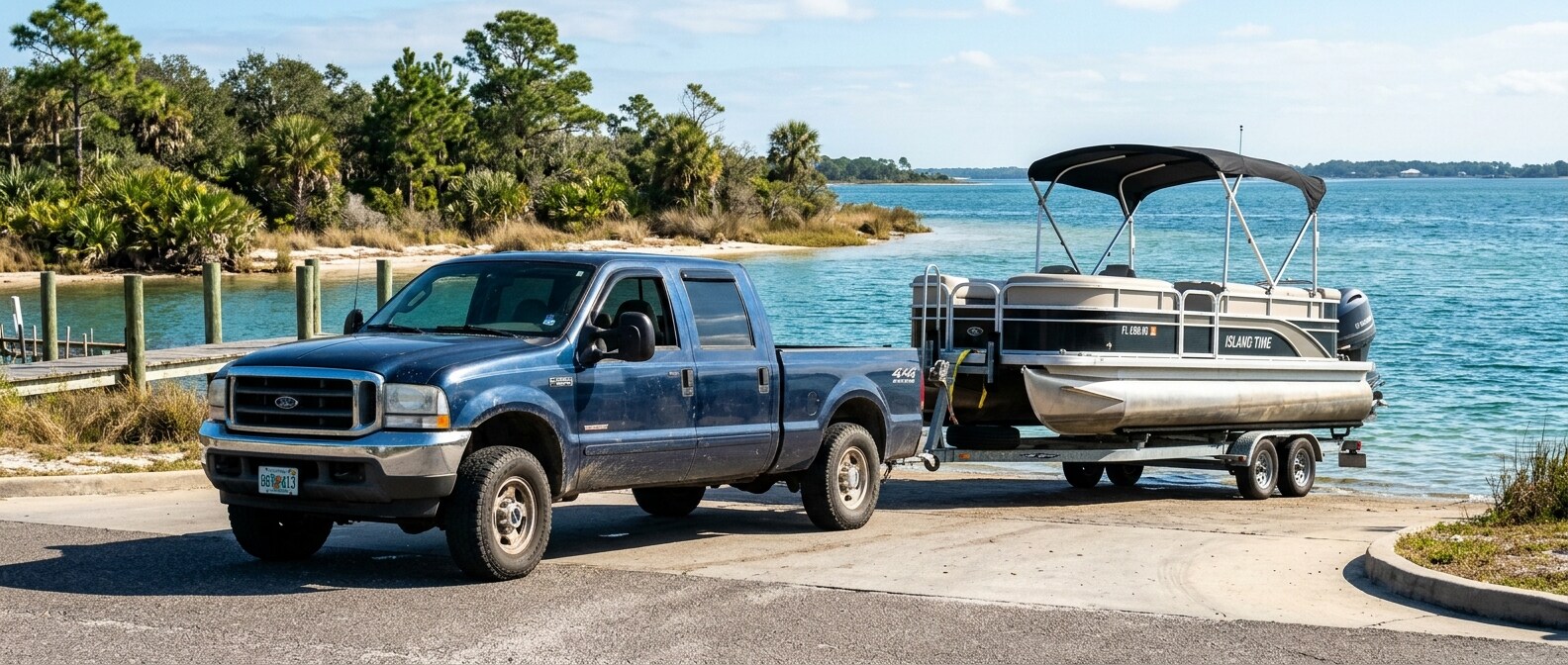
Your neighbor pulls into Bayside Marina with a 24-foot pontoon on a trailer and a Ram 2500 doing the work without a flicker of strain. You've got a 19-foot bay boat, two teenagers who eat up backseat space, and a half-ton in the driveway you're not totally sure is enough truck. So you start to wonder whether "Heavy Duty" is a meaningful distinction that changes what your family can do, or just a bigger badge for contractors.
The distinction is real. And for the right Panama City Beach family, a heavy-duty truck is the right answer.
Browse used Ram 2500 trucks on our lot and see what's available in Bay County right now.
How Does a Heavy-Duty Truck Actually Work Differently?
A heavy-duty truck works differently in two ways easy to overlook until you own the wrong truck, Gross Vehicle Weight Rating (GVWR) and payload capacity, and both come down to weight the truck is engineered to carry rather than horsepower or badge size. GVWR is the total weight the truck is designed to handle, counting everything inside and behind it. Payload is how much you can add to that truck before you're exceeding its design limits. Those two numbers separate the half-tons from the three-quarter and one-ton trucks that actually carry the HD name.
Compare the most common used HD trucks against the light-duty half-tons that commonly serve as a first truck, and the gap shows up fast.
| Truck | Class | Max Conventional Towing | Max Payload | Rear Suspension | EPA Fuel Rating |
|---|---|---|---|---|---|
| Ram 1500 / Ford F-150 / Sierra 1500 | Half-ton (light duty) | 11,000-14,000 lbs (varies by config) | Up to ~2,440 lbs | Coil or leaf | Published mpg |
| Ram 2500 | 3/4-ton (heavy duty) | Up to 20,000 lbs (diesel) | Up to 4,420 lbs (gas HEMI) | Leaf spring | None (exempt) |
| Ford F-250 | 3/4-ton (heavy duty) | Up to 22,000 lbs (diesel) | Up to 4,300 lbs | Leaf spring | None (exempt) |
| Silverado 2500 HD | 3/4-ton (heavy duty) | Up to 22,500 lbs | Up to 3,900 lbs | Leaf spring | None (exempt) |
| Ram 3500 / Ford F-350 | 1-ton (heavy duty) | 35,000+ lbs (diesel, 5th wheel/gooseneck) | Up to 7,680 lbs | Leaf spring (often dually) | None (exempt) |
That payload gap is the number easy to miss when comparing trucks on a dealer lot. The 2026 Ram 2500 with the 6.4L HEMI gas engine carries up to 4,420 lbs of payload. The most capable F-150 configuration manages around 2,440 lbs. When you account for rear passengers, a gear bag, cooler, and the tongue weight your trailer puts on the hitch, those numbers close faster than you'd think on a loaded family trip to the ramp, especially in summer.
The other structural change shows up in real life. Heavy-duty trucks use leaf-spring rear suspension. Leaf springs are stiffer, better at handling sustained load, and they don't squat under a trailer the way coil springs can. They also ride harder when the bed is empty. More on that tradeoff shortly.
See What Your Current Truck Is Worth
Which Families in Bay County Actually Need One?
Which families around Bay County actually need a heavy-duty truck comes down to what you tow and how often you tow it, and the fair starting point is that plenty of local setups don't need one at all, a well-configured half-ton covers a surprising amount of Gulf Coast boating. Pull a 16-foot skiff or a single Jet Ski to the Panama City Beach Public Launch on St. Andrew Bay, and a half-ton does it. No argument.
But if your family's setup looks like any of the following, the math shifts.
Pontoon boats, 22 feet and up. A loaded pontoon with outboard motor, bimini, life jackets, and gear commonly weighs 4,500 to 5,000 lbs on its trailer. Add the trailer itself, factor in tongue weight (typically 10-15 percent of total trailer weight), and toss three adults and a cooler in the cab. You're at or near the realistic ceiling of a half-ton's comfortable range, without any safety buffer for hill grades or emergency stops.
Travel trailers for Panhandle road trips. A mid-size family travel trailer runs 5,000 to 8,000 lbs loaded. Those weights sit right where 3/4-ton trucks are designed to work, not at the outer limit of what they can handle. For a half-ton, the reverse is true.
Mixed work-and-family use. A truck that hauls kids to school on Monday and 1,500 lbs of landscaping material on Saturday is managing combined passenger and cargo weight continuously. Payload capacity is the number that covers all of it at once.
The honest tradeoff. Real-world fuel economy on the Ram 2500, based on aggregated owner data, runs around 13 to 15 mpg in everyday mixed driving. The F-250 and Silverado 2500 HD land in a similar range. EPA doesn't publish ratings for these trucks, since federal regulations exempt heavy-duty pickups from that requirement. On an empty HD truck the ride is noticeably firmer than a half-ton, because those leaf springs are built to carry weight, not smooth out a commute. Parking a crew cab that stretches 240-plus inches in some configurations takes patience in tighter spots around Panama City. None of these are deal-breakers, but they're real and they belong in the conversation before you buy.
A used HD truck earns its place for one kind of family. You pull something serious at least a few times a month, you carry people and cargo at the same time on a regular basis, and you'd rather have capability on tap than wish you had it. You know who you are.
Quick Reference: HD Truck Terms Explained
| Term | What It Actually Means |
|---|---|
| GVWR | Gross Vehicle Weight Rating. The maximum total weight (truck + passengers + cargo + tongue weight) the truck is designed to handle. |
| Payload | The weight you can add to the truck itself: people, cargo in the bed, and tongue weight from the trailer. The sticker on the driver's door gives your specific truck's number. |
| Tongue weight | The downward force a trailer hitch puts on the truck's rear. Typically 10-15 percent of total trailer weight, and it counts against payload. |
| 3/4-ton / 1-ton | Historical load designations now used as class labels. A Ram 2500 is 3/4-ton; a Ram 3500 is 1-ton. Neither literally refers to 2,500 or 3,500 pounds of anything. |
What This Means for Your Next Vehicle
A used heavy-duty truck is a genuinely practical choice for a Bay County family that boats seriously, hauls regularly, or needs a truck that holds its capability under real combined loads, though it asks for some fuel economy and parking ease in return. The Ram 2500, Ford F-250, and Silverado 2500 HD are built for exactly the conditions this part of the Panhandle produces, saltwater boat ramps, loaded trailers, and year-round use that doesn't give the truck many easy days.
From the trucks that move through our lot, we can tell you used crew cab HD trucks hold their capability well over time when they've been maintained. The Crew Cab configuration on a used Ram 2500 gives you 40.2 inches of rear legroom for actual rear passengers. The Mega Cab stretches that to 43.1 inches. These aren't cramped work trucks that families have to compromise to ride in. They seat six, carry real cargo, and tow without strain.
The buying decision comes down to a clear-eyed self-assessment of your own hauling. How heavy is your trailer, how often are you pulling it, and are you willing to trade some fuel economy and ease of parking for a truck that doesn't flinch at the job? Answer yes to that last one, and a used HD truck is worth a serious look.
See all pre-owned trucks on our lot
Frequently Asked Questions
What is the difference between a heavy-duty truck and a regular half-ton truck?
A heavy-duty truck (3/4-ton or 1-ton, like a Ram 2500, Ford F-250, or Chevrolet Silverado 2500 HD) has a higher Gross Vehicle Weight Rating, a reinforced frame, leaf-spring rear suspension, and significantly higher towing and payload capacity than a light-duty half-ton. The 2026 Ram 2500 with the 6.4L HEMI gas engine carries up to 4,420 lbs of payload and tows up to 20,000 lbs with the diesel, compared to roughly 2,440 lbs of payload on the most capable F-150 configuration. When your trailer, passengers, and gear combine to press against those limits, the gap starts to matter.
Do heavy-duty trucks like the Ram 2500 and F-250 have fuel economy ratings?
No. Heavy-duty pickups are exempt from EPA fuel economy rating requirements. Real-world owner data puts the Ram 2500 in the 13 to 15 mpg range for everyday mixed driving, with the Ford F-250 and Chevrolet Silverado 2500 HD landing in a similar band. If your truck will also serve as a daily commuter around Panama City on top of towing duty, that's a real cost factor worth running the numbers on before you buy.