
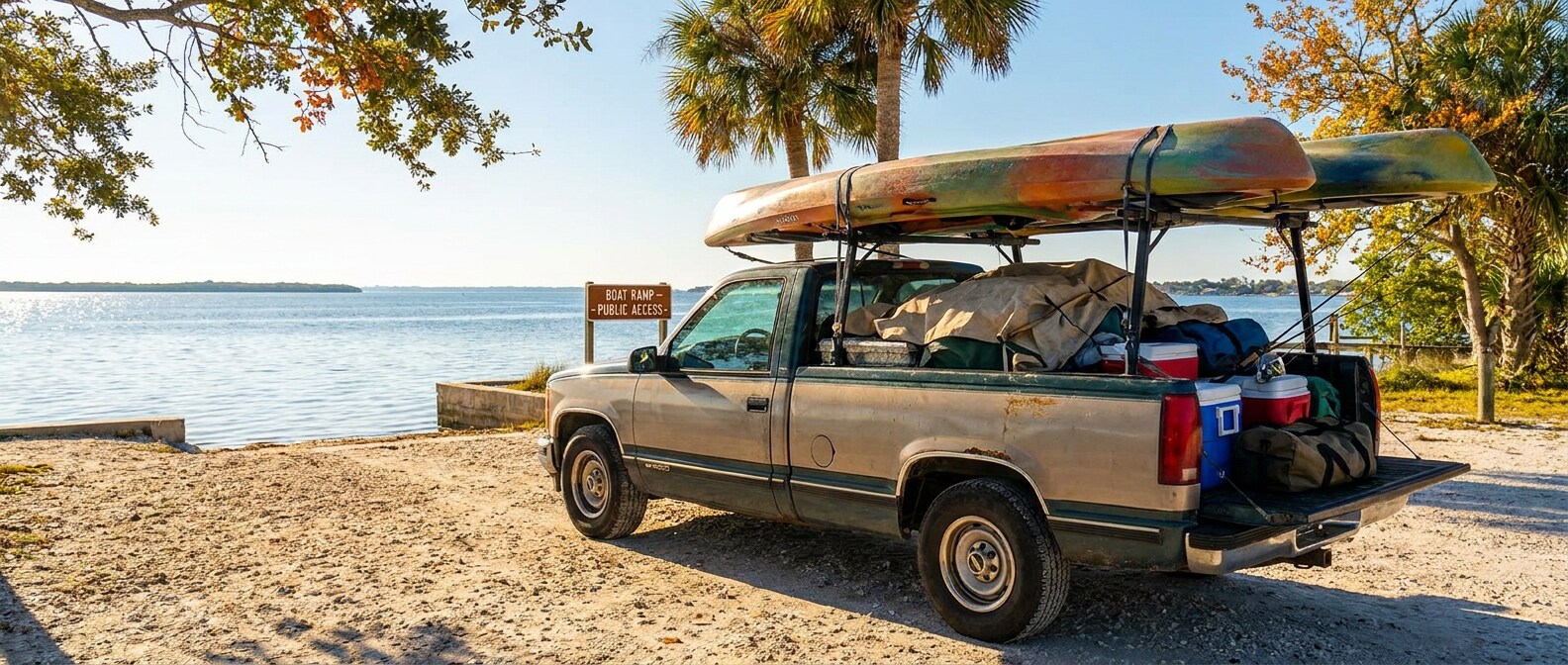
Picture the plan. Two kayaks on the bed, a loaded cooler, a tent and sleeping bags shoved in behind the seats, and a short run from Panama City down Thomas Drive to the St. Andrews State Park boat ramp on Grand Lagoon. The question that's easy to skip until you're standing in the parking lot is whether your truck can actually handle that load without creeping past its payload rating.
A used full-size half-ton gets you there with real headroom. A used A used Ford F-150 or a Sierra 1500 from our lot carries a typical St. Andrews weekend load and barely registers the weight. A used Tacoma can do it too, but the ceiling on that truck is tighter than the brochure makes it sound. Run the math first.
The numbers below tell the rest.
Will Your Weekend Load Actually Fit?
Two kayaks, a cooler, camp gear for two adults, and those two adults themselves add up to a real number, and a used half-ton clears it with room to spare while a used Tacoma clears it only if you're watching the margins. We built the load out below using typical weights (recreational kayaks at 35 lbs each, a 65-qt loaded cooler at roughly 50 lbs, a two-person tent and sleeping bags at around 20 lbs combined, and 90 lbs of miscellaneous camp and paddle gear), then held that against the verified payload ratings for the used trucks we keep on our lot.
| Truck (used model years) | Bed length (standard) | Payload rating (standard config) | Typical weekend load* | Headroom left |
|---|---|---|---|---|
| Ford F-150 (2019-2023, SuperCrew 6.5-ft) | 78.9 in | ~1,765-2,120 lbs | ~570 lbs | ~1,195-1,550 lbs |
| GMC Sierra 1500 (2019-2022, Crew Cab 5.75-ft) | 69.9 in | ~2,010-2,080 lbs | ~570 lbs | ~1,440-1,510 lbs |
| Toyota Tacoma (2019-2023, Double Cab 5-ft short bed) | 60.5 in | ~1,105-1,175 lbs | ~570 lbs | ~535-605 lbs |
| Toyota Tacoma (2019-2023, Access Cab 6-ft long bed) | 73.7 in | ~1,105-1,175 lbs | ~570 lbs | ~535-605 lbs |
*Payload includes passengers. Two adults at 170 lbs each = 340 lbs; bed cargo (kayaks, cooler, gear) = ~230 lbs. Total: ~570 lbs. Payload ratings from manufacturer specifications; check your door-jamb sticker for your specific truck.
The Tacoma number is a tighter window, not a dealbreaker. That remaining 535-605 lbs of capacity disappears fast if you're a heavier person, if a third passenger rides along, or if you add a fishing crate and a second cooler. On the Tacoma, a second cooler and a third rider can put you right at the ceiling, with no way around it. The F-150 and Sierra 1500 each leave you north of a thousand pounds of headroom with the same load, which is the practical difference between a relaxed drive and a truck riding visibly low on its springs.
One detail matters before you shop. Both the F-150's standard 6.5-ft bed and the Sierra's standard 5.75-ft bed have about 50.6 inches of flat floor between the wheel wells. A recreational kayak runs 8 to 12 feet long. So kayaks ride on the bed rails or in a bed extender, not flat on the floor, no matter which truck you choose.
How to Load Smart for the Drive to St. Andrews
Once you've picked the truck, good loading matters as much as the payload number, because a weekend load that's balanced rides fine down Thomas Drive while the same gear shoved to one side makes the back end wander. Get the distribution right and the boat ramp run on Grand Lagoon goes smoothly.
St. Andrews has a double-sided concrete launch on the lagoon, so you'll be backing down and leveling out the rear of the truck. Uneven loading makes that harder than it needs to be. Our team thinks about it this way, based on how these trucks handle when they're weighted toward one side.
A used A used GMC Sierra 1500 and the F-150 both have six or more tie-down cleats in the bed from the factory. Use them. A loose kayak on the highway isn't a small problem.
A few habits make a real difference on this run, and they're quick:
- Kayaks centered over the bed, not stacked to one side. Even a 35-lb hull throws off the truck's feel over the bridge approaches on US-98 if it's shifted far to one side.
- Cooler forward, behind the cab. Weight low and toward the cab keeps the rear suspension from squatting as much. A fully loaded 65-qt cooler is about 50 lbs, light enough that position matters more than weight.
- Sleeping bags and soft gear fill gaps, not pile on top. The bed depth on a standard F-150 or Sierra is about 21-22 inches. Stacking beyond that puts gear at risk of going overboard on the highway entrance ramps.
- Tie your kayaks at three points minimum: bow, stern, and the cockpit. A single strap at the cockpit lets the hull rock on the bed rails at speed.
Used Used Toyota Tacoma trucks in the 2019-2023 range give you a tighter but workable window. If you're set on a Tacoma, go for the Access Cab long-bed (73.7-in bed) over the Double Cab short-bed (60.5-in bed). The longer bed handles 10-ft recreational kayaks without needing a bed extender, and the extra length is easier to work with at the ramp.
How to Find Your Specific Truck's Real Payload Rating
- Open the driver's door and find the placard on the door jamb or the door edge.
- Locate "GVWR" (Gross Vehicle Weight Rating) and "Curb Weight" if listed, or look directly for a "Payload" or "Combined Weight of Occupants and Cargo" line.
- Subtract your estimate of driver and passengers from that cargo/occupant number. What's left is what you can put in the bed.
- Build your load list before you pack: kayaks, cooler with ice, dry bags, tent, chairs, paddle gear. Estimate weights. Add them.
- If the numbers are close, err on the conservative side. Overloading a used truck stresses the rear suspension, the brakes, and the tires, especially on a Florida summer run where tire pressures are already elevated by heat.
The Run Is Short. Make It Right.
Bay Cars sits on W. 15th Street, and St. Andrews State Park is roughly 10 miles south, so the Thomas Drive approach and the Grand Lagoon boat ramp make for a genuinely easy run that both the F-150 and the Sierra 1500 handle without drama when they're loaded properly. The Tacoma handles it too, but we want you to know exactly where you stand before you back a loaded truck onto a concrete ramp.
Browse our pre-owned truck inventory to see what's on the lot right now. Configurations, bed lengths, and trim packages vary, so if you're specifically hunting a 6.5-ft or longer bed in a half-ton, it's worth calling us at (850) 785-1591 so we don't send you on a trip for a short-bed Crew Cab.
You're buying a truck partly for weekend trips like this one, and ours should fit your load, not the other way around.