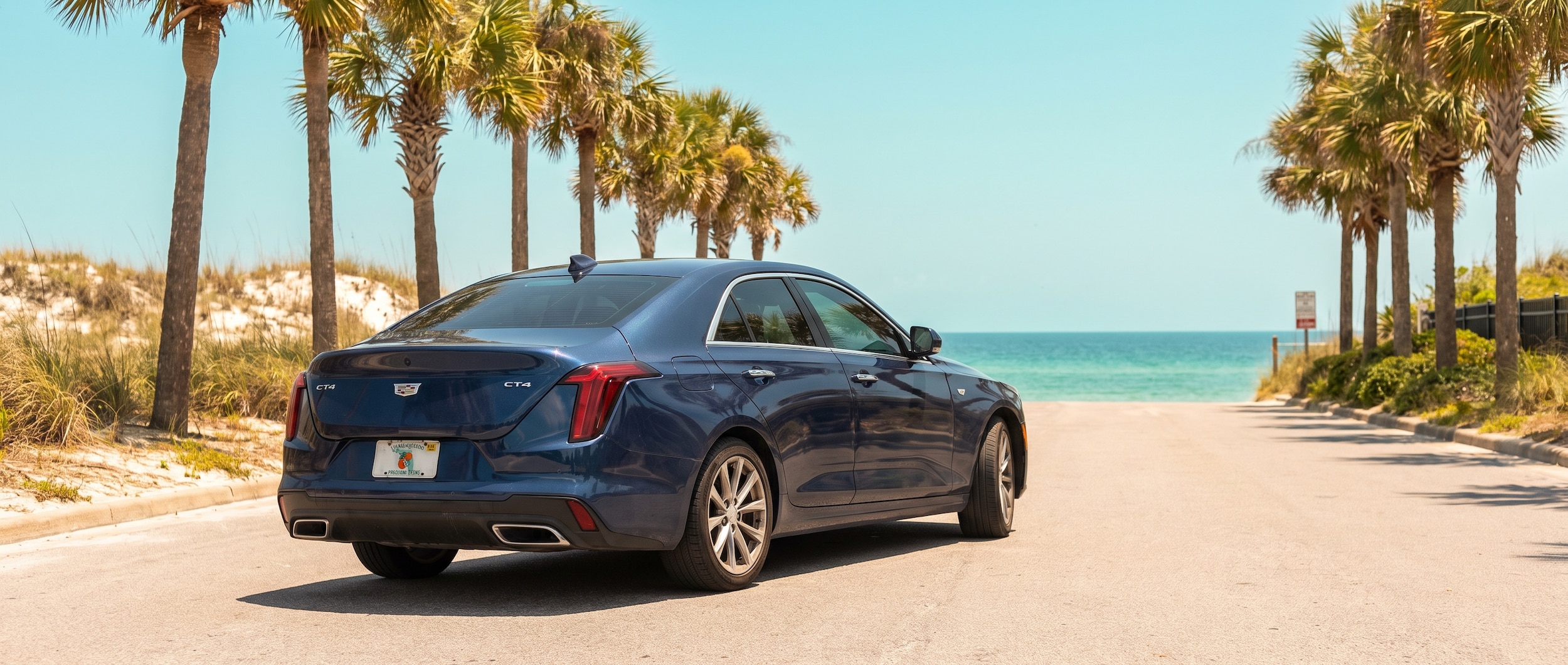
Cadillac is shutting the CT4 down after the 2026 model year. Used-car shoppers shouldn't read that as bad news. For them, the timing works out to a buying opportunity, a compact luxury sedan with a strong chassis, a legitimate performance bloodline, and a used-market price that keeps sliding as buyers look away from sedans toward SUVs. So the question worth answering is which year of CT4 gives you the most car for the money, and which years carry baggage worth understanding before you sign.
We've moved a good number of these on the Bay Cars lot, and the year of the car shapes the conversation every single time.
- Sweet-spot years: 2022 and 2023. These are where the CT4 matured (first-year kinks worked out, the Blackwing trim added, Super Cruise available, and no major open recall exposure in the base 2.0L).
- 2024's clean too, though used supply is thinner and the EPA rates it slightly lower in fuel economy than the 2023 on the base engine.
- Watch the 2020 closely. It collected the most NHTSA activity of any CT4 year, including a roof-rail airbag recall and an early brake-boost sensor issue.
- 2021 also carries the 10-speed transmission recall (NHTSA 25V148). A software fix, not a mechanical replacement, but confirm it's been done.
- The 2026 is the last one ever made. It's still technically new on some lots; used examples are just starting to appear.
Which CT4 years are the sweet spot for used buyers?
The 2022 and 2023 model years are where we usually land when a buyer asks which used CT4 to target, though a clean 2024 belongs in that same conversation if you can find one on the lot, because thin supply is the only real knock against it. 2022 was the year Cadillac added the CT4-V Blackwing to the lineup and made Super Cruise (the hands-free highway driving system) available on Premium Luxury and Sport trims. That made the 2022 a genuinely more capable car than anything that came before it, and it didn't pile new mechanical complexity onto the base engine that's caused real-world grief.
| Model Year | Sweet Spot? | Years to Watch? | Why It Matters |
|---|---|---|---|
| 2020 | No | Yes | Most NHTSA activity: airbag install recall, brake-boost sensor recall, early 10-speed transmission recall |
| 2021 | Caution | Watch | 10-speed transmission recall (NHTSA 25V148); confirm software fix completed |
| 2022 | Yes | No | Blackwing added; Super Cruise available; airbag recall (N212342780) remedied at dealer inspection |
| 2023 | Yes | No | Minimal changes; 2.0L RWD EPA-rated at 23 city / 34 hwy; cleanest recall profile in the lineup |
| 2024 | Good | No | Slight fuel-economy dip on base engine (22 city / 32 hwy RWD); otherwise very clean |
| 2025 | Good | No | Carries over with no notable changes; used supply limited in 2026 |
The 2023 deserves a specific callout. The EPA rates the 2023 CT4 2.0L RWD at 23 city and 34 highway. For a rear-wheel-drive compact luxury sedan making 237 horsepower and 258 lb-ft of torque, those are real numbers. On the stretch of US-98 between Panama City and Panama City Beach (plenty of stop-and-go), that highway rating matters for anyone who's regularly running that corridor.
Browse our current pre-owned inventory to see what years and trims we've got on the lot right now.
Which CT4 years should give you pause?
The 2020 is the year that shows up most in NHTSA data for this nameplate, so it's the one to approach with a VIN check in hand, though a 2020 that's already cleared its recalls at a dealer can still be a fair buy once you confirm the paperwork. Per NHTSA records, GM issued a recall (campaign N212342780) covering 2020-2022 CT4 vehicles for roof-rail side-curtain airbags that may not have been installed correctly. The fix was a dealer inspection and reinstallation of the airbag modules as needed, at no charge. That recall was initiated in 2021, so any 2020 that's been through a dealer should have it addressed. The key word is "should." Always pull the VIN on NHTSA.gov before you buy.
A second issue is worth knowing about. NHTSA campaign 25V148 covered 2020-2021 CT4 models equipped with the 10-speed automatic transmission. Per NHTSA, a fluid leak could cause internal transmission damage and, in the worst case, wheel lockup while driving. The remedy is a software update to the transmission control module (not a full replacement), but it's got to be done. We check this on every unit before it goes to the floor.
A daytime running lights issue is also on the NHTSA record for 2020-2023 vehicles, logged as a compliance concern rather than a safety crisis. The DRLs may fail to deactivate when the headlights are on.
One tradeoff is worth naming up front. The CT4 is a compact sedan at heart, and the trunk measures 10.7 cubic feet (workable, not cavernous). St. Andrews State Park has a boat launch where the Shell Island shuttle departs. Load up a week's worth of beach gear for a family day trip out there and you'll fill that trunk fast. A 2022 or 2023 CT4 drives sharp and enjoyable on US-98, but you shouldn't expect it to haul cargo. Know that going in.
Explore financing options that work with your budget when you're ready to take the next step.
Which CT4 year fits which buyer?
Not every shopper wants the same thing from a used CT4, so the right year really depends on whether you're chasing value, strong fuel economy, outright Blackwing performance, or simply the newest example you can still track down before this nameplate disappears for good. We'd sort the choices roughly like this.
- You want the most car for the money. Go 2022 or 2023. Both years benefit from the full lineup (including the available Blackwing and Super Cruise), the first-year bugs are behind them, and used pricing reflects the sedan segment's soft demand. That soft demand works in your favor.
- You want the base engine and strong fuel economy. The 2023 2.0L RWD is your best bet. The EPA rates it at 23 city and 34 highway, a tick better than the 2024 and 2025 revisions. For a daily driver on the Panhandle's mix of surface streets and longer highway runs, that's the practical pick.
- You want Blackwing performance and you can stomach a higher entry. Look at 2022-2024 CT4-V Blackwing examples. The 3.6L twin-turbo V6 produces 472 horsepower and 455 lb-ft of torque, and it can be had with either a 6-speed manual or a 10-speed automatic. It's the last gasoline V-Series Cadillac will ever make. For an enthusiast buyer, that matters.
- You're on a tighter budget and don't mind doing homework. A 2021 with confirmed recall completion (NHTSA 25V148 software update done, airbag inspection done) can be a solid value. Just verify both repairs are in the service history before you commit.
- You want the newest possible and can find it. The 2025 carries over without changes from 2024. Used 2025 examples are just entering the market. The 2026 is the last CT4 ever, still technically new at some Cadillac stores. Used units will start appearing later this year as early lessees turn them in.
See what your current vehicle is worth before you shop (knowing your trade value changes the math).
Frequently Asked Questions
What's the most reliable Cadillac CT4 model year to buy used?
Per NHTSA complaint data, the 2.0L turbocharged engine has the lowest complaint density across the CT4's production run. The 2022 and 2023 model years carry the cleanest combination of resolved recall history, full feature availability, and real-world reliability feedback. The 2020 collected the most NHTSA campaigns of any CT4 year and deserves a VIN check before purchase.
Does the Cadillac CT4 have a transmission recall I should know about?
Yes. NHTSA recall campaign 25V148 (GM number N242480630) covers 2020-2021 CT4 models equipped with the 10-speed automatic transmission. The issue is a potential internal fluid leak that could cause wheel lockup; the fix is a transmission control module software update performed by a dealer at no charge. Any used 2020 or 2021 CT4 you consider should have documented proof this update was completed. You can verify your specific VIN at NHTSA.gov.
Is the Cadillac CT4 being discontinued, and does that affect used values?
Yes. Cadillac confirmed the CT4 and CT5 are both being discontinued after the 2026 model year. For used buyers, this generally means softer resale competition as production ends and no next-generation replacement exists to drive excitement. The Blackwing trim (the final gasoline V-Series Cadillac will ever build) is the exception (enthusiast interest in those units tends to hold value better than base trims).