Panama City Beach's summer roads will humble a vehicle that looks tough but isn't actually built for them. If your business runs service routes near Breakfast Point Academy on Richard Jackson Blvd, you're navigating standing water after afternoon squalls, soft sandy road shoulders, and the stop-and-go of a busy school-zone corridor, all of it in July heat that stresses cooling systems hard. A properly configured used off-road truck or SUV handles that without drama. A stock crossover that just looks rugged will have you stranded on a soggy verge by August.
This guide walks you through the specs to verify, the systems to test, and the configuration decisions to make before you buy, so the vehicle works for your actual service route and not just the listing photos.
The Jeep Wrangler is the first vehicle most buyers in this market reach for, and for good reason. But let's go through this in order.
Specs to Verify Before You Commit
Pull these figures on any used off-road candidate before you step onto a lot. They live on the window sticker, the owner's manual, or the OEM's published towing guide. Miss one and you may end up with a rig that can't handle your gear trailer or can't ford a flooded curb cut.
| Spec | Why it matters on PCB service routes | Target minimum |
|---|---|---|
| Ground clearance | Sandy soft shoulders, post-storm runoff, lot-edge drainage near BPA | 9.4 in (workable); 10+ in preferred |
| Approach angle | Steep curb cuts at school drop-off and loading zones | 30 degrees or more |
| Tow rating (with factory Tow Package) | Equipment, landscape, or supply trailer | Must match your actual loaded trailer weight |
| Water fording depth | Afternoon squall runoff on Richard Jackson Blvd | 20 in minimum; 30 in (Wrangler-class) is better |
| Payload | Tools, supplies, coolers, a helper in the cab | Check the door-jamb sticker, not the advertising |
| A/C refrigerant condition | FL summer means the system is running full-blast daily | Within 3-4 model years or confirmed serviced |
Get the VIN and run it through NHTSA's free recall database before you write a check. Four minutes. It catches open safety recalls the seller may not bring up.
Step-by-Step Setup for a Used Gulf Coast Work Rig
Business buyers often skip ahead at this stage. They see a lifted truck they like and miss the configuration details that make it actually work. Go through these in order.
Step 1: Match the vehicle class to your cargo and tow needs.
"Off-road" labels don't all mean the same thing. The Ford Bronco (2021-2023, body-on-frame) tows up to 3,500 lbs on most standard trims when properly equipped with the factory Trailer Tow Package. That's enough for a single-axle landscape or catering trailer. If your business pulls heavier equipment, move up to a truck platform. The Toyota Tacoma TRD Off-Road (third generation, 2020-2023) carries a 9.4-inch ground clearance rating from Toyota and tows up to 6,800 lbs with the V6 and tow package, a meaningfully higher ceiling than SUV-based off-roaders. Its bed also doubles as genuine cargo space when you're hauling supplies to a school campus.
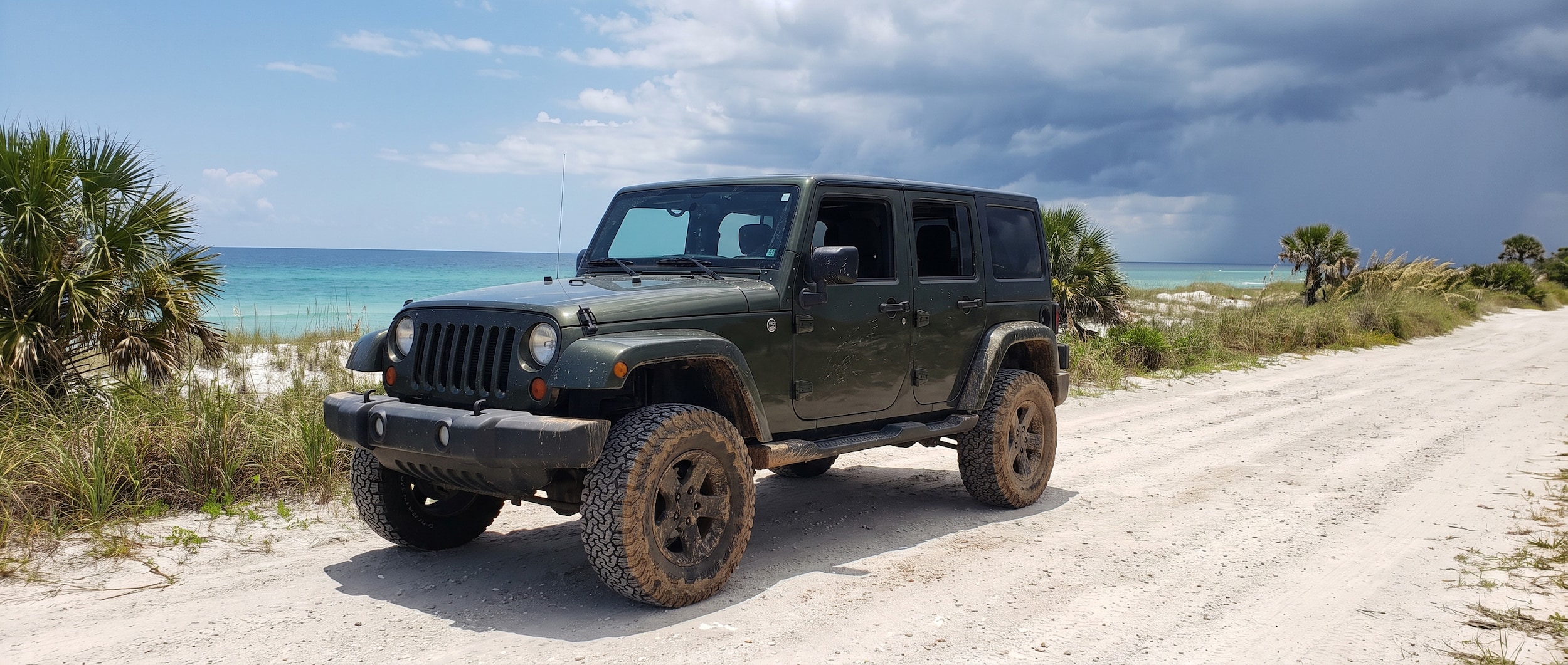
The Jeep Wrangler 4-door Unlimited (used 2019-2023) gives 9.7 inches of ground clearance on the Sport trim and 10.8 inches on the Rubicon per Jeep's published specifications, plus 30 inches of water fording depth on standard configurations. A four-inch puddle from a summer squall is nothing to it.
Step 2: Confirm the Tow Package is actually on the vehicle.
We see buyers skip this one, and it's the most expensive thing to discover after the purchase. A used off-road vehicle's rated tow capacity only applies when the factory Trailer Tow Package was ordered from the factory. That means a Class IV hitch receiver, a 7-pin wiring harness, and on trucks, an upgraded transmission cooler. Pull the vehicle's build sheet from the OEM website using the VIN. An aftermarket hitch bolted on by a previous owner is not the same thing. Running a heavy trailer in Florida summer heat without a transmission cooler can damage the transmission on any tow vehicle.
Explore Financing Options for Your Work Vehicle
Step 3: Test the four-wheel-drive engagement.
On a Gulf Coast work vehicle that sits in 2-wheel drive ninety percent of the time and then needs 4-Low on a wet sandy shoulder, the transfer case has to work cleanly when you ask it to. Test it before you buy. Engage 4-High, then 4-Low, while stationary on flat pavement. Listen for grinding. Feel for hesitation. A used Wrangler or Bronco with a balky transfer case is a negotiating point or a deal-breaker. Sorting it out later, when you need it on a rain-soaked road edge, is not an option.
Step 4: Check the tires, both condition and type.
An all-terrain tire (AT) is the right call for mixed PCB work use. A mud-terrain (MT) tread is too aggressive for pavement-heavy campus routes and wears faster on the road surface. On used off-road vehicles, check tread depth with a quarter test (not just the penny, since a penny gives you the legal minimum and not a useful work margin). Then check sidewalls for dry rot. Florida's UV intensity and salt air age rubber sidewalls faster than inland climates will. A tire with acceptable center tread can still have sidewalls that are cracked and compromised. Tap the sidewall with a knuckle. A healthy tire sounds solid, not hollow or papery.
Step 5: Verify A/C output and coolant condition.
Not glamorous. Absolutely critical. Panama City Beach summer temperatures regularly hit the low-to-mid 90s Fahrenheit, and your driver needs a functioning cab. Start the vehicle, max the A/C, and measure the center vent with an inexpensive infrared thermometer. A properly functioning system should drop vent output below 45 degrees F. Above that means a refrigerant recharge at minimum. While you're at it, look at the coolant overflow reservoir. It should be clear or faintly tinted. Rusty brown indicates old coolant and potential corrosion. Milky or foamy coolant means coolant and oil are mixing. That's a serious engine problem and a walk-away condition.
Step 6: Test cargo fit with your actual business load.
Take your single largest regularly-hauled item and put it in the vehicle at the lot. A Jeep Wrangler 4-door cargo area, a Tacoma bed, and a Ram pickup bed are different shapes and configurations. A caterer's cambro stack, a landscaper's leaf blower, a cleaning crew's supply bin all fit differently in each. Five minutes of physical testing at the lot is worth more than any cargo volume spec sheet number.
Step 7: Run the NHTSA recall check and confirm completion.
Free at NHTSA.gov, uses the VIN, takes under five minutes. Third-generation Tacomas (2016-2023) had documented frame-related recalls in northern states. Florida trucks are generally less rust-affected, but it's still worth confirming on any unit you're considering. Wranglers from the 2018-2022 model years had a documented fuel pump recall (NHTSA Campaign 22V318000). Neither is automatically a deal-breaker if the recall work is confirmed completed. An open, uncompleted recall on a used vehicle is a real negotiating lever.
Your Print-and-Go Purchasing Checklist
Run this before you sign:
- [ ] Ground clearance verified at 9.4 inches or better from the OEM spec sheet
- [ ] Factory Tow Package confirmed via build sheet from OEM website (not just "has a hitch")
- [ ] Tow rating meets or exceeds loaded trailer weight with a working margin
- [ ] 4-High and 4-Low engage cleanly; no grinding or hesitation
- [ ] All-terrain tires confirmed; tread passes quarter test; sidewalls free of cracking
- [ ] A/C vent output below 45 degrees F at max setting (bring an infrared thermometer)
- [ ] Coolant is clear; no milky or rust-brown discoloration in overflow reservoir
- [ ] NHTSA recall check complete; any open recalls either resolved or priced into negotiation
- [ ] Cargo area physically tested with your actual largest item
- [ ] Budget confirmed: financing or trade-in value understood before negotiating
A used Ram 1500 with the 4x4 package deserves a spot on your shortlist if your routes involve regular heavy towing. It carries a higher payload than most SUV-based off-roaders and handles long US-98 corridor runs between supply stops more comfortably over time.
A well-spec'd used off-road vehicle is a genuine business asset on the Gulf Coast. The Bay Cars team carries a range of used trucks and SUVs across multiple brands, and we're happy to help you work through these checks on any unit on our lot. Come in knowing your numbers, and we'll help you find what fits the job.
Frequently Asked Questions
What ground clearance do I need for driving around Panama City Beach in summer?
For the mixed conditions typical of Panama City Beach service routes, including sandy road shoulders, post-storm standing water, and school-campus lot edges, look for at least 9.4 inches of ground clearance. Toyota rates the third-generation Tacoma TRD Off-Road at 9.4 inches; Jeep lists the Wrangler Sport 4-door at 9.7 inches and the Wrangler Rubicon at 10.8 inches. Either of those specs gives real margin on wet Gulf Coast road surfaces without needing an aftermarket lift kit.
Does a used Ford Bronco tow enough for a small business work trailer?
Most used Ford Bronco trims from 2021 through 2023 are rated to tow up to 3,500 lbs when the factory Trailer Tow Package is installed. That covers a single-axle landscape, catering, or equipment trailer comfortably. If your loads regularly run heavier than that, a truck platform like the used Toyota Tacoma (up to 6,800 lbs with V6 and tow package) or Ram 1500 gives you more working margin.