
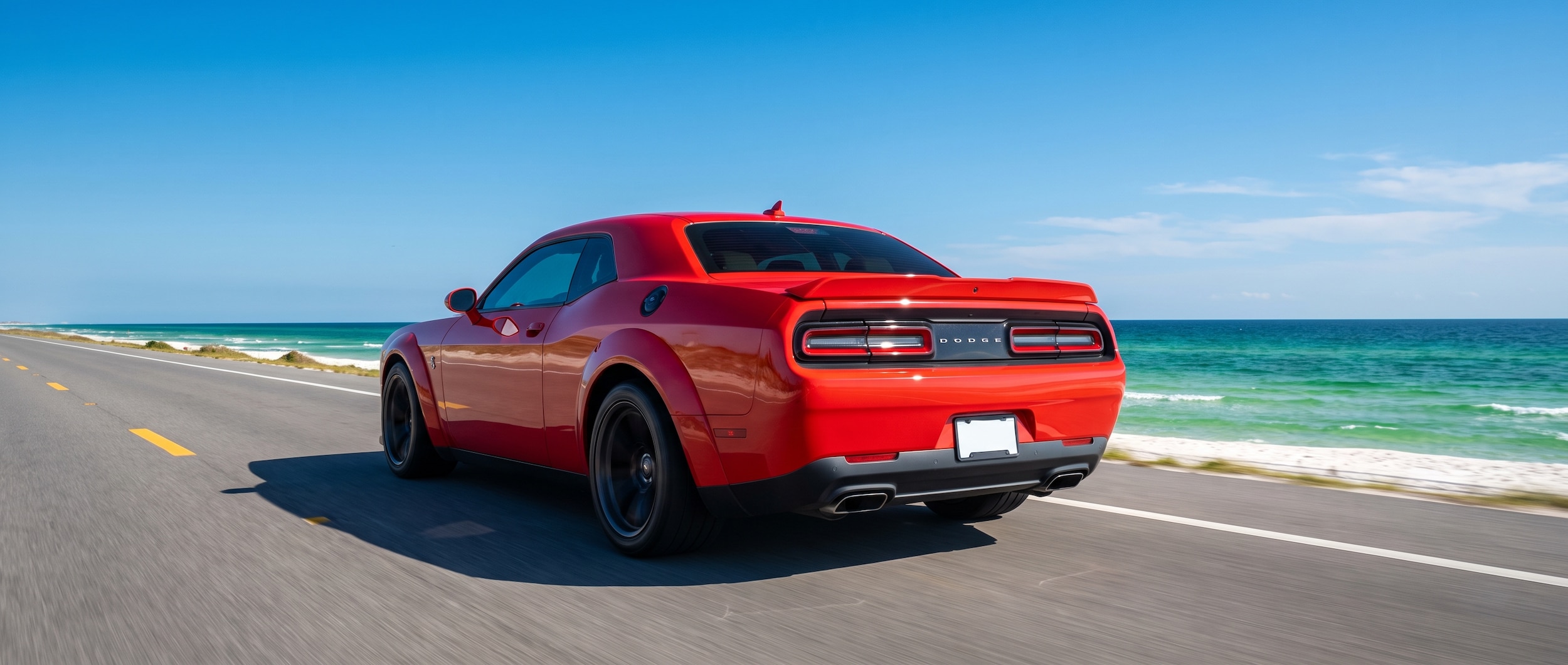
The used muscle car sitting on our lot right now could be doing exactly this: windows down, the Gulf glittering to the right, US-98 unrolling east past Tyndall Air Force Base toward Mexico Beach on a Saturday morning. That is the scenario that separates the genuinely great used performance cars from the ones that just look good in a parking lot. The Bay Cars team has helped a lot of Panama City buyers find exactly that car, so here is the honest ranking: Dodge Challenger first, Ford Mustang second, Chevrolet Camaro third -- and the specific model years that make each one the right or wrong buy.
The Rankings at a Glance
| Rank | Model | Best-For | Standout Spec | Sweet Spot Years |
|---|---|---|---|---|
| 1 | Dodge Challenger | Comfortable long cruise, V8 drama | Rear-seat room, highway composure | 2018-2022 |
| 2 | Ford Mustang | Driver engagement + cargo versatility | 13.5 cu ft trunk, 5.0L V8 | 2018-2020 (GT) |
| 3 | Chevrolet Camaro | Sharpest corner-carver | 455 hp, 455 lb-ft (SS V8) | 2018-2019 |
No. 1 -- Dodge Challenger: Built for Exactly This Drive
If US-98 had a car made for it, the Challenger is a strong argument. The wide, low cabin is genuinely comfortable for two adults on a 45-minute coastal run, the rear seat will hold gear without complaint, and the standard Hemi soundtrack does something to your mood that a playlist cannot replicate.
The reliability data backs up the road-trip case. According to NHTSA-sourced scoring compiled by Auto Reliability Index, the Dodge Challenger averages 74 out of 100 across the 2018-2023 model years -- rated "Good" -- and the 2020 model year scores the highest in the generation at 77 out of 100. The 2020 Challenger also carries only one documented NHTSA recall on file, the lowest of any year in that era.
Sweet spot years: 2018-2022. The 2018 model was the first year the Hellcat Widebody arrived and the first year all Challengers received standard backup cameras. By 2018, the electrical and TIPM issues that plagued 2010-2014 models had been resolved; the 8-speed automatic was refined; and build quality had improved meaningfully across the lineup. The 2019 and 2020 models are particularly clean from a complaints standpoint.
Years to watch: 2009-2014. NHTSA data shows the 2010 Challenger accumulated 442 complaints and seven recalls, with documented premature timing chain failure and widespread electrical-system problems centered on the Totally Integrated Power Module (TIPM). The 2012 carries 398 complaints and six documented recalls, including alternator failure that could cause complete power loss while driving. Skip these entirely for any road-trip duty; if you are considering one anyway, confirm every open recall is closed via NHTSA.gov before you buy.
For the Gulf Coast buyer, the Challenger's wide cabin also means the A/C system is working harder in a Panama City July. Confirm the cabin air filter and refrigerant are in good shape before any summer run.
No. 2 -- Ford Mustang: The Driver's Pick with Real Cargo Room
The Mustang makes the ranking for a different reason than the Challenger: it is the most driver-focused of the three and it actually fits weekend luggage. The coupe carries 13.5 cubic feet of cargo space -- more than many compact crossovers -- so packing for a Friday-to-Sunday Panhandle trip does not require Tetris skills.
The 5.0-liter Coyote V8 in the GT trim is the engine to target for the US-98 coastal run. It pulls cleanly at highway speeds, sounds appropriately serious, and the GT's suspension tuning is firm enough to be engaging on winding sections of the road without becoming tiresome on the long straight sections toward Mexico Beach.
Sweet spot years: 2018-2020 GT. The 2018 GT brought revised steering, updated suspension geometry, and improved throttle response to the sixth-generation platform. NHTSA-sourced data shows the 2018 Mustang carries four recalls on file, all of which have known remedies, and no documented pattern of catastrophic powertrain failure in the 5.0L engine. The 2019 model improved on the infotainment system and interior materials. Consumer Reports rates the 2019 Mustang as "more reliable than other cars from the same model year."
Years to watch: 2021. NHTSA-derived data shows the 2021 Mustang scores 54 out of 100 -- the lowest reliability score in the sixth-generation run -- driven primarily by electrical system and powertrain complaints. Specific to used buyers, the 2021-2023 Mustang is also subject to a documented NHTSA recall (campaign 23V727000) for a brake fluid level sensor warning light that may not illuminate when brake fluid is low, a safety-critical fault that NHTSA confirmed. Some 2021-2023 vehicles repaired under that original recall required a second repair under campaign 25C55, issued in 2025. These are fixable -- dealers update software at no charge -- but verify the VIN.
Also worth noting: the 2019-2020 Mustang GT with manual transmission has a documented NHTSA recall (Ford number 22S37) in which the PCM may disable the reverse camera, reverse light, and driver-assist features. Again, a software update resolves it, but confirm it is done before you drive off.
The EcoBoost four-cylinder is the honest choice if the daily commute around Bay County matters as much as the weekend run -- it returns better highway numbers while still pulling hard enough to be fun. The V8 is the road-trip soul pick.
See What Your Current Ride Is Worth
What to Look for in Any Used Performance Car on the Gulf Coast
Before settling on a specific trim or year, there are a few things worth checking that apply to all three cars in a coastal environment:
- Underbody corrosion -- salt-air proximity in Bay County accelerates rust on exhaust hangers, brake lines, and subframe bolts. Lift the car and look.
- Tire age and compound -- performance tires degrade faster in Florida heat. Check the DOT date code on the sidewall; anything over five years old in this climate is replacement territory regardless of tread depth.
- Cooling system condition -- July in Panama City is not gentle. Hose condition, coolant color, and thermostat behavior all matter more here than in a northern climate.
- Open recalls -- run every VIN at nhtsa.gov before purchase. All three cars here have documented open recall histories that are free to fix at any franchised dealer.
- A/C performance -- not optional. Sit in the car with the engine warm and confirm the system blows cold within 60 seconds.
No. 3 -- Chevrolet Camaro: The Sharp One, With Caveats
The sixth-generation Camaro (2016-2024) is, by most driving measures, the most dynamically accomplished of the three. According to EPA ratings, the SS trim's 6.2-liter V8 produces 455 horsepower and 455 pound-feet of torque, and Chevrolet's own testing showed the automatic SS variant reaching 60 mph in about 4 seconds. On a twisty stretch of road, nothing in this lineup turns in with more precision.
The problem is that the sixth-gen Camaro's reliability record has real fine print. The 2016-2017 models had a documented 8-speed automatic transmission shudder issue caused by moisture contamination in the transmission fluid -- GM addressed it with Technical Service Bulletin 18-NA-355, and a fluid flush typically resolves it, but confirm it was addressed. More significantly, NHTSA records show a power steering recall affecting 2017-2018 Camaros in which the electric power steering assist may fail, requiring a steering gear replacement (GM recall N252497020, remedy letters mailed April 2025). The 2017-2021 Camaro is also subject to a recall for a steering wheel airbag emblem that may separate during deployment.
Sweet spot years: 2018-2019. These years benefit from the resolved transmission TSB and, in the 2019 model, the transition to the 10-speed automatic. The sixth-generation platform is lighter and more agile than both the Mustang and Challenger, and the cabin -- while tighter in the rear -- is perfectly adequate for a solo driver or two-person road trip on US-98.
Years to watch: 2020-2022 with 10-speed automatic. A 2025 NHTSA recall affects 90,081 Camaros from these years for a transmission control valve issue that can cause wheel lock-up. GM estimates roughly 1% of affected vehicles will experience the problem, so the risk is low, but verify the recall is resolved on any specific VIN you are considering.
The Camaro also has one real practical limitation for weekend trips: visibility is genuinely poor, particularly to the rear and side. Over-the-shoulder checks in US-98 traffic benefit from the available backup camera, which makes a unit confirmed to have that camera working correctly worth seeking out.
The Bottom Line: Which One Belongs in Your Driveway
For most Panama City buyers who want a weekend companion that handles the US-98 coastal cruise comfortably, the Dodge Challenger in the 2018-2022 window is the most balanced choice. It delivers the V8 experience, the most usable cabin space of the three, and a documented reliability track record that holds up across that model-year span.
The Mustang GT in the 2018-2020 range is the pick for the driver who wants more engagement and does not mind a tighter back seat -- and who values a trunk that actually fits luggage. The Camaro SS is the right call if dynamic sharpness is the priority and you are comfortable doing your homework on the specific VIN's recall and transmission history.
All three are available in the used market right now, and all three reward a buyer who checks the VIN, lifts the car for a look underneath, and verifies the A/C before a July weekend in the Panhandle.