
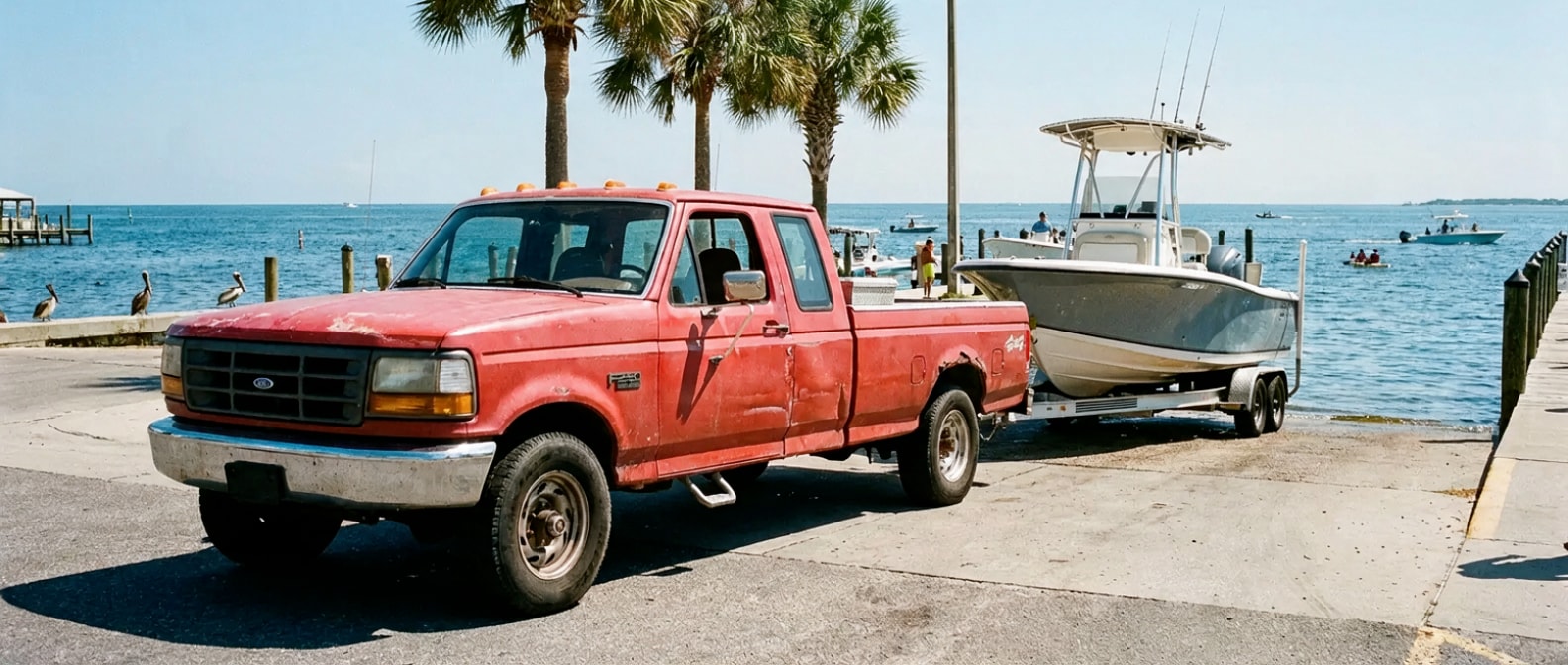
You've got a 22-foot center console on the trailer, four people in the cab, the cooler in the bed, and you're headed to the St. Andrews State Park boat ramp for the weekend. That scenario carries real weight numbers. The question isn't just whether the truck can tow a boat. What matters is whether the specific used HD truck you're considering can handle that full load inside all three of its weight limits at the same time.
Most used-truck listings lead with the maximum tow rating. That number matters. But two others (payload and GCWR) govern whether a given truck can safely handle your weekend rig. Miss one and you're overloaded before you hit US-98.
Browse our used Ram 2500 inventory to see what's on the lot while you read through this.
How Do Towing Capacity, Payload, and GCWR Actually Work Together?
They're three different numbers, and all of them apply at the same time, so a truck can clear one limit while blowing past another. Towing capacity, payload, and GCWR each measure a distinct part of the load, and safe towing means living inside all three together, not just the headline tow figure on the listing.
Towing capacity is the maximum weight your truck can pull on a hitch. Payload is how much weight can go into the cab and bed combined (passengers, gear, tools, and the tongue weight from your trailer all count here). GCWR is the total maximum weight of the entire rig in motion, meaning your truck plus a fully loaded trailer together.
The piece that trips people up is tongue weight. On a conventional trailer setup, the hitch point puts roughly 10 to 15 percent of the trailer's total weight down onto your truck's rear axle. That force counts against your payload budget at the very moment it counts against your tow rating. You can sit under the headline towing capacity and still run over your payload limit, especially once you add family and weekend supplies to the cab and bed. The door-jamb sticker on your specific truck is the authoritative source for these numbers. Not the brochure. Not the listing description. The sticker.
| Concept | What It Measures | Where to Find It | Gulf Coast Use Case |
|---|---|---|---|
| Towing Capacity | Max weight the hitch can pull | Door-jamb sticker / owner's manual | Boat and trailer combined weight |
| Payload | Max weight into cab + bed (incl. tongue weight) | Door-jamb sticker | People + gear + tongue weight |
| GVWR | Max safe loaded weight of the truck alone | Door-jamb sticker | Stays within chassis limits |
| GCWR | Max combined weight: truck and fully loaded trailer | Owner's manual | The whole rig rolling down US-98 |
| Tongue Weight | Downward hitch force (10-15% of trailer weight on conventional setup) | Calculate from loaded trailer weight | Counts against both payload and tow rating |
Which Used HD Truck Gives You the Most Real-World Margin Here?
No single truck wins outright here, because the right pick depends on whether your load leans toward heavy towing or heavy payload, and the three you'll see most on the used market in Bay County split those strengths differently. Those three are the Ford F-250 Super Duty, the Chevrolet Silverado 2500 HD, and the Ram 2500. Their verified used-generation numbers break down like this on the three things that matter.
| Truck (Engine) | Max Conventional Tow | Max Payload | Key Caveat |
|---|---|---|---|
| Ford F-250 (6.8L V8 gas) | Up to 17,300 lbs | Up to 4,268 lbs | Tow package required for top figures |
| Ford F-250 (6.7L Power Stroke diesel) | Up to 23,000 lbs | Up to approx. 4,000 lbs | Fifth-wheel needed for max tow rating |
| Ram 2500 (6.4L HEMI V8 gas) | Up to 17,740 lbs | Up to 4,010 lbs | Strong payload for a gas HD |
| Ram 2500 (6.7L Cummins diesel) | Up to 19,980 lbs | Up to approx. 3,150 lbs | Higher tow ceiling, lower payload vs. gas |
| Silverado 2500 HD (6.6L V8 gas) | Up to 17,900 lbs | Varies by config | Widest trim availability on used lots |
| Silverado 2500 HD (6.6L Duramax diesel) | Up to 22,420 lbs | Varies by config | Max Trailering package required for top number |
Per Ford's RV and Trailer Towing Guide, Stellantis Ram body builder data, and the Chevrolet Silverado 2500 HD Trailering Chart.
The honest tradeoff runs like this. Diesel gives you a bigger tow ceiling, but the Ram 2500 diesel delivers less payload than the gas version. If you're pulling a heavy fifth-wheel and the bed stays mostly empty, diesel makes sense. If you've got four people, camping gear filling the bed, and a loaded 21-foot boat on a conventional hitch, the 6.4L HEMI gas engine's 4,010-pound payload rating gives you more real margin than the Cummins diesel in that scenario. Neither is the wrong answer. It depends entirely on what you're loading.
See What Your Trade-In Is Worth
The Tow-Package Problem on Used HD Trucks
The maximum tow rating on any HD truck assumes the factory tow package was ordered, and on a used truck that equipment is never a given, so the brochure figure can overstate what the truck in front of you is rated to pull. We pay attention to this when a used HD truck comes through the lot.
Ford's Power Stroke diesel trucks need the properly equipped tow package and the right hitch configuration to reach those headline figures. A used F-250 without the factory tow package isn't dangerous (it just carries a lower rating than the brochure implies). Know that before you hook up a heavy trailer. The same caveat applies to GM's Max Trailering package on Silverado 2500 HD trucks built for fifth-wheel and gooseneck work. Always check the build sheet or confirm the hitch hardware is factory-installed.
If your load regularly pushes past 20,000 pounds, that's when a Ram 3500 changes the conversation. The 3500-series opens up meaningfully higher GCWR ratings for serious RV or commercial towing, and it's worth understanding the difference before you commit to a 2500.
Quick Terms: Gulf Coast HD Towing Glossary
| Term | Plain-Language Meaning |
|---|---|
| GVWR | The max your truck can weigh fully loaded (chassis, fluids, people, gear, everything). Set by the manufacturer. |
| GCWR | The max your entire rig can weigh in motion (truck plus trailer combined). Check the owner's manual. |
| Payload | What the cab and bed can carry (including tongue weight). Calculated as GVWR minus curb weight. |
| Tongue Weight | The downward force your trailer puts on the hitch. Target 10-15% of loaded trailer weight on a conventional hitch. |
What This Means When You're Shopping for a Used HD Truck in Panama City
Shopping smart here comes down to three checks in order, and none of them is the headline tow number on the listing, because the figure that applies to your rig lives on the truck itself and on your own loaded weight. Work through them before you sign anything.
Know what you're towing. Weigh your loaded boat-and-trailer at a truck stop scale or look up the rated weight for your specific rig. That number tells you whether a 2500 handles the job or whether you need a 3500.
Check the door-jamb sticker on the actual truck. Two F-250s from the same model year can carry a payload difference of several hundred pounds depending on cab style, bed length, and options. The sticker is the only number that applies to the specific vehicle you're standing next to.
Confirm the tow package. The factory receiver, an integrated trailer brake controller, and the correct hitch ball are not always standard. A used HD truck without those components isn't a dealbreaker, but it's information you need.
St. Andrews State Park has a public boat ramp. Gulf Coast salt air and August heat are real factors in used-truck condition. Our team inspects undercarriage and cooling systems on every truck that comes through. A truck with Panhandle miles behind it deserves a close look at those points before it earns its spot on our lot.
Frequently Asked Questions
What is the difference between towing capacity and payload on a heavy-duty truck?
Towing capacity is the maximum weight a truck can pull on a trailer behind it. Payload is the maximum weight you can carry inside the cab and bed, and it includes tongue weight from any trailer you're hitching up. The two numbers are connected. Tongue weight (typically 10 to 15 percent of the loaded trailer's total weight on a conventional hitch) counts against your payload rating at the same time it counts against your towing budget. Safe towing means staying within both limits at once, which is why the door-jamb sticker on your specific truck matters more than any published brochure figure.
Does the engine make a real difference in a used Ram 2500 or Ford F-250 for Gulf Coast weekend towing?
It does, and the answer isn't always the diesel. The Ram 2500 with the 6.4L HEMI V8 gas engine carries up to 4,010 pounds of payload per Stellantis Ram data, more than the 6.7L Cummins diesel version of the same truck. If your weekend load includes four people, a full bed, and a boat on a conventional hitch, that payload margin is genuinely meaningful. The Cummins diesel raises maximum towing capacity considerably (up to 19,980 lbs when properly equipped) but trades some of that payload to do it, making it the stronger choice for heavy fifth-wheel or gooseneck loads rather than the classic Gulf Coast boat-and-family combination.