
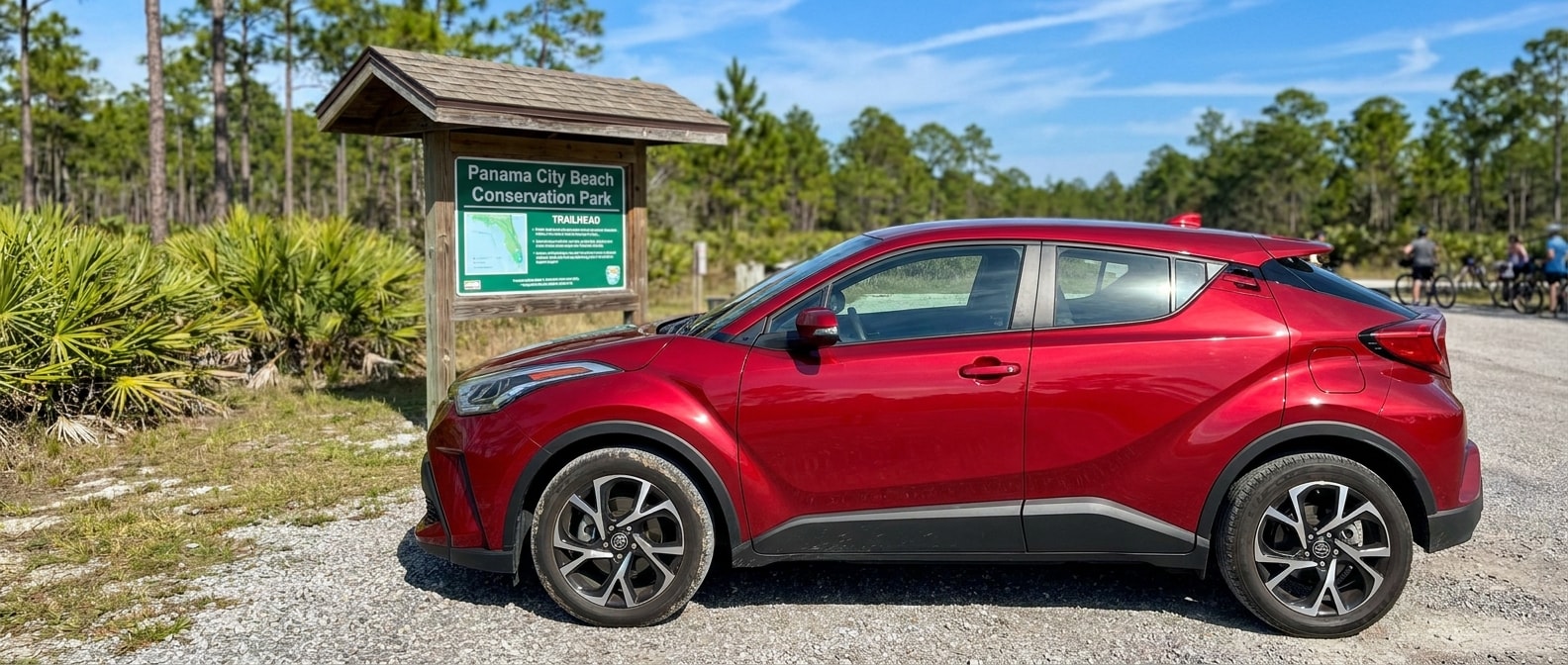
The Toyota C-HR ran for exactly five model years in the United States (2018 through 2022) before Toyota pulled it from North American sales entirely. That short window shapes everything about buying one used. Land the right year and you get a genuinely fuel-efficient, low-drama crossover for Gulf Coast commuting. Pick the wrong one and you're inheriting the early-build headaches Toyota hadn't ironed out yet.
We've broken down every year below, backed by NHTSA recall data and documented owner complaint patterns. Our read is blunt where it needs to be.
Browse our used Toyota C-HR inventory at Bay Cars
- The 2020-2022 model years hit the sweet spot. Toyota refreshed the infotainment for 2020 (adding Apple CarPlay and Android Auto), and NHTSA complaint volumes drop noticeably in these later years.
- The 2022 is the cleanest of the bunch. It's the final year, built with the most refinements, and it draws the fewest documented complaints per NHTSA data.
- The 2018 is the year to avoid. It carries a brake recall (NHTSA 17V717000) and leads the entire generation in powertrain and CVT complaints.
- 2019 had a seat-related recall (NHTSA 19V877000) affecting about 9,468 vehicles (lower risk than the 2018, but still worth checking the VIN on any specific car).
- The 2021 carries its own recall (pre-collision radar sensor, NHTSA 22V107000, 36,558 vehicles), but the fix is a software/sensor activation Toyota handles at no charge (a known, addressable issue, not a reliability pattern).
- FWD-only is a genuine limitation, though on flat Gulf Coast roads it rarely matters in practice.
Which C-HR Years Hit the Sweet Spot?
The 2020 through 2022 model years are the sweet spot, because Toyota's 2020 mid-cycle refresh finally added Apple CarPlay and Android Auto as standard, and NHTSA complaint volumes settle down after 2019, though every year still asks you to live with a modest engine. Before that refresh, the infotainment supported neither, which is a real daily inconvenience rather than a quibble. Combined with the documented drop in owner complaints in NHTSA data after 2019, the 2020 through 2022 range is where we'd focus a search.
| Model Year | Sweet Spot? | Years to Watch | Why It Matters |
|---|---|---|---|
| 2018 | No | Yes | Brake recall (NHTSA 17V717000); leads generation in CVT/powertrain NHTSA complaints |
| 2019 | Borderline | Yes | Seat recall (NHTSA 19V877000, ~9,468 vehicles); cleaner than 2018 but still early-build |
| 2020 | Yes | No | Mid-cycle refresh: Apple CarPlay + Android Auto added; NHTSA complaints quieten |
| 2021 | Yes | Verify recall | Pre-collision radar recall (NHTSA 22V107000, ~36,558 vehicles); fix is software/sensor, not mechanical failure |
| 2022 | Best | No | Final model year; fewest documented complaints; full feature set from launch |
The tradeoff with any C-HR sits under the hood. The 2.0-liter four-cylinder produces 144 horsepower, and it isn't a fast car. Toyota designed this for efficiency and style, not spirited driving. The EPA rates the 2021 and 2022 C-HR at 27 city and 31 highway. Around Conservation Park's trailhead access roads and the Panama City Beach Parkway, that kind of mileage adds up meaningfully. Just don't expect it to pull away from a light with authority.
Check Financing Options at Bay Cars
Which Years Should You Watch Out For?
The 2018 is the one year we'd steer you away from without much hesitation, since NHTSA data shows it drawing the highest complaint volume of the whole generation, with nearly half of those complaints landing in the powertrain category, though a fully recall-closed car with clean history isn't impossible to live with. The CVT in particular is the culprit. It also carries a brake recall (NHTSA campaign 17V717000, affecting 28,764 vehicles) that's one of the first things to verify is closed on any specific car.
Search our pre-owned inventory by year to filter 2020-2022 C-HRs
Check the VIN on any 2019 before you get attached, because it still carries a seat-related recall (NHTSA 19V877000) that touched about 9,468 vehicles. The 2019 is a step better than the 2018 either way. Beyond the recall itself, it sits in the generation's transitional period, sharing the same infotainment limitations as the 2018 without the refresh that makes the 2020 and later a cleaner used buy.
The 2021 deserves its own paragraph. It carries the pre-collision radar sensor recall (NHTSA 22V107000, affecting 36,558 vehicles), which is legitimate enough to take seriously. The good news is this isn't a mechanical failure in the traditional sense. The radar sensor needs activation or replacement, and Toyota handles that at no charge to the owner. Confirming that recall is closed is step one on any 2021. A 2021 with a clean recall record and documented service history is still a solid used buy.
One more thing worth stating plainly about the whole generation. There's no all-wheel drive on any US-market C-HR. It's front-wheel drive, full stop. In some parts of the country that limitation is genuine. Here in Bay County, on flat Panhandle roads, it's largely a non-issue. For someone who drives the Panama City Beach Parkway to Conservation Park on weekends and commutes on US-98 during the week, the FWD setup is fine, most days. The limitation matters if you move or if your driving changes significantly.
See current Vehicle Specials at Bay Cars
Which Year Fits Which Buyer?
The best year for you depends on what you're weighing, so the "which year is best" question really splits into a handful of clean answers shaped by your budget, how long you plan to keep the car, and whether you're comfortable running a VIN check yourself.
You want the most car for your money and plan to keep it several years. Go 2022. The 2022 is the final model year, it has the lowest documented complaint rate per NHTSA data, and it carries the full refreshed feature set (CarPlay, Android Auto, Toyota Safety Sense P standard). A 2022 with reasonable mileage is about as clean a used buy as this nameplate offers.
You want to save some money and don't mind running a VIN check. The 2021 is a legitimate option at a lower used price point, provided you verify the pre-collision radar recall (NHTSA 22V107000) is already resolved. A closed recall on a 2021 isn't a red flag. It's a documented repair Toyota completed.
You're on a tighter budget and the 2020 appeals. That works too. The 2020 is where the generation became actually livable with the infotainment upgrade. It doesn't carry the serious recall history of the 2018 or 2019, and it gives you both CarPlay and Android Auto. Less money than a 2021 or 2022, and still a reasonable commuter.
You're looking at a 2018 or early 2019. We'd rather steer you somewhere else. The documented complaint patterns and the brake recall on the 2018 in particular aren't worth the savings against a 2020. If a 2018 truly is the budget ceiling, verify every open recall is resolved and inspect the CVT carefully before committing.
For folks near Conservation Park using this as a daily driver (carrying bikes to the trailhead, navigating the Beach Parkway, making easy work of the 24-mile trail system access roads), the C-HR's compact footprint, easy parking, and 29 combined EPA-rated MPG make a solid case. Just pick the right year.
See what your current vehicle is worth at Bay Cars
Frequently Asked Questions
Is the Toyota C-HR still being made?
No. Toyota discontinued the C-HR in the United States and Canada after the 2022 model year. The second-generation C-HR exists, but Toyota confirmed it will only be sold in Europe. In North America, the Corolla Cross has taken the C-HR's place in Toyota's lineup. That makes 2022 the newest C-HR you'll find on any US used lot.
What is the biggest problem with used Toyota C-HRs?
The most documented issue across the US generation is the CVT (continuously variable transmission), particularly in 2018 models. Per NHTSA complaint data, nearly half of all 2018 C-HR complaints fall in the powertrain category. The 2020-2022 models show significantly fewer powertrain-related complaints. Alongside that, three specific recalls touched different model years: a brake recall on the 2018 (NHTSA 17V717000), a seat recall on the 2019 (NHTSA 19V877000), and a pre-collision radar sensor recall on the 2021 (NHTSA 22V107000). Verifying those recalls are closed on any specific car you're considering is the most important homework you can do.
Does the Toyota C-HR have all-wheel drive?
No. Every C-HR sold in North America (2018-2022) was front-wheel drive only. Toyota did not offer AWD for the US market. For Gulf Coast buyers using the vehicle primarily for commuting, beach access, and light weekend trips, FWD is generally adequate. If your needs include frequent off-road or severe weather driving, a different vehicle is worth considering.