
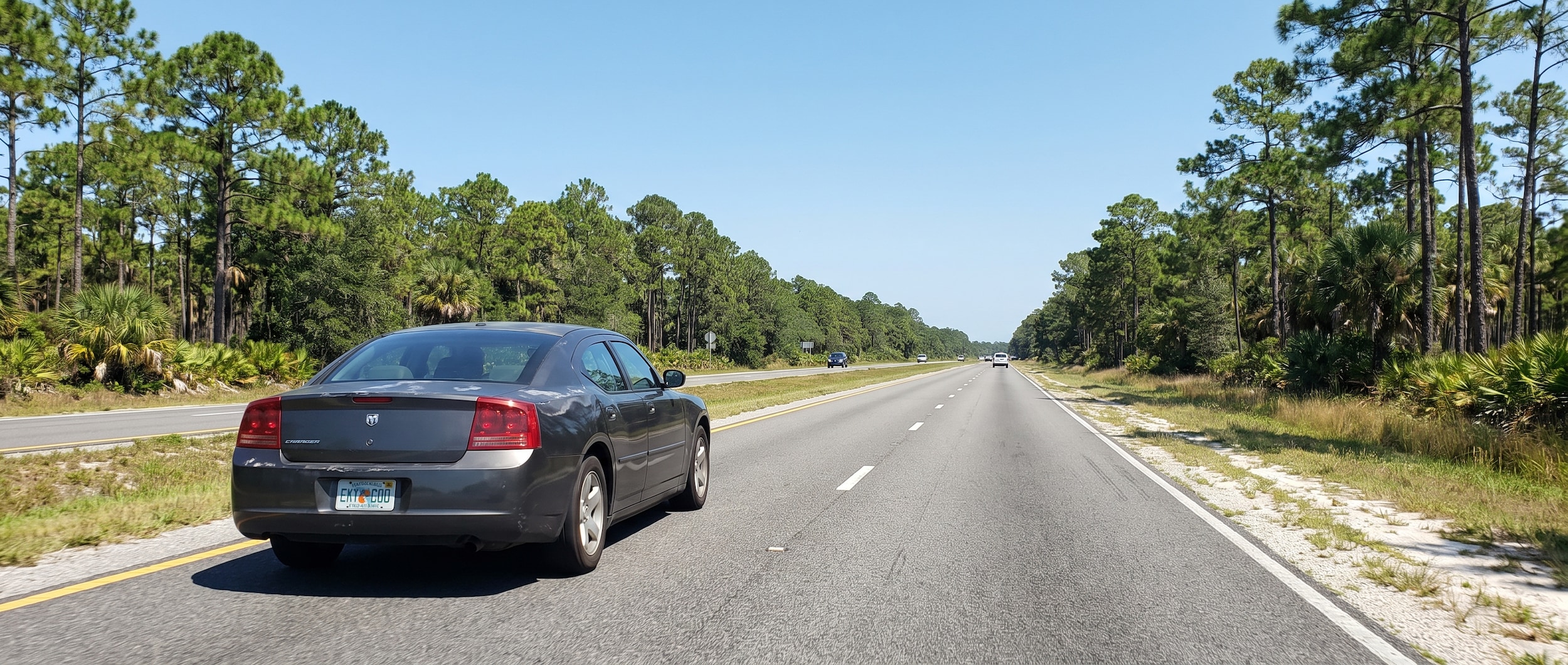
Drive from Youngstown or Fountain into Panama City on a workday and you already know that stretch of US 231. Four lanes of divided highway cutting straight through north Bay County pine country, roughly 20 miles each direction, 85 degrees before 8 a.m. Daily mileage like that exposes every weakness in a vehicle. Rattles get louder. Seats get less forgiving. If you're stuck in something purely utilitarian, the drive feels longer than it is. When buyers shop a used Dodge Charger, the worry we hear runs about the same every time. "I love what it is, but am I buying someone else's problem?" The answer depends on the model year, the trim, and whether the documented recalls have been fixed on that specific car. Reputation doesn't decide it.
Browse used Dodge Chargers at Bay Cars
What's Actually Going On With Used Charger Reliability?
The Charger's reputation runs more polarized than the documented record justifies, and most of that split comes from buyers mixing the Hellcat ownership experience with the V6, or trading real NHTSA data for general internet anxiety, so a reliable read starts by separating the trim you're buying from the trim people argue about online. Sort the concerns from the noise and the record reads clearly.
| Concern You've Heard | Likely Source | What the Record Actually Shows |
|---|---|---|
| "They're money pits" | Hellcat and Scat Pack running costs applied to all trims | V6 trims carry a manageable cost profile; this is a trim-specific issue |
| Airbag safety worry | NHTSA recall: certain 2018-2021 Chargers, side airbag inflator defect (March 2024) | Free dealer fix; confirm on any specific VIN at nhtsa.gov |
| Shifter won't engage Drive cleanly | NHTSA recall: 2022 Charger, shifter assembly improperly heat-treated | Dealers replace the assembly free of charge; confirm via VIN before purchase |
| Rear seat feels unstable | NHTSA recall: 2023 Charger, left rear seat back latch may not lock | Simple latch adjustment at no cost; verify status on any 2023 you're considering |
| Fuel costs across a daily commute | V8 consumption lumped in with V6 in general discussions | EPA rates the 3.6L V6 RWD Charger at 19 city / 30 highway MPG |
| Parking brake rollaway concern | NHTSA recall: certain 2023 Chargers, parking brake improperly adjusted | Dealers correct free of charge; verify via VIN |
Every item in that table has a documented remedy that costs the buyer nothing, and that's the useful distinction. A quick VIN check at nhtsa.gov tells you in two minutes whether any of these are still open on the car in front of you.
Prefer a two-door layout? See used Dodge Challengers
The 2022 and 2023 Models Are the Cleanest Exit From the Traditional Generation
Search Bay Cars' full pre-owned inventory by model and year
If you want the traditional gas Charger with the fewest open questions, the 2022 and 2023 model years are the cleanest exit, since the last of that generation left the line in 2023 and the tidiest used examples cluster right at the end of the run. NHTSA data shows the 2023 Charger carrying two recalls on file, the seat back latch and a parking brake adjustment. Both are straightforward, dealer-remedied repairs at no cost. The 2022 has three recalls, including the shifter assembly item, which is a parts replacement rather than a sign of broader mechanical fragility.
The 2018-2021 range asks for more deliberate attention. In March 2024, NHTSA issued a recall covering certain 2018-2021 Chargers for a side airbag inflator defect. NHTSA's findings describe moisture introduced during manufacturing, which can cause internal corrosion and a potential inflator rupture. The defect is a serious item. Leave one unrepaired in that year range and it's a hard pass. A confirmed-repaired one is a legitimate car worth evaluating on its own merits.
Does a full-size sedan really pencil out for a daily fuel budget? On the US 231 corridor it can, because the EPA's figures on the 3.6-liter V6 rear-wheel-drive Charger land at 30 miles per gallon on the highway. Across a 40-mile daily round-trip, that holds up for a full-size car with 292 horsepower and seating for five. The Scat Pack's 6.4-liter V8 delivers a different experience entirely (satisfying in a way the V6 simply isn't), and you feel it at the pump every day. Match the engine to how you drive.
DIY Checks vs. What Our Team Walks You Through
You can settle a good share of the Charger question yourself before you ever set foot on the lot, and the rest is worth a short conversation with us, because a VIN report and a few hands-on checks cover the recalls while the trim-versus-usage call is where our read on the car earns its keep.
Before you visit, check these yourself:
- Run the VIN at nhtsa.gov. Free and fast. Before any used-car purchase this is the single most useful step, and it's especially relevant here.
- Look at the coolant reservoir cap. On higher-mileage V8 examples, oil-coolant mixing shows up as a documented owner complaint pattern. A milky or discolored cap is a genuine flag.
- Press firmly on the rear seat back on any 2023 you're considering. A seat back that flexes more than expected may point to an unresolved latch recall.
- Watch the TPMS warning light. On 2022 Chargers, NHTSA flagged premature sensor battery failure as a recall item. A persistent warning with correctly inflated tires is a tell.
What the Bay Cars team focuses on:
We're a multi-brand used lot, so we see a wide range of Charger histories. The V6 highway commuter and the Scat Pack with a different usage pattern are two genuinely separate pre-owned conversations, and we're straightforward about which is which.
Our team notices one pattern consistently. Chargers with documented highway-heavy histories tend to show cleaner drivetrain wear than the same car worked hard on repeated short trips around town. US 231 produces exactly that kind of vehicle, long steady-state miles that are easier on an engine than constant cold-start city cycles. A higher odometer number on a well-maintained V6 highway car isn't automatically the liability it looks like at first glance. That context shapes how we read the car.
See current Vehicle Specials at Bay Cars
Explore Financing Options at Bay Cars
Frequently Asked Questions
Is a used Dodge Charger a practical daily driver for the US 231 corridor between Youngstown and Panama City?
It's more practical than its reputation suggests, particularly in V6 trim. The EPA rates the 3.6-liter V6 rear-wheel-drive Charger at 30 miles per gallon on the highway, which is competitive for a full-size car with genuine room for five adults and 292 horsepower on tap. The trunk checks in at 16.5 cubic feet (larger than many compact crossovers). The honest tradeoff is the V8 trims: more satisfying to drive, but you'll pay for it in fuel across a regular daily commute.
Which years of used Dodge Charger are the safest bets, and which need more scrutiny?
The 2022 and 2023 model years are the cleanest end of the traditional gas Charger's run, with the fewest documented NHTSA recalls. The 2018-2021 range needs careful VIN verification because NHTSA issued a recall in March 2024 for a side airbag inflator defect on certain vehicles in that window. A confirmed, repaired example is a solid car. An unrepaired one is not worth the risk.