
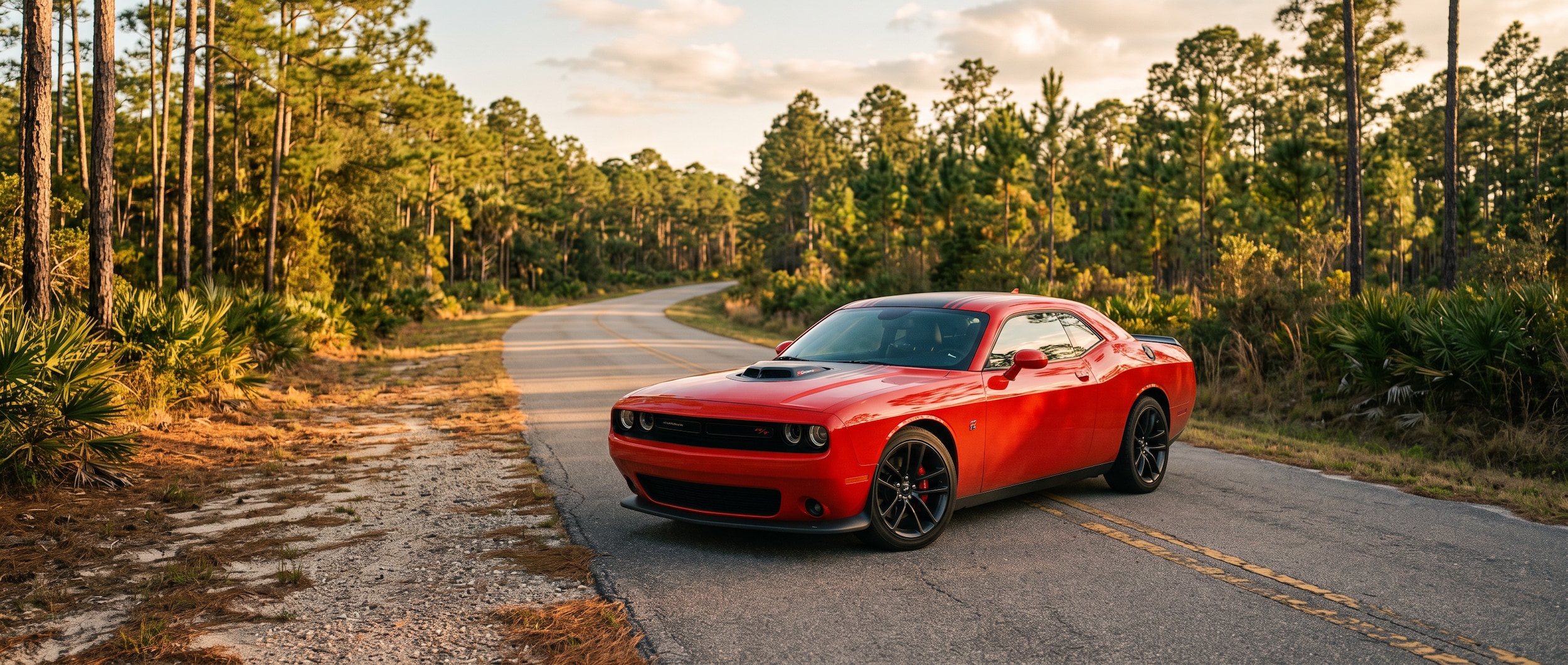
No new Challengers are coming. Production ended after the 2023 model year, so every Challenger on the lot today is a used car, and the model year you pick matters more than it would for one still in production. Land the right year and you've got one of the most characterful two-door coupes ever built at used-car pricing. Land the wrong one and you're wrestling electrical gremlins that earned some of these cars a genuinely bad name.
Short version, the 2015 refresh was the dividing line. Before it, buyer beware. After it, the Challenger turned into a dependable machine. For most shoppers around County Road 388, the 2016-2021 window is where we'd focus the search.
- Sweet spot: 2016-2021 (post-refresh reliability, modern tech, full trim ladder)
- Best value in that window: 2018-2020, with the 2020 standing out for fewest documented complaints
- The Hellcat (707 hp) and Hellcat Redeye (797 hp) arrived in 2015 and 2019 respectively. Verify service history on both before buying.
- Avoid 2010-2014, especially 2012: per NHTSA data, 398 complaints and 6 recalls dominated by alternator and TIPM electrical failures
- 2023 Last Call editions are the final chapter (mechanically sound, but priced as collectibles)
Browse our used Dodge Challenger inventory to see what model years we have on the lot right now.
Which Challenger Years Are the Sweet Spot?
For most shoppers the sweet spot runs 2016 through 2021, and the reason traces back to 2015, when Dodge overhauled the styling, refreshed the interior, updated the electronics, and dropped in the 707-horsepower SRT Hellcat all at once, which is exactly why it's the pivot point. A lot changed in one model year. That's why we'd point most shoppers at 2016 rather than 2015. Let the first-year-of-a-refresh bugs settle, then buy the improved version.
From 2016 through 2021, the Challenger hits its stride. The full trim ladder is available, from the 3.6-liter V6 SXT (303 horsepower, with available AWD on the GT trim) all the way up to the supercharged Hellcat. Infotainment was competitive. The reliability record cleaned up a lot compared with the early generation. And the platform itself hadn't changed dramatically, so parts availability and independent-shop familiarity are both strong.
None of that makes a 2016 bulletproof. It does make it a safer bet than anything from the early years.
| Model Year | Trim Highlights | Sweet Spot? | What You're Getting |
|---|---|---|---|
| 2008-2009 | SRT8 (425 hp); V6 added in 2009 | No | Earliest cars, thin tech, Takata airbag recall exposure on some |
| 2010-2014 | Growing lineup, troubling record | Avoid | NHTSA-documented alternator recalls and TIPM electrical failures; 6-10 recalls per year |
| 2015 | Full refresh; Hellcat debut at 707 hp | Borderline | Great model but first-year-of-refresh risk; confirm all open recalls are closed |
| 2016-2018 | Refresh matured, reliability improved | Yes | Low complaint counts, prior recall issues largely resolved |
| 2019-2021 | Hellcat Redeye (797 hp), Widebody option | Yes (Best) | 2020 is the standout: fewest NHTSA complaints of any third-gen year |
| 2022-2023 | Final production years; Last Call editions | Situational | Mechanically solid; Last Call variants carry collector premiums |
The R/T is the entry point for HEMI ownership, rated by Dodge at 375 horsepower from the 5.7-liter. Step up to the Scat Pack and you get the naturally aspirated 6.4-liter HEMI 392, good for 485 horsepower and 475 lb-ft of torque. For a used-car price, that's a serious amount of engine, and it's the trim enthusiasts gravitate toward. Then comes the Hellcat, a whole different conversation.
Which Years Should You Watch Out For?
The years to steer around run 2010 through 2014, and this one isn't a matter of taste; the pattern comes straight from NHTSA's complaint and recall database, so you can check it yourself before you ever set foot on a lot. Knowing what you're looking at changes everything.
Search our pre-owned inventory filtered to 2016 and newer to simplify your search from the start.
The 2009 cars also carry documented exposure through the Takata airbag recall campaign, which swept through a wide range of Chrysler products including early Challengers. Our advice on any pre-2015 Challenger you're eyeing, run the VIN through NHTSA's free recall lookup before anything else. Five minutes is all it takes, and it tells you immediately what's been completed and what hasn't.
Talk to our financing team so you know your budget before you narrow down by year. It changes the calculation.
One thing we keep an eye on with any used performance car, the earlier the model, the more likely it lived a spirited life. That's not automatically a problem, but it means the inspection matters even more than usual. Tires, brakes, and the cooling system all take abuse on a car people actually enjoy driving.
The Right Challenger for Your Situation
Which Challenger fits you comes down to how you'll actually use it, and around the CR 388 corridor that question answers itself for a lot of buyers, since this is a muscle coupe that's genuinely practical and not just a track toy. County Road 388 runs through rural Bay County. That open, two-lane, pine-lined stretch is exactly the kind of road where a Challenger makes sense. Most buyers aren't chasing track times; they want a coupe that's comfortable on a long Florida highway run, with a real trunk and a back seat adults can use. The Panhandle's long straight roads and the daily commute between West Bay and Panama City are both environments the Challenger handles without drama, as long as you pick the right year and trim.
You want daily reliability and the most car for the money. Look at a 2016-2018 R/T or Scat Pack. The 5.7-liter R/T shrugs off the Gulf Coast heat and the daily commute. Step up to the Scat Pack and the 6.4-liter adds real punch without the Hellcat's fuel and insurance math. Either one gets you to downtown Panama City and back without drama.
You want the cleanest example with the fewest question marks. The 2019 or 2020 is your call. That year has the smallest documented complaint footprint of any third-gen Challenger. It came with the full modern feature set (including the Widebody option if you want the wider stance and upgraded suspension geometry). The V6 GT with AWD is also available in this window, which is worth knowing if you share the car or want a more forgiving rear end.
You want a Hellcat and understand what that means. The supercharged 6.2-liter has been producing 707 horsepower since 2015. The Redeye (2019 and up) raises that to 797. These are extraordinary cars, and we'd tell any buyer the same thing. Verify the service history, look at the tires, and be clear-eyed about what running a supercharged V8 in August Gulf Coast heat costs in fuel and rubber. The trade-off is real. If you know all that and still want one, the 2019-2022 Hellcat and Redeye models are mechanically mature and well-sorted.
You want the final year. The 2023 Last Call editions are genuinely the end of the gas-powered Challenger line. Seven special editions, unique badging, commemorative underhood plaques on all 2023 models. They command a premium and will hold collector interest. Practical? Yes. But price them accordingly.
Check out used Dodge Charger listings if you need four doors with similar HEMI energy. The Charger ran the same platform and ended production the same year.
Frequently Asked Questions
Is the Dodge Challenger still being made?
No. Dodge ended Challenger production after the 2023 model year. The final cars came off the Brampton, Ontario assembly line in December 2023. There's no 2024, 2025, or 2026 Dodge Challenger. Every Challenger available today is a used vehicle, which makes picking the right model year significantly more important than it would be for a car still in production.
What is the most reliable used Dodge Challenger year to buy?
The 2019-2021 window is the strongest overall, with the 2020 standing out based on NHTSA complaint data as the year with the fewest documented owner complaints in the third generation. The 2016-2018 models are also solid choices with low complaint counts and resolved recall histories from earlier years. The years to avoid based on NHTSA records are 2010-2014 (particularly 2012, which logged 398 complaints and six recalls centered on alternator failure and TIPM electrical issues).
What is the difference between the Challenger R/T, Scat Pack, and Hellcat?
The R/T uses the 5.7-liter HEMI V8, rated by Dodge at 375 horsepower. The Scat Pack steps up to the 6.4-liter HEMI 392 at 485 horsepower and 475 lb-ft of torque. This is a naturally aspirated engine with real mid-range punch. The Hellcat uses a supercharged 6.2-liter V8 rated at 707 horsepower; the Hellcat Redeye, introduced for 2019, raises output to 797 horsepower. Each step up brings meaningful performance and meaningful operating costs. The Scat Pack is the trim that tends to make the most sense for buyers who want real V8 performance without the Hellcat's fuel and insurance implications.